Tag Archives: Getty Museum

Editor’s Choice: “It’s impossible not to become engaged…”

The Christian Science Monitor has named Chasing Aphrodite an “Editor’s Choice.” Their review says:

“Felch and Frammolino are serious men, investigative reporters at the top of their games, who very intelligently lay out all the issues at stake here, and you’d probably do best to read this one sitting up straight.

But like all of the titles above, “Chasing Aphrodite” is blessed with the odd allure that marks the world of art itself – a world that Felch and Frammolino describe as “glamorous but not pretty.”

Low-down thugs rub elbows with terrifyingly erudite curators and ridiculously wealthy collectors, all of them almost helplessly attracted to a handful of the most beautiful objects in the world. Museum staffs with more PhDs per capita than you’ll find at MIT create “spiteful environment[s]” in which a sense of entitlement runs wild and trips to Paris on the Concorde are viewed as a basic right. And then there are the earnest investigators – Italian, in this case – driven by a deep-seated conviction that what’s theirs is theirs and that when it comes to the finest of antiquities “such loveliness belongs at home.”

Felch and Frammolino researched their topic for five years, doing countless interviews and enjoying access to confidential Getty files. The result is a book so tightly nailed down that when they describe a meeting you sometimes learn who sat where and what the weather was like that day.

That’s not to say that it’s not a page turner. As a reader it’s impossible not to become engaged with characters like True, who started life in blue-collar Massachusetts but eventually landed – thanks to morally questionable intervention on the part of some wealthy friends of the Getty – a Greek villa of her own.

It’s a world that’s as distant from most of us as the Peloponnesian War – and yet as close as the museum that you visited last week.”

Read the full review here.

Five Tips for Finding Loot at Your Local Museum

Jason and Ralph will be speaking Friday, June 10 in Orlando at IRE, the annual gathering of investigative reporters. Our topic is how to find loot at your local museum.

You don’t have to be an investigative reporter to find looted antiquities. Museums around the country are home to ancient art of questionable origins. As Marion True once told her museum colleagues: “Experience has taught me that in reality, if serious efforts to establish a clear pedigree for the object’s recent past prove futile, it is most likely — if not certain — that it is the product of the illicit trade and we must accept responsibility for this fact.” (p. 190 of Chasing Aphrodite)

So, in that spirit, here are five things to look for at your local museum:

1. The Usual Suspects:For decades, the market in Classical antiquities

Robert Hecht poses in front of the famous looted Greek vase he sold the museum in 1972 for $1 million.

was controlled by a handful of shady dealers who operated much like a cartel. They were competitors, but cooperated as necessary to get the highest price for their wares. Look for their names in the ownership histories of ancient art: Robert Hecht, Frieda Tchakos, Fritz Burki, Gianfranco Becchina, Robin Symes, Christo Michaelidis.

2. Read the Labels: Many museums are frustratingly vague about an object’s origins. In the language displayed next to a piece of ancient art, you’ll find see something like “said to be from” this or that country or region. The question to ask is: who said? The answer is often dealers, middlemen and even looters. Curators often sought out this important information from their market sources, but kept it vague to hide an object’s illicit origins.

3. Accession numbers: Most museum objects are identified by an accession number, the inventory number given to an object when it enters the collection. Every museum uses a different code for their acquisitions, but they usually contain the date of acquisition. For example, the Getty’s statue of Aphrodite was 88.AA.76. “88” is for 1988, the year the Getty acquired the statue. “AA” is the Getty’s code for ancient statues. “76” tells you its the 76th acquisition of the year. This can be key information. For example, if you know the year an object was acquired, you can figure out the standards and policies that were in place at the time.

4. Scrutinize the donors. Museums have been getting in trouble for donations for decades. Donations of art are tax deductible, and have often been a means for tax fraud at museums. Museums have also used donors to launder recently looted art. (See Chap 2: A Perfect Scheme) Some museums have lower standards when it comes to objects donated to the museum.

5. Ask for answers: Once you see an object the sparks your curiosity, ask the museum for answers about the object’s provenance, or ownership history. Most museums should (reluctantly) provide you with what they know. If they claim to have no information, ask them why they felt it was safe to purchase. The AAMD has guidelines for museum transparency on these issues. Is your museums following them?

In our view, not all looted antiquities need be returned to the country from which they were stolen. (The Getty, for example, returned only a fraction of the hundreds of objects in their collection its former curator would consider “almost certainly looted.”) But museums should be asked to come clean about their collecting practices.

Joining us on Friday’s panel will be Lee Rosenbaum of CultureGrrl fame, and James Grimaldi, the WaPo’s lead reporter on the Smithsonian’s shenannigans.

VOA on the illicit antiquities trade

VOA's On the Line

Voice of America’s international TV program “On the Line” interviewed Jason Felch about the international trade in illicit antiquities.

You can watch the program here. (The antiquities segment starts at 11:30, about half way through the show.)

New York Review of Books: “An important book”

The New York Review of Books has just published a lengthy write-up of Chasing Aphrodite, calling it “an important book…about money, art and power.”

The author, Hugh Eakin, has covered the antiquities issue over the years for the New York Times and others. In December 2007, he wrote a lengthy profile of Marion True for the New Yorker (that curiously failed to ask some key tough questions.)

NY Post: How the Met dodged a bullet

In Sunday’s New York Post, Ralph describes how the Metropolitan Museum of Art in New York narrowly avoided becoming the center of the antiquities scandal that consumed the Getty Museum.

“A few years ago, the world’s richest arts organization became the epicenter of a scandal that, like revelations of steroid use in baseball, exposed a dirty little secret of the American cultural establishment.

Antiquities dealer Robert Hecht, now on trial in Rome, poses in front of the Met's famous looted vase.

It was revealed that the J. Paul Getty Museum of Los Angeles, along with other American museums, had long been involved in the black market for looted Greek and Roman antiquities — a trade the museums themselves fueled with multimillion-dollar acquisitions of illegally excavated masterpieces.

To stop the cycle, Italian authorities took aim at the biggest customer, the Getty. A Roman court indicted the Getty’s antiquities curator, Marion True, for trafficking in looted objects. The Getty eventually expelled its most generous living donor, Manhattan socialite Barbara Fleischman, from the board for her involvement in the scandal. And the Getty was made to pay for its crimes by returning 40 of its best antiquities to the governments of Italy and Greece.

But had things gone a bit differently, what is now known as the “Getty scandal” could have very well have been the “Metropolitan Museum meltdown.”

Only timing, luck, and a grudging act of cultural contrition saved the venerable New York institution from taking the biggest fall.”

Read the full story here.


Chasing Persephone?

In Sunday’s LA Times, Jason has an article on his recent trip to Aidone, Sicily, where the return of the Getty’s goddess has revived a debate about her true identity: Aphrodite, or Persephone?

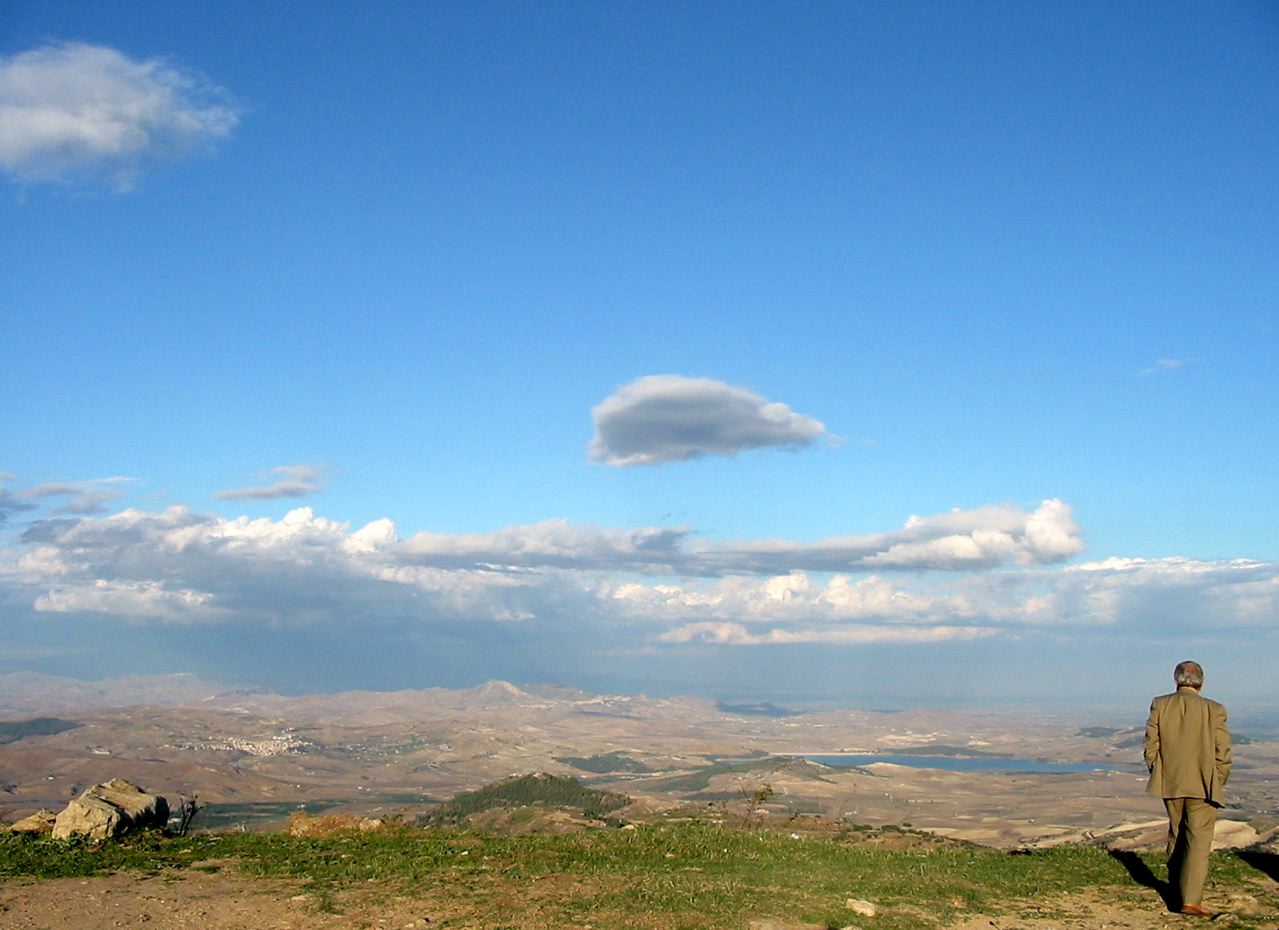
The vista of central Sicily from the ruins of Morgantina, where the statue of Aphrodite was illegally excavated in the late 1970s.

“In ancient times, central Sicily was the bread basket of the Western world. Fields of rolling wheat and wildflowers, groves of olive and pomegranate and citrus — even today, fertility seems to spring from the volcanic soils surrounding Mt. Etna as if by divine inspiration.

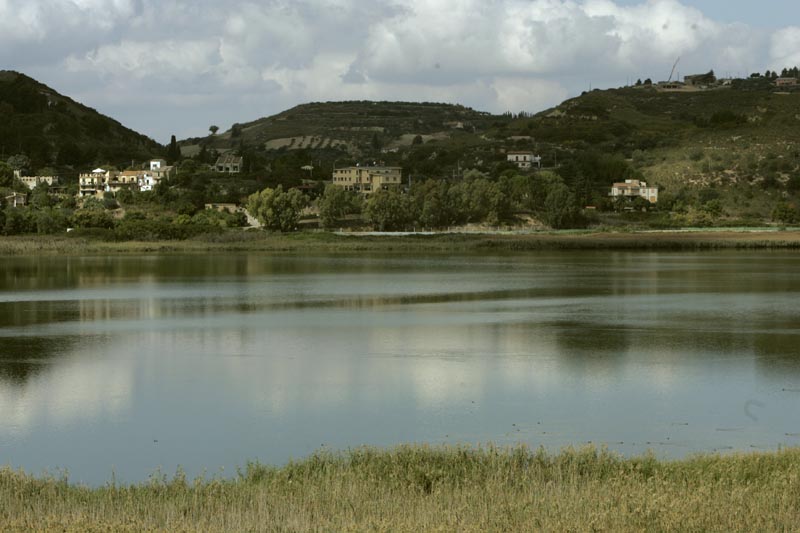
It was here on the shores of Lake Pergusa that ancient sources say Persephone, the goddess of fertility, was abducted by Hades and taken to the underworld. She was forced to return there for three months every year, the Greek explanation for the barren months of winter.
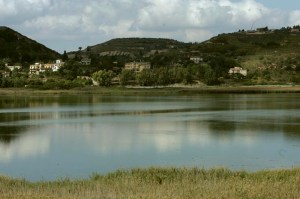
Ancient sources say it was while picking flowers along the banks of this lake, a short drive from Morgantina, that Persephone was abducted by Hades and taken to the underworld.

When Greek colonists settled the region some 2,500 years ago, they built cult sanctuaries to Persephone and her mother, Demeter. The ruins of Morgantina, the major Greek settlement built here, brim with terra-cotta and stone icons of the two deities.

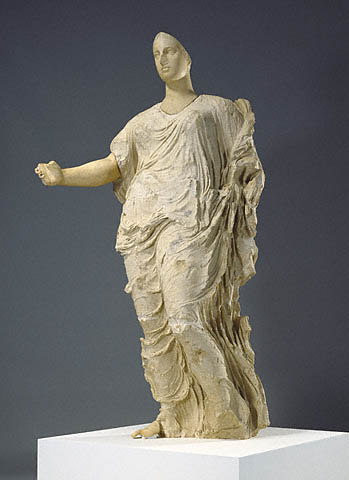
It seems a fitting new home for the J. Paul Getty Museum’s famous cult statue of a goddess, which many experts now believe represents Persephone, not Aphrodite, as she has long been known.
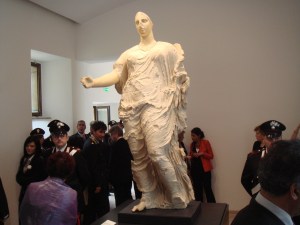
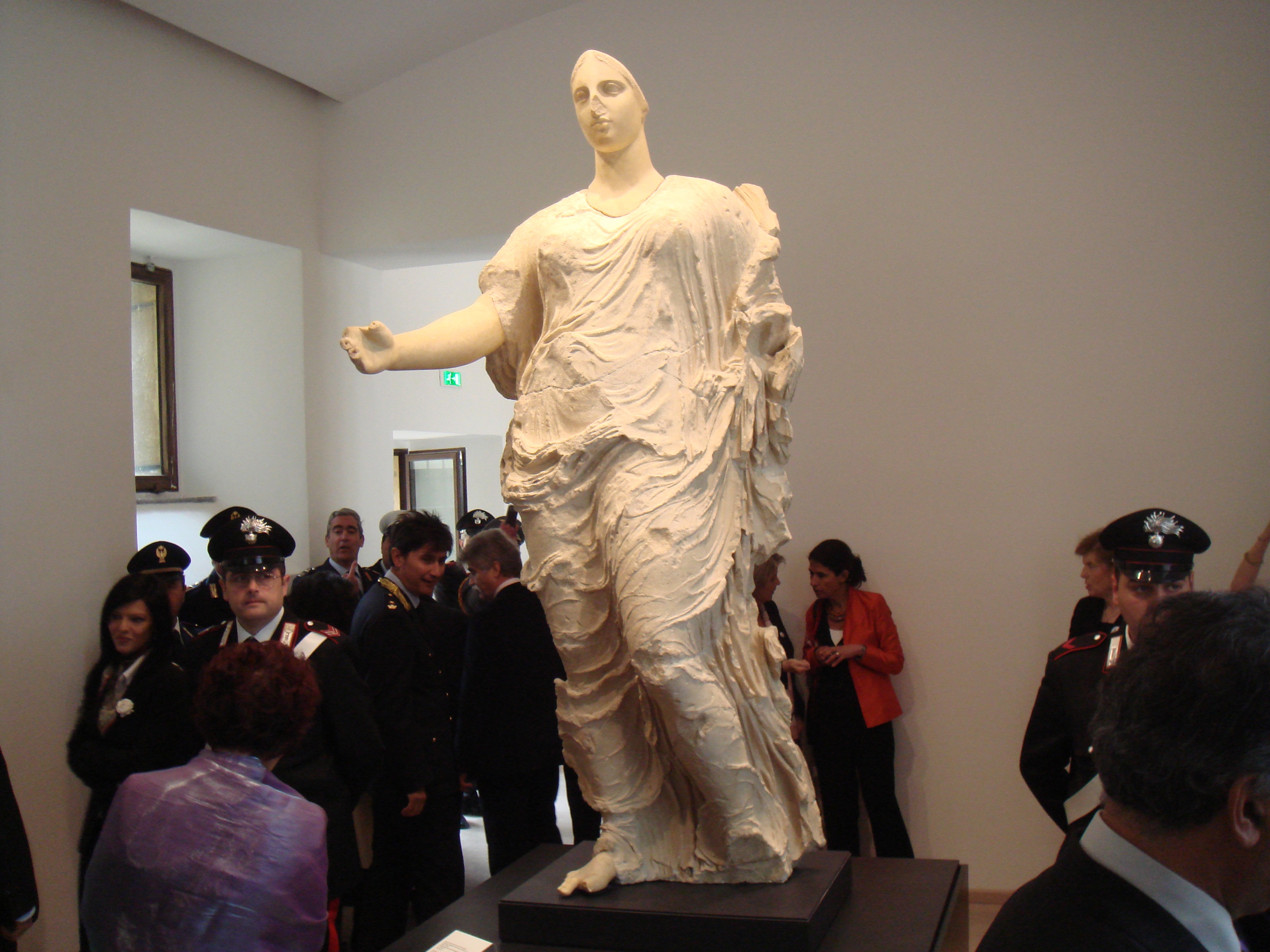
The Getty goddess in her new home in the archaeological museum in Aidone, Sicily.

Since the Getty’s controversial purchase of the statue in 1988 for $18 million, painstaking investigations by police, curators, academics, journalists, attorneys and private investigators have pieced together the statue’s journey from an illicit excavation in Morgantina in the late 1970s to the Getty Museum.

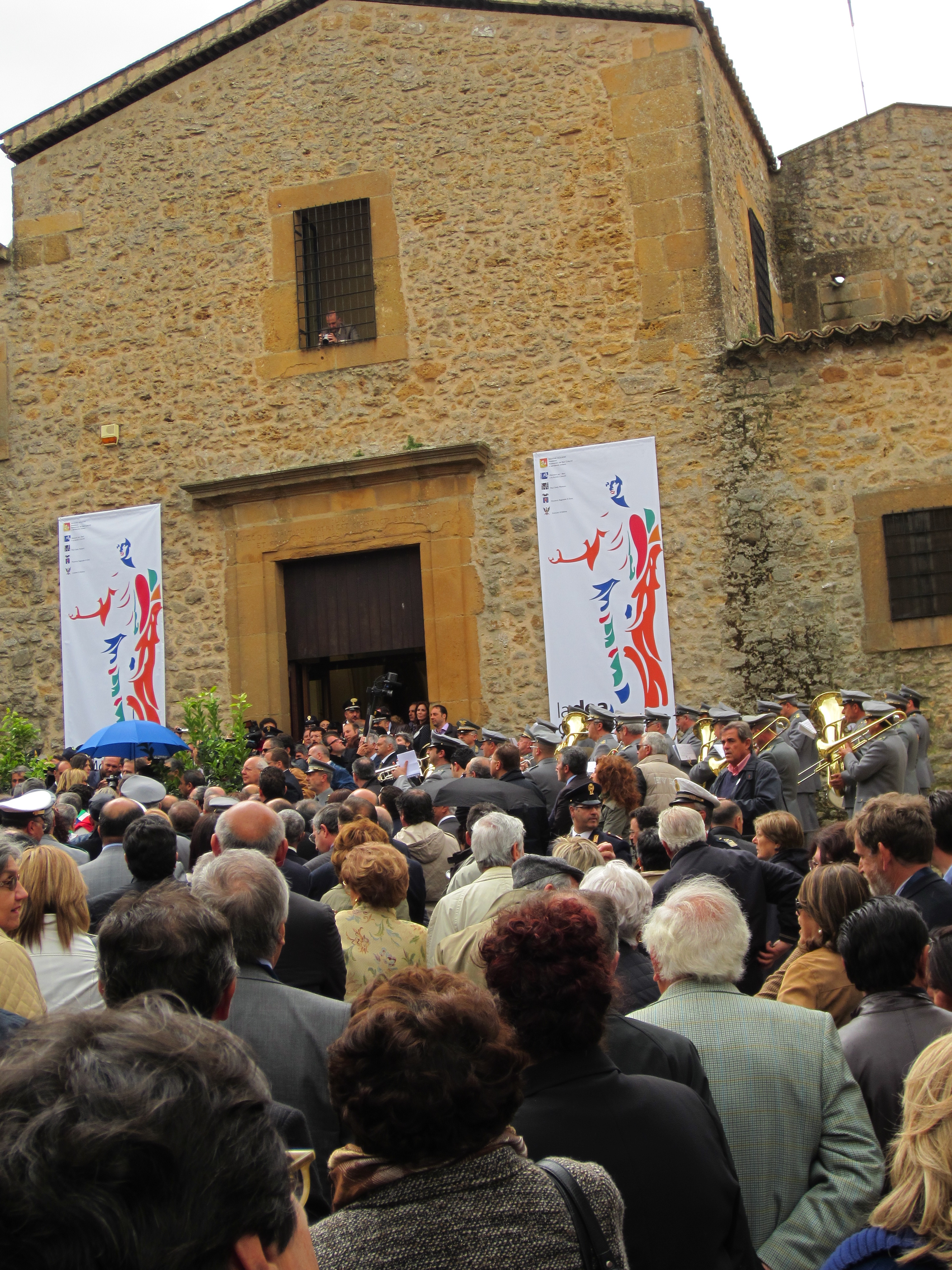
The Getty returned the goddess to Italy this spring, and a new exhibition showing the statue and other repatriated antiquities from a private American collector and the Metropolitan Museum of Art in New York was inaugurated here last week.

The archaeological museum in Aidone, Sicily

The goddess’ new home is a 17th century Capuchin monastery that now serves as the archaeological museum in Aidone, a hilltop village of about 6,000 residents. The cozy museum, which holds up to 150 visitors at a time, contains the most important objects discovered in the nearby ruins of Morgantina.

During its 22 years at the Getty Museum, the statue was virtually ignored by scholars, thanks largely to the aura of controversy that surrounded it. But as the scandal recedes, new, deeper mysteries about her are finally coming to the fore.

Who is the goddess? Does her slightly awkward marble head really belong atop the massive limestone body? Where precisely was she found? And what can she tell us about the ancient Greek colonists who worshipped her some 2,400 years ago?

The fact that so little is known about the marble and limestone statue — one of the few surviving sculptures from the apex of Western art — illustrates the lasting harm brought by looting and the trade in illicit antiquities. As the goddess was smuggled through the black market, she was stripped of her meaning and rendered a mute object of beauty.

The one thing scholars agree upon is her importance. The goddess’ clinging, windblown drapery is a clear reference to Phidias, the Greek master who a few decades earlier carved the figures that adorned the Parthenon in Greece — many of which now reside in the British Museum.

“It’s one of the very few examples we have from the high Classical period,” said Katerina Greco, a Sicilian archaeological official and leading expert in Greek art who wrote one of the few studies of the statue. “There is nothing like it in Italy.”

Today, central Sicily is an underdeveloped backwater of Europe. Just 17,000 visitors currently see the archaeological museum in Aidone where the statue now sits. At the Getty, about 400,000 saw her every year.

Residents here hope that the statue’s return marks the beginning of a new chapter, one focused on economic development and a deeper understanding of the goddess’ identity and significance.

“The statue didn’t exist by herself, she was made for a specific place and a particular purpose,” said Flavia Zisa, president of Mediterranean archaeology at the University of Kore in nearby Enna.

Most experts today agree the goddess most likely does not represent Aphrodite, as former Getty antiquities curator Marion True surmised when she proposed the statue for acquisition. But because some key fragments are missing from the goddess, scholars remain divided.

Greco has argued that the goddess represents Demeter, noting her matronly build and the remains of a veil covering her hair, a feature most often identified with older women in Greek times. In a forthcoming study, New York University professor Clemente Marconi will expand on his argument that the goddess is Persephone.
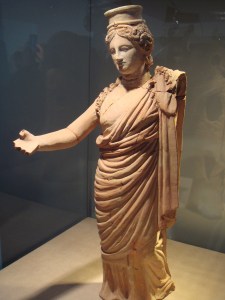
A terracotta Persephone on display in the same gallery as the goddess. Many experts now believe the Getty goddess is not Aphrodite.

In an acknowledgement of the changing views of the statue’s identity, Sicilian officials have re-branded the statue as the “goddess” of Morgantina and abandoned earlier references to Venus, the Roman name for Aphrodite.

More definitive answers to the mysteries of the goddess may rest with the looters who dug her up. If the statue’s exact excavation spot were known, archaeologists could re-excavate the area and build a better understanding of her purpose.

But omerta — the Sicilian oath of silence — has long kept that key piece of information a secret. Whispers in Aidone tell of two shepherd brothers who found the statue on the eastern flank of Morgantina where a sanctuary to Demeter and Persephone has been found.

“It is time for them to speak,” said Silvio Raffiotta, a local prosecutor who investigated the statue’s looting in the 1990s. “Now there is no risk.”


LA Times: Aphrodite Goes Home

Co-author Jason Felch has a story in Wednesday’s LA Times on the statue of Aphrodite’s return to Sicily. It contains a few scoops from the book on what convinced the Getty board to return the prized statue. Hint: it involves damning photos and the Mafia.

“The J. Paul Getty Museum’s iconic statue of Aphrodite was quietly escorted back to Sicily by Italian police last week, ending a decades-long dispute over an object whose craftsmanship, importance and controversial origins have been likened to the Parthenon marbles in the British Museum.

The 7-foot tall, 1,300-pound statue of limestone and marble was painstakingly taken off display at the Getty Villa and disassembled in December. Last week, it was locked in shipping crates with an Italian diplomatic seal and loaded aboard an Alitalia flight to Rome, where it arrived on Thursday. From there it traveled with an armed police escort by ship and truck to the small hilltop town of Aidone, Sicily, where it arrived Saturday to waiting crowds.

It was just outside this town, in the ruins of the ancient Greek colony of Morgantina, that authorities say the cult goddess lay buried for centuries before it was illegally excavated and smuggled out of Italy.”

Find the full story here.