Author Archives: Chasing Aphrodite

Fall Book Tour: Chasing Aphrodite across the East Coast

Here’s the line up for this week in New York City and beyond. Hope to see you there. To suggest an event near you, please contact us at ChasingAphrodite@gmail.com

October 26th: The National Arts Club in New York City hosts Jason for 6:30pm lecture and book signing. 15 Gramercy Park South. (Members and guests only.)

October 26th: Archaeological Institute of America The Institute’s New York Society will host Ralph for an evening talk about Chasing Aphrodite. Details here.

October 27: Harvard Club of NYC will be hosting us for a lecture, book signing and dinner. (Members only.)

October 28: Beacon Award Dinner. SAFE will host a dinner honoring Jason and Ralph for “their dedication to uncovering the truth” about the role of museums in the illicit antiquities trade. Details here.


October 29: Walters Museum of Art in 
Baltimore. Museum Director Gary Vikan will be moderating a public talk with Ralph, Jason and Arthur Houghton, the former interim Getty antiquities curator and a staunch advocate of collector’s rights. Discussion at 2pm, followed by book signing. Details here.


A Call from Robert Hecht: I’m Not a Squealer

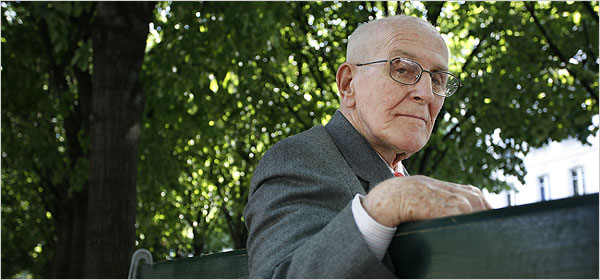
photo by Ed Alcock/NYT

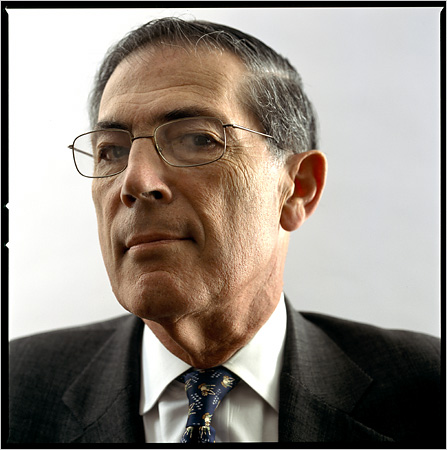
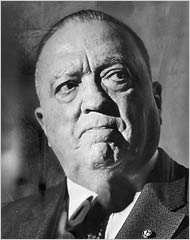
Robert Hecht

Robert Hecht called the other day to say he’d received the copy of Chasing Aphrodite that we sent to his home on Boulevard La Tour Maubourg in Paris.

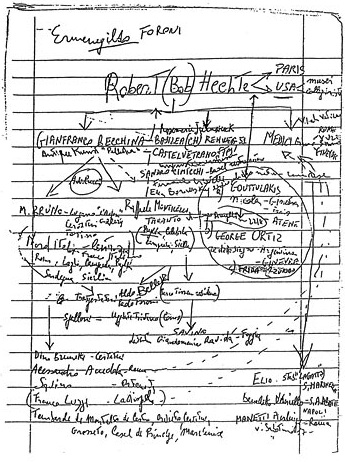
This chart showing the key players in the illicit antiquities trade was seized by Italian police in the 1990s.

Hecht is the American antiquities dealer who has dominated the trade for more than 50 years. Italian authorities believe he was also a mastermind of the international blackmarket in looted art — his name appeared at the top of an organization chart of looters, middlemen and dealers that Italian police found in the early 1990s. When Getty antiquities curator Marion True was indicted in 2005, Hecht was named as her co-defendant. His criminal trial in Rome on charges of trafficking in looted art continues today.

Here’s how we describe “the preeminent middleman of the classical antiquities trade” on page 30:

“Since the 1950s, Hecht had sold some of the finest pieces of classical art to emerge on the market. […] His network of loyal suppliers reached deep into the tombs and ruins of Greece, Turkey, and Italy. […] His clients included dozens of American and European museums, universities, and private collectors, including J. Paul Getty, whom Hecht had once persuaded to buy an intricately carved Roman bust. For decades, Hecht single-handedly dominated the antiquities market with his brilliance, brutality, and panache. He cited Virgil as readily as the lyrics of Gilbert and Sullivan, and he was known to break into operatic arias. He often drank to excess and was known to gamble his money away in all-night backgammon games. He tamed competitors with an unpredictable temper and eliminated rivals with anonymous calls to the police. Even those who sold directly to museums gave Hecht a cut of the deal, earning him the nickname ‘Mr. Percentage.'”

Robert Hecht poses in front of the famous looted Greek vase he sold the museum in 1972 for $1 million.

That’s the first of nearly thirty references to Hecht in Chasing Aphrodite. Even so, we felt it was short shrift for a man whose role in the art market is truly legendary. During our interviews and meetings with Hecht over the years, he was always a pleasure to deal with. He is an engaging dinner companion, often charming and talkative while being coy about the key details we were scratching for. Today, at 92 years old, he suffers from some health problems but retains the sharp wit he’s long been known for.

So, what did Hecht think of the book? “It was a well written book except for one lie, which I hope was not your invention,” he said.

Hecht was not disturbed by the allegations that he virtually ran the illicit antiquities trade for 50 years. He wasn’t upset about being called a gambler and an abusive alcoholic, or a participant in a massive tax fraud scheme, or the man largely responsible for the destruction of thousands of archaeological sites. The offending passage was the  reference to Hecht “eliminating rivals with an anonymous call to the police.” We based it on conversations with Italian law enforcement sources. Hecht assures us it is not true.

“The accusation of being a squealer is very serious,” Hecht said. “That is not in my blood.” Hecht said such accusations could be bad for business, which has been slow lately: “A customer might say, oh my god, you’re a spy for the police.” Hecht’s wife Elizabeth got on the phone next to explain that the charge had troubled her husband: “A lot of people we know did do that, but Bob never did. He’s not a rat, and does not wish to be known as such.”

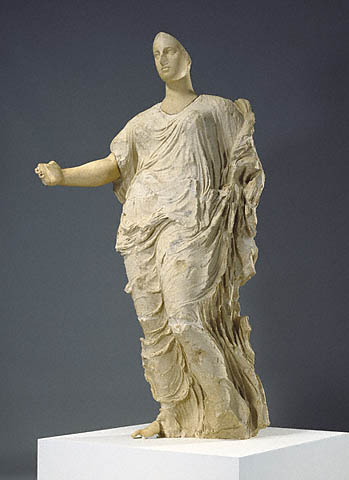
Cult Statue of a Goddess (Aphrodite)

Many in the trade recall how Hecht threatened to expose his rivals in a memoir he was writing. He never followed through on those threats — the unpublished memoir was seized by Italian authorities and is now among the most compelling evidence against him at trial.

But dropping a dime to the police is different. Going back over our notes, there is only one specific case Italian authorities cited in suspecting Hecht of being “a squealer.” It involved the Getty’s 1988 acquisition of the statue of Aphrodite from Hecht’s rival, London dealer Robin Symes.

Shortly after the whopping $18 million acquisition — a record at the time –Interpol Paris received an anonymous tip claiming the Aphrodite had been looted from Morgantina, Sicily. The tipster named the looters and middlemen in the transaction with detail that later proved remarkably accurate. Italian authorities have long suspected the source was Hecht, who lived in Paris at the time and may have been jealous of his rival Symes. But the Italians have no proof of their hunch, and Hecht flatly denies being the tipster.

Given his clear denial, and absent further supporting evidence from our Italian sources, we agreed to correct the record. Robert Hecht is many things, but to the best of our knowledge, he is not a squealer.

We’ve invited Hecht to join us later this month in his hometown of Baltimore, where we’ll be speaking at the Walters Museum on October 29th. He will be in the States that week and did not rule out the possibility of joining us.

Hot Docs: Marion True the Crusader

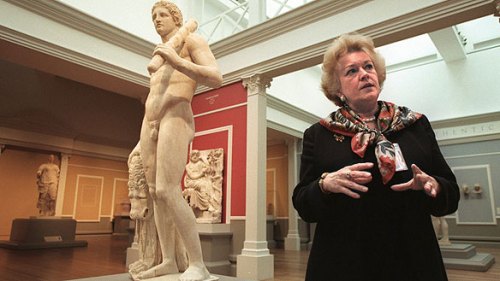
Former Getty Antiquities Curator Marion True

One of the most scathing rebukes of the collecting practices of American museums in recent memory came not from a grumpy archaeologist, a nosy journalist or an overzealous foreign prosecutor. It came from one of the museum field’s rising stars: Getty antiquities curator Marion True.

In June 2000, True delivered a gutsy speech to an audience of museum peers that denounced them for relying on “distorted, patronizing and self-serving” arguments to justify their collecting of ancient art. Over the course of the next hour, True dismantled the various justifications museums had long used to buy ancient art that was almost certainly looted.

The speech, whose full text we’ve posted and annotated here, is remarkable not just for True’s scathing remarks but also for their venue: the annual gathering of the Association of Art Museum Directors. The group is the museum profession’s most powerful, consisting of representatives from the country’s largest and wealthiest collecting institutions. As such, the AAMD wields immense clout on matters of institutional policy, including collection practices.
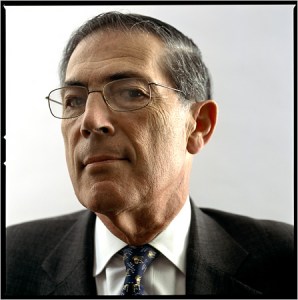
Philippe de Montebello, former director of the Met

Under the sway of former directors Philippe de Montebello of the Met and James Cuno of the Art Institute of Chicago (now CEO of the Getty), the AAMD had long resisted the 1970 UNESCO Convention, which calls for import restrictions and international cooperation to stop trafficking in illicit antiquities. Instead, AAMD’s guidelines were riddled with caveats and loopholes that allowed member institutions to buy undocumented antiquities as long as the pieces were artistically “significant.” In her speech, True was calling out the power structure of American museums.

James Cuno, CEO of the J. Paul Getty Trust

Her speech was inspired by an earlier panel at Columbia University on the Elgin Marbles. The discussion “had nearly devolved into a fistfight” when a fellow panelist suggested the Parthenon sculptures needed to remain the British Museum because the Greeks were “unworthy custodians and therefore did not deserve to have it” [sic]. “As the three front rows of the audience were primarily of Greek nationals or Greek Americans, this statements did not go down very well,” True noted dryly.

True said the debate had caused her to re-trace the evolution of what had become an increasingly nasty debate about cultural patrimony that pit foreign officials and archaeologists against American museums, dealers and collectors. “Given the seemingly noble intentions that inspired the foundation and development of American Art museums, how have they now come to be so often in direct conflict with the source countries and the academic communities that work on cultural heritage?”

Her answer laid the blame squarely at the feet of American museums, which had used similarly “demeaning arguments” to justify their acquisition of marquee objects and to brush off the concerns of foreign countries. She listed the most common arguments, many of which are still used today:

“–Because the contemporary population was ethnically not the same people as the creators even thought they inhabit the same territory;

–Because the police force in the source country does not do enough to protect its patrimony and maybe even is in collusion with the smugglers;

–Because art historians in the country are not up to the job of studying their own patrimony but have had to look to the British German and American scholars for leadership;

–Or because the national laws governing the protection of cultural properties are repressive since they do not allow the free trade in the objects that US laws allow and,

–Or most perplexingly and inflammatory, in the case of Italy, because Mussolini had continued to enforce the laws instituted in the 18th century to protect Italian artistic heritage, that we would be enforcing the laws of a fascist regime.”

“Surely,” True said, “we should not have to rely on such distorted, patronizing and self-serving observations to justify collecting ancient art in this country.”

Next, she turned her sights on dealers and collectors, who still “vehemently denied” the extent of looting that has been clearly documented by archaeologists and governments. Their claims that the illicit trade was small were “contradicted by the evidence,” including their own political machinations to gut American laws prohibiting the import of such objects. It was time to accept that most undocumented antiquities came not from “old European collections,” as dealers and museums were fond of claiming, but from recent chance finds or illegal excavations, True said.

Likewise, the claim made by Sothebys and other auction houses that sellers preferred not to reveal provenance information “flew in the face of logic” because such information would only increase an object’s value. And the common practice of asking governments for evidence of whether a piece had been looted “conveniently ignores” the fact that, by definition, such objects are “undocumented,” she said.

She concluded with a knock-out punch: “Most museums have long preferred to consider objects innocent until proven guilty,” she said, citing the Getty’s own 1987 acquisition policy and the writings of James Cuno while at the Harvard Arts Museums. “But experience has taught me that in reality, if serious efforts to establish a clear pedigree for the object’s recent past prove futile, it is most likely—if not certain—that it is the product of the illicit trade and we must accept responsibility for this fact.

“It has been our unwillingness to do so that is most directly responsible for the conflicts between museums, archaeologists and the source countries.”

In one fell swoop, True had laid bare the cynical path of many museum masterpieces—a path few insiders had ever been willing to publicly acknowledge.

But as powerful and succinct as True’s presentation was, her listeners could have been forgiven a measure of skepticism. While it represented one side of Marion True – the crusader for reform — they knew another: the accomplished curator and competitor who for a decade had used those very same tactics to fill the Getty with some of the best undocumented pieces in the world. Indeed, True’s intimate knowledge of museums’ efforts to navigate the illicit trade was based on her personal experience.

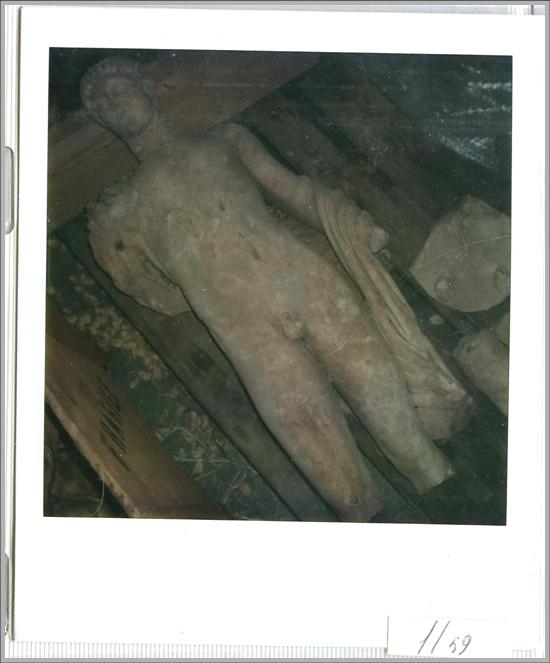
As it happened, the day after True gave her speech a judge in Switzerland ruled that Italian officials could take possession of hundreds of Polaroids and documents that had been seized in a 1995 raid of an antiquities dealer’s Geneva warehouse. The Polaroids showed scores of looted artifacts as they appeared fresh from the ground. Eventually Italian investigators traced the greatest number to the Getty and Italian prosecutors started planning a prosecution of Marion True.
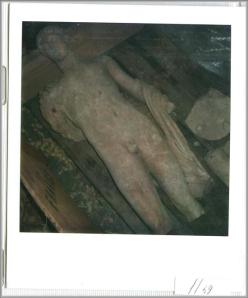
A Polaroid of the Getty's Statue of Apollo showing it soon after being looted

Soon after, an internal Getty probe found similar photos in True’s own curatorial files showing, in the words of the Getty’s outside counsel, “objects in a state of disrepair or in a location from which they may have been excavated.” The Getty’s attorney concluded it would take little for the Italians to link True to a conspiracy or to support a claim that the curator “knew or should have known that many objects acquired by the Getty were illegally excavated from Italy.”

Among their best evidence, he noted, would be True’s own 2000 speech before her peers at the AAMD.


Chasing Aphrodite events in October: NYC, Philly, Princeton, Rutgers, Baltimore and more

Next month we’ll be heading East for several lectures and book events. Please help us spread the word:

October 17th: Rutgers University. The university’s program in Cultural Heritage and Preservation Studies (CHAPS) will host us for a talk about Chasing Aphrodite. Open to the public. Details here.

October 19th: Princeton University. The Center for Arts and Cultural Policy Studies, will host us for a discussion. Open to the public. Details here.

October 20th: University of Pennsylvania will host us for a 12:30 pm lecture at the Penn Museum’s Cultural Heritage Center.

That evening at 6pm, Penn Law and the Museum will host us for a discussion on the illicit trade with Robert Wittman, former head of the FBI’s art squad and author of “Priceless: How I Went Undercover to Rescue the World’s Stolen Treasures.” Open to the public. Details here and here.

October 24th: New York University. 

NYU’s Department of Classics will be hosting us for an evening chat. Details TBA.

October 25: The National Art Club in New York City hosts us for a lecture and book signing. Details here.

October 26th: Archaeological Institute of America The Institute’s New York Society will host us for an evening talk about Chasing Aphrodite. Details here.

October 27: Harvard Club of NYC will be hosting us for a lecture, book signing and dinner. (Members only.)

October 28: Beacon Award Dinner. SAFE will host a dinner honoring Jason and Ralph for “their dedication to uncovering the truth” about the role of museums and the illicit antiquities trade. Details here.


October 29: Walters Museum of Art in 
Baltimore. Museum Director Gary Vikan will be moderating a public talk with Ralph, Jason and Arthur Houghton, the former interim Getty antiquities curator and a staunch advocate of collector’s rights. Discussion at 2pm, followed by book signing. Details here.
We also have some exciting events in Southern California lined up for November:

November 2: Chapman University. The Department of Art and Chapman Law School will host Jason for an evening lecture and book signing. Details TBA.


November 12: An Insiders Tour of the Getty Villa. Jason will lead a tour of the Getty Villa, discussing the Getty’s origins, the highlights of its controversial antiquities collection and its recent collaboration with Italy. Organized by SAFE Tours. Details TBA.

November 18th: Jonathan Club in LA. (Private event.)

Hope to see you at one of these. To suggest an event near you, please contact us: ChasingAphrodite@gmail.com

Getty Museum Returns Two Objects to Greece, Signs Collaboration Deal

The Getty Museum agreed on Tuesday to return two antiquities to Greece and formalized a broad cultural agreement that will lead to loans, joint research and other collaboration with the art-rich Hellenic Republic.

The agreement mirrors similar deals struck with Italy and Sicily in the wake of a negotiated settlement to claims the Getty had for years purchased ancient art looted from those countries. The Getty resolved its differences with Greece in 2007 with the return of four contested antiquities, including a golden funerary wreath. Today’s agreement formalizes that accord.

The returned objects are:

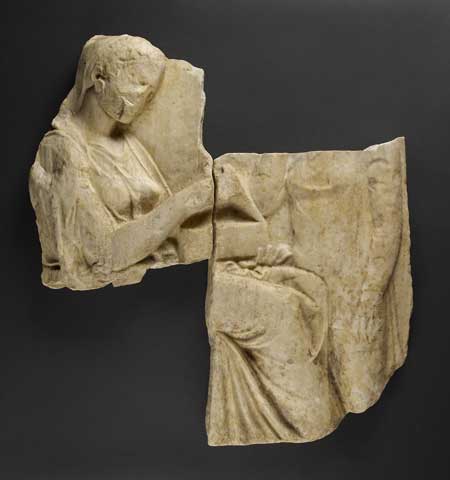
Fragments of a grave stone showing a seated woman (73.AA.115). Under former antiquities curator Jiri Frel, the Getty purchased the object for $20,000 in 1973 from Paris antiquities dealer Nicolas Koutoulakis, who has been linked to the illicit trade in Italy’s investigation. It adjoins a funerary relief currently in the Kanellopoulos Museum in Athens.

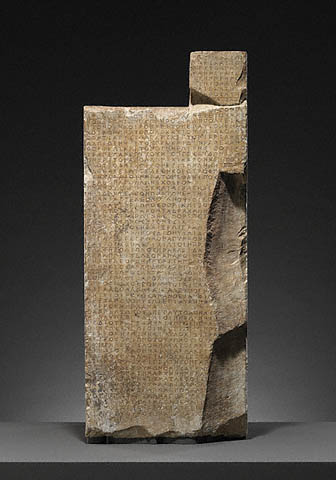
An inscribed tablet describing the religious calendar of Thorikos. (79.AA.113) It was purchased by the Getty in 1979 for $50,000 from Jacques Roux, whose name is not familiar to us. Currently on view in the Getty Villa, the object “describes sacrifices and festivals celebrated in Thorikos, in southeast Attica, in honor of local deities and heroes,” according to a Getty press release.

For those keeping score, the Getty has now returned 6 objects to Greece and 43 to Italy since 2005.

A few things worth noting about the deal, which the Getty touts as a “landmark agreement”:

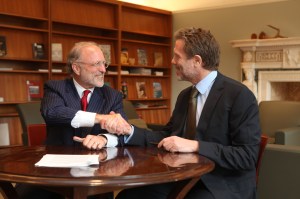
— It was enthusiastically signed by Getty CEO Jim Cuno, who has long been an outspoken critics of repatriations. Before coming to the Getty in August, Cuno railed against repatriation claims from nations like Greece, calling them “nationalistic.” Today he’s shown in a Getty photo grinning broadly as he seals the deal with the Greek minister of Culture Pavlos Yeroulanos, who greatly impressed Getty officials. In an earlier post we asked: “Will the Getty change Cuno, or will Cuno change the Getty?” Looks like we’re starting to see an answer.

— The objects being returned were never demanded by Greece, were not the result of new information coming to light, and do not bear clear signs of being looted. (Thought the role of Koutalakis is certainly suspect.) Indeed, Getty Museum officials recommended their return, according to Getty spokesman Ron Hartwig. Scholars have long known the grave stone fragments matched a stele in a Greek museum. And the inscription’s cultural importance isn’t new. The returns were orchestrated by interim Getty antiquities curator Claire Lyons and her predecessor Karol Wight during informal discussions with Greek colleagues earlier this year.

Our take: The Getty should be applauded for these moves, another step in its embrace of cultural collaboration. But we’re curious: does this set a new precedent for returns by the Getty? For years, the Trust insisted it can only return objects if confronted with compelling reasons, such as evidence of criminal origins. Officials have gone as far as suggesting the museum’s tax exempt status could be in jeopardy if they relinquished objects without a such a cause. We see no compelling demand for return here. Re-uniting fragments and returning culturally important material are laudable moves, but why now? And what else at the Getty should be returned on similar grounds?

Hartwig, who we caught on a bad day, didn’t have a clear answer.

Gary Vikan on Moving Museums Beyond Ownership

In February 2006, shortly after Getty Trust CEO Barry Munitz was forced to resign in the wake of an LA Times expose on his personal excesses with Getty money, New York Times art critic Michael Kimmelman weighed in with an analysis of the institution’s core problem.

Barry Munitz, former CEO of the Getty Trust

“The Getty, at staggering cost and at little or no obvious benefit to the general public, directed millions to new programs,” Kimmelman wrote, referring to the Trust’s investments in conservation, research and education. Instead, Kimmelman argued the Getty should do what the Met had done a century earlier: spends its money buying A-list objects with the hope that, over time, the museum could catch up with the world’s great collections.

Gary Vikan, the director of the Walters Museum in Baltimore, read the piece and immediately recalled a conversation he had had with Munitz a few years earlier. During a seminar at the Trust, the profligate CEO had proposed a surprising new direction for the Getty, one that flew in the face of critics like Kimmelman:  rather than spending vast amounts buying a handful of masterpieces, why not bring them to the Getty on loan, leveraging the Getty’s conservation expertise for a chance to display world-class art.

Gary Vikan, Director of the Walters Museum

This ” “simple and provocative” idea — moving the museum beyond ownership — stuck with Vikan, and he expanded on it in a rebuttal to Kimmelman that was never published. Here are excerpts of Vikan’s letter, whose ideas have taken on new relevance in the wake of the antiquities controversy recounted in our book:

“Why shouldn’t the Getty, with its spectacular wealth, its enormous prominence among the world’s art centers, and its relative ‘institutional youth,’ challenge the very notion of art acquisition and ownership?” Vikan asked. Such a move would “cut to the heart of the disequilibrium” between artifact-rich but cash poor nations like Italy and the wealthy young museums like the Getty, which have the expertise to conserve works and the burning desire to show them.

Museums “can offer an art experience, with its associated learning and scholarship, without having to own the work of art.” Vikan proposed replacing many acquisitions with a system of “innovative long-term loans derived from partnerships across the divide that separates the cash-rich/art poor from the cash-poor/art rich.”

“Such a visionary reordering of Getty Museum priorities would not only create a shining new model for art museums worldwide, it would remove a troublesome roadblock that would almost immediately open up at least two great opportunities. First would be the the opportunity to form a much stronger, more synergistic community of purpose among the four programmatic components of the Getty Trust under a single, education-centered mission — one wherein the Museum becomes at once the laboratory and showcase for the aspirations and achievements of all that the Getty Trust undertakes….Second would be the opportunity for the Getty Trust to play a leadership role in forging a community of purpose among museums internationally, and in establishing new, transparent models of mutually beneficial partnership….”

“This,” Vikan concluded, “is a vision that could help to re-shape the entire world community of art museums in the 21st century.”

Vikan and Munitz did not invent this vision — others had made similar proposals, notably Max Anderson of the Indianapolis Museum of Art and Wolf-Dieter Heilmeyer of the Berlin Museums. Ironically, former Getty curator Marion True emerged as the the greatest champion of the idea before her indictment by Italy. (See our Chap 8.) Still, the vision articulated by Vikan and others was strikingly audacious:  a rethinking of centuries of collecting practices.

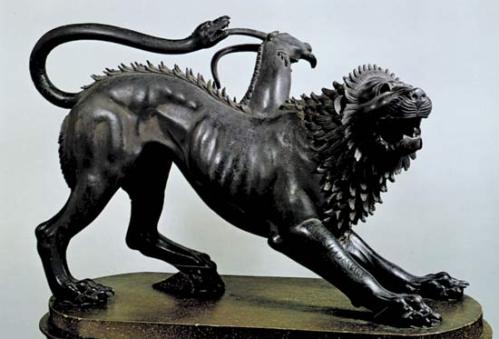
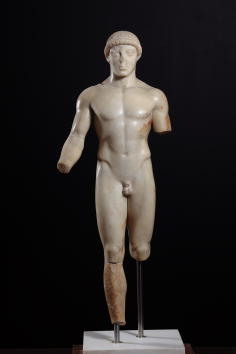
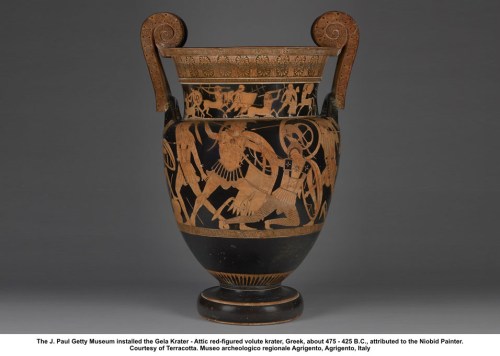
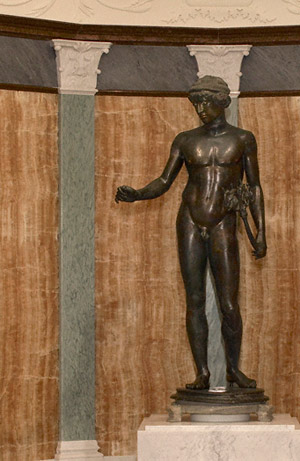
Remarkably, five years later, it is a vision that appears more and more like reality, especially at the Getty. A year after Vikan’s letter, the Getty ended its decade-long controversy with Italy over its purchase of looted antiquities and forged an agreement that embraces the key ideas in Vikan’s letter. Subsequent agreements were also struck with the National Archaeological Museum in Florence and the autonomous region of Sicily. In the end, the Getty lost 40 of its most prized antiquities, but has begun receiving on loan prized masterpieces from Italy, some of which had never before left Italy.

Here are a few (click the images for details on the loan):

Chimaera of Arezzo

Agrigento Youth

The Gela Krater

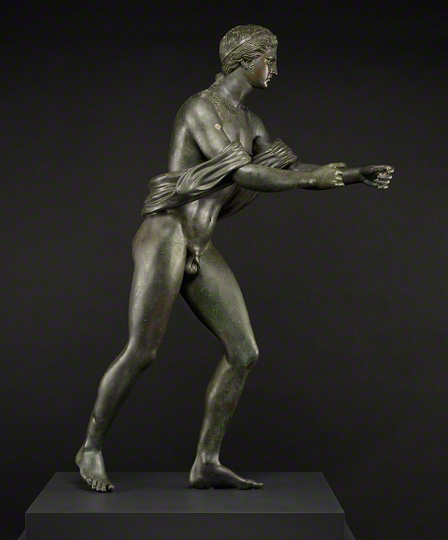
Statue of Ephebe from Pompei

Apollo from Pompei

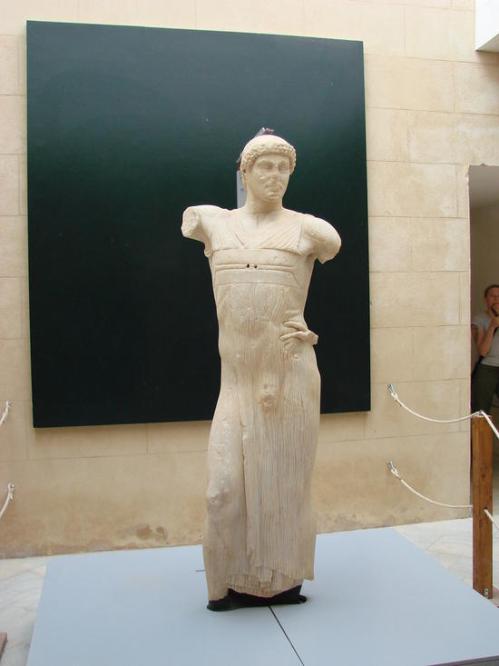
Mozia Charioteer (coming Spring 2012)

To be sure, the Getty continues to purchase art, and — cautiously — antiquities. But with the growing roster of loans and collaboration, the historically underachieving Getty has also begun to look something like that 21st Century museum that Vikan envisioned. And the Trust’s new CEO Jim Cuno has already signaled that he hopes to continue in this direction.

As we wrote in the epilogue of Chasing Aphrodite: “The new era…is now within sight. It is one in which museums and countries alike will look beyond questions of ownership and embrace, as True said, the “sharing of cultural properties, rather than their exploitation as commodities.”

What are other examples of museums moving beyond ownership? Leave a comment below and we’ll raise them Baltimore, where we’ll be speaking with Vikan at the Walters Museum on October 29th at 2pm. Details here.

Jiri Frel: Scholar, Refugee, Curator…Spy?

In the early 1980s, the antiquities department at the J. Paul Getty Museum was a hotbed of whispered political intrigue.

Rumors swirled that the department’s Czech curator, Jiri Frel, was a Communist spy. And many believed the deputy curator, former State Department official Arthur Houghton, was a CIA plant tasked with keeping an eye on Frel’s activities.

Frel’s once-classified FBI file, obtained by the authors under the Freedom of Information Act, reveals that the US Government asked similar questions about Frel in 1971, when an investigation was conducted into his “possible intelligence connections.”

As part of our Hot Documents series, we’ve posted the entire FBI file here.

Frel was born in Czechoslovakia 1923 as Jiri Frohlich to a Czech father and Austrian mother, the FBI records show. (The family changed the surname to Frel in 1940s, possibly to hide Jewish roots.) Frel entered the United States in 1969 as a visiting scholar at Princeton University’s Institute for Advanced Studies. The Institute had long been an intellectual home base for leading scholars, including Albert Einstein.

After a year at the Institute, Frel was granted political asylum with the help of lawyers at the Metropolitan Museum of Art, where he had begun working as an research associate in the Greek and Roman Department under Dietrich von Bothmer. Interestingly, Frel cites additional assistance from George Kennan, the former US Ambassador to the Soviet Union and a leading historian at the IAS.

During an interview with FBI agents in September 1971, Frel was “extremely cooperative,” the records show. Frel denied ever being a spy but he admitted to providing Communist government officials with the names, background information and psychological assessments of those he met on his scholarly travels throughout Europe during the Cold War. “He stated that while he was never aware of this information being used for intelligence purposes, he often suspected that the Chechoslovak [sic] Intelligence Service reviewed copies of this form,” the report notes.

The FBI seemed particularly interested in Frel’s ties to his mentor at Charles University, a woman whose name is redacted in the FBI file. We shared the FBI file with an expert on academic life under Communist Prague, UC Berkeley Associate Professor John Connelly, who was able to identify the woman as Ruzena Vackova,  a professor of classical architecture in Prague who was condemned to 22 yrs. prison in 1952.

According to Connelly, Vackova was one of the few in academia to speak openly against the Communist regime and was the only professor in Prague to march with student protesters. In Connelly’s book “Captive University,” he describes Vackova telling a group in March 1948, “…if a criteria for dismissing these students was participation in these demonstrations, then I would like to share their fate.” (p.194) Vackova spent 16 years in prison and her dissent continued after her release, Connelly told us in an email.

“She was an extraordinary, outstanding person,” he said.

The FBI had picked up on whispers that Frel may have been a Communist agent who turned Vackova in to the authorities. “Since he was one of her protégés at Charles University in Prague, a rumor began to spread of which he was aware, that he had somehow cooperated with the Communist government in her demise,” the report notes.

Frel denied the claim and railed against the Soviet overlords in his Czech homeland, saying he “vehemently disagrees with the Communist regime.” Yet the curator also volunteered (we imagine somewhat sheepishly, but the bland FBI prose doesn’t say) how he cultivated the regime’s approval by once applying for the Communist party. Frel said he applied “to keep his position at the university,” and was rejected because of his incompatible political views.

Connelly believes that it is unlikely that Frel had any role in Vackova’s arrest. “He was probably a conformist (like the overwhelming majority) who tried to anticipate the will of the regime,” Connelly wrote to us. Few who knew him at the Getty would think of Frel as a conformist, but during his years there he certainly showed a flare for telling those in power what they wanted to hear while doing what he damn well pleased.

Espionage allegations aside, the Frel file is a fascinating study of a complicated personality. It hints at Frel’s famously chaotic love life. More importantly, it demonstrates how adept the charismatic polymath, connoisseur and political shape-shifter was at manipulating situations and spinning answers for his own survival. Colleagues at the Getty knew Frel as an Old World snob who constantly complained about America, its broken education system, its obsession with pop culture, its hot dogs and unpalatable mustard. Indeed, years later, when he was caught conducting a massive tax fraud scheme and falsifying provenance for million-dollar fakes at the Getty, Frel left America and never looked back. Yet during his 1971 FBI interview, the reporting agent noted how Frel gushed that “he considers the United States to be in his words ‘a great and good country.”

The story told by the documents is not complete: 10 pages were redacted, citing exemptions for national security and privacy. But it’s clear the FBI closed its case in 1971, concluding Frel had no ties to foreign intelligence services. Frel died in Paris on April 29, 2006.

As for Houghton and his ties to the CIA, the rumors were not far off. Before coming to the Getty in 1982, he had spent a decade working for the State Department, including time in its bureau of intelligence and research as a Mid East analyst. Houghton was fond of cultivating his image as a man of mystery. In truth, he had burned out on the diplomatic bureaucracy and chose a career that brought him closer to his long time passion — ancient coins. Houghton remains active in the field to this day.

Beacon Award for Chasing Aphrodite authors

We’re honored to announce our work has been recognized with a Beacon Award from Saving Antiquities for Everyone (SAFE), the non-profit organization dedicated to the preservation of cultural heritage worldwide.

In announcing the 2011 award, SAFE cited the authors “for educating the public about how museum practices affect the preservation of cultural heritage. As investigative reporters at the Los Angeles Times, their dedication to uncovering the truth was essential in breaking open the case with the J. Paul Getty Museum. Through their recent book and continued effort to raise awareness online, many will learn, some for the first time, about the devastating effects of the illicit antiquities trade.”

SAFE will be presenting the award at a dinner in New York City on October 28th. You can find details on this and our other upcoming East Coast appearances here.

We’d also like to congratulate the 2012 Beacon Award Winner David Gill, the mind behind Looting Matters and soon to be Head of Humanities and Professor of Archaeological Heritage at University Campus Suffolk. We’ve followed David’s important research closely over the years and his blog is must-read for those interested in the illicit antiquities trade.

Wrestling with Orphans in the Skagit Valley

On this summer’s book tour/family road trip to the Pacific Northwest, Jason spent some time at a family farm in the scenic Skagit Valley. While there, our hosts Drs. David and Jenny Benson organized what has got to be one of the best book parties in recorded history.

The festivities included a jam session by David and his old band; grilled oysters from the nearby Puget Sound; and a delicious Frogmore Stew (aka Low Country Boil) prepared by Liz and Ben Fischer, our friends from North Carolina.
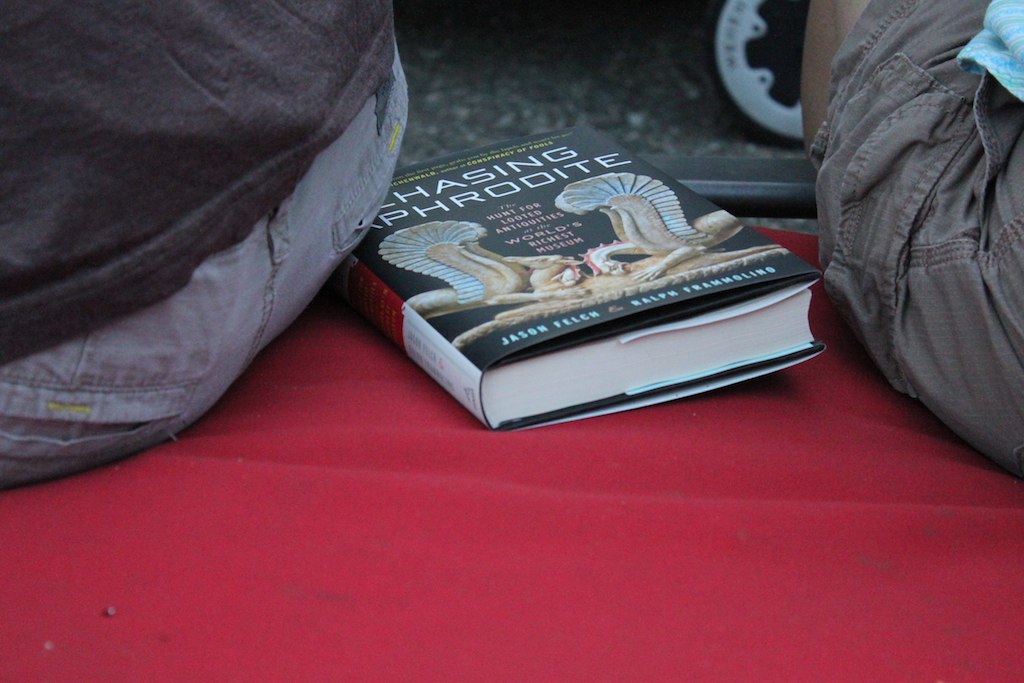
After the feast, Jason spoke a bit about Chasing Aphrodite, then opened the floor for a lively discussion about the problem of the so-called “orphans,” archaeological objects that have been looted and now — thanks to reforms in museum collecting practices — have no home.

The two dozen or so guests — who ranged from farmers and doctors to teachers and artists and film makers — had lots of ideas for solutions to a problem that has perplexed a generation of art world leaders.

Why not make an international museum for these objects? Perhaps a traveling exhibition that tours around the world? Could they be distributed to museums with lesser collections? Ray Bakke, the distinguished author and theologian, spoke eloquently about his insights from years of inter-faith dialogue around the globe.

In these dog days of summer, that lovely afternoon in the Skagit Valley is stuck in our minds. Our thanks to the Bensons for hosting the wonderful event. We’ll be sharing some of these insights as we continue our book tour in the fall with several stops on the East Coast.

Meantime, what do you think should be done with the “orphans”?


The Secret FBI File: J. Edgar Hoover vs. J. Paul Getty

Was J. Paul Getty a Nazi collaborator?

That is the provocative question that J. Edgar Hoover asked in 1940, when the FBI opened a secret investigation into J. Paul Getty’s possible ties to the Nazi regime.

While reporting Chasing Aphrodite, we obtained Getty’s FBI file under the Freedom of Information Act. It contains a fascinating account of the FBI’s ultimately inconclusive espionage investigation into Getty, who some in the government feared was “extremely dangerous to the safety of this country.”

We’ve posted and annotated* the complete FBI file in four parts: Part 1, Part 2, Part 3, Part 4. We’ve also posted a declassified file from the Department of State here.

Here are highlights from Hoover’s investigation in J. Paul Getty, at the time one of the world’s richest men:

Aug 1940: The FBI takes notice when sources report that J. Paul Getty (“Geddy”) buys the run-down Hotel Pierre on 5th Avenue in New York City, fires the staff and replaces them with “employees of the Italian consulate.” Months earlier, Italy had joined forces with Nazi Germany. An inquiry is opened.

Aug 29, 1940: J. Edgar Hoover orders the special agent in charge of the FBI’s Los Angeles field office to launch “a complete and thorough investigation” of Getty, noting his employees’ “Italian consular connections.” Hoover writes: “Getty may, because of his oil interests and German descent, be engaged in activity inimical to our Government.”

Nov 1940: After a preliminary investigation, the FBI opens a formal case file on Getty, listing the focus of the investigation as “Espionage.”

Nov 11, 1940: The investigation finds Getty has been married four times, and was accused of “immorality” and adultery by his wives.

Dec 1940: FBI file cites a New York Daily News article describing Getty as a “personal friend” of Hitler who has supplied oil to Russia.

December 1940: Getty’s attorneys write to US Embassy in London, denying claims made in Daily News article. Getty “never met and does not know Hitler, and is not and has never been friendly or sympathetic to him.”

Jan 1941: J. Edgar Hoover writes to the Attorney General, summarizing the investigation into possible espionage by J. Paul Getty.

Jan 1941: The FBI learns that in Nov 1939 Getty was in Berlin negotiating the sale of 1 million barrels of California oil to Soviet Russian buyers.

Nov 1941: FBI report from New York office summarizes investigation, concluding, “Investigation has failed to disclose information to substantiate allegations that the employees and those who frequent the hotel have Italian Consular connections.”

Jan 1942: Assistant Attorney General Wendell Berge writes to Hoover saying there is insufficient evidence for a criminal prosecution against Getty, but asks the FBI to continue its investigation.

April 1942: Assistant Attorney General Wendell Berge instructs Hoover to continue investigation of Getty, noting “If these allegations, or some of them, are true the subject is a person extremely dangerous to the safety of this country.”

April 1942: In a heavily redacted report, a confidential source tells FBI investigators that Getty advised Nazi army “a way to break through the Maginot line,” France’s protective barrier with Germany. Source tells FBI investigator that Getty was interested in Hitler “merely because of the efficiency with which HITLER and other German officials conducted their system of government…” Getty is “amenable towards the way those in power crush the weak.” Source tells FBI investigators that Getty turned down offers of oil and art from Russian and German officials in exchange for his help drilling oil wells.

Aug 29, 1942: Getty was interviewed by the FBI and denied any ties to Hitler’s government.

Oct 1942: FBI summarizes investigation of Getty, concludes facts “do not reflect that he is engaged in espionage activities.” Case transferred to unnamed division of FBI.

July 1943: Attorney General Francis Biddle concludes the FBI’s use of “danger classifications” for individuals was a mistake and should be stopped. He orders a memo placed into Getty’s file and others classified as dangerous, noting that such designations were unreliable.

Sept 1961: In 1961, the Kennedy White House opened a confidential “name check” inquiry into Getty. The report notes the FBI’s investigation of Getty and the oil tycoon’s promiscuous relations. It also mentions that in the 1940s Getty was involved in a paternity dispute with a woman who claimed the true father of the child was Getty’s friend Charlie Chaplin. The White House deemed the information in the file not relevant to the the inquiry, whose focus is not revealed.

Aug 1963: Kennedy is said to have accused Getty of avoiding income tax payments and using his money to subsidize “extreme right-wing propaganda.”

March 1973: Nixon Dept Assistant Alexander Butterfield requests inquiry into J. Paul Getty.

In hindsight, the FBI’s two-year investigation of Getty found nothing concrete, and appears more guided by innuendo and rumor than hard fact. With the FBI’s current focus on penetrating domestic terror networks, it is noteworthy that soon after the investigation concluded, Attorney General Francis Biddle advised the FBI halt its use of “danger classifications” like the one applied to Getty.

“This classification system is inherently unreliable,” Biddle concluded. “The notion that a valid determination can be made of how dangerous a person is…is impractical, unwise and dangerous.”

To this day, rumors persist about Getty’s ties to Hitler and Mussolini.

*Thanks to our friends at DocumentCloud for hosting the Getty FBI files.