Category Archives: News

The Cleveland List: 21 objects Turkey wants Cleveland Museum of Art to Return

UPDATE: Steven Litt at the Cleveland Plain Dealer has published an update on the Cleveland case here, saying the case “could shake the foundations of encyclopedic museums.” The Cleveland Museum was first contacted by Turkey in 2008, and took two years to respond before refusing to allow testing on the contested objects or provide information about their provenance, Litt reports.

We noted with interest that several of the questioned objects were acquired under former Cleveland antiquities curator Arielle Kozloff, who worked closely with the Getty’s Marion True to exhibit the Fleischman Collection, went on to work for the Merrin Gallery, and now describes herself as “a private consultant and lecturer for museums and private collectors.” In this video, Kozloff expresses her admiration for former Cleveland director Sherman Lee, saying, “As soon as the glimpse of a question arose about [a contested painting], he went right after it to find the truth and made sure that the truth came out.” Times have changed at the Cleveland.

UPDATE II: David Gill notes that Kozloff has suggested previously that one of the museum’s contested bronzes came from Bubon, Turkey and was looted in the 1960s  — a claim she has now backed away from. And Paul Barford has some additional thoughts here.

On Saturday, Jason revealed in the Los Angeles Times that the government of Turkey is seeking the return of dozens of allegedly looted antiquities from American museums, including 21 objects from the Cleveland Museum of Art.

We’ve posted a complete list of the Cleveland objects below. They range from 14th Century BC Hittite objects through the Greek and Roman period and up to Ottoman period tiles and ceramic work.

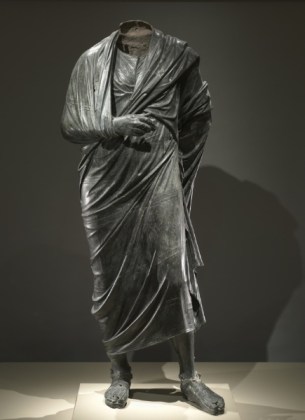
The Emperor as Philosopher, probably Marcus Aurelius (reigned AD 161-180)(CMA 1986.5)

The most prominent piece is likely this bronze Roman statue believed to represent Marcus Aurelius, which Cleveland acquired in 1986. On its website, the museum describes its origin as “Turkey, Bubon(?) (in Lycia.)” It is unclear how the bronze got from Bubon to Cleveland, and whether the object was granted an export permit, as required since the passage of Turkey’s 1906 cultural patrimony law. The Cleveland Museum of Art declined to answer questions about Turkey’s claim.

As David Gill has noted, a series of monumental bronze statues were taken from the sebasteion, or imperial cult room, of Bubon. A similar bronze depicting Lucius Verus is in the collection of Shelby White.

In the coming days, we’ll be posting details on the requested objects at the Getty and Dumbarton Oaks. We already posted the list of contested objects at the Met  here.

Scoop: Turkey asks Getty, Met, Cleveland and Dumbarton Oaks to Return Dozens of Antiquities

In Saturday’s Los Angeles Times, Jason reports on Turkey’s bid to repatriate dozens of allegedly looted antiquities in American museums.

The requests include 10 objects at the J. Paul Getty Museum; 18 at the Metropolitan Museum of Art; 21 objects at the Cleveland Musuem of Art; and the Sion Treasure at Harvard’s Dumbarton Oaks.

Below we’ve provided the complete article. In the coming days, we’ll be providing additional details on the objects sought at each of the museums.

Turkey asks U.S. museums for return of antiquities

The Getty and the New York Met are among the U.S. institutions the Turkish government has contacted over artifacts it believes were smuggled out of the country.

By Jason Felch, Los Angeles Times

8:48 PM PDT, March 30, 2012The government of Turkey is asking American museums to return dozens of artifacts that were allegedly looted from the country’s archaeological sites, opening a new front in the search for antiquities smuggled out of their original countries through an illicit trade.

The J. Paul Getty Museum, the Metropolitan Museum of Art in New York City, the Cleveland Museum of Art and Harvard University’s Dumbarton Oaks Research Library and Collection are among the institutions that the Turkish government has contacted, officials say.

Turkey believes the antiquities were illegally excavated and smuggled out of the country after the passage of a 1906 law that gave the state ownership of antiquities in the ground.

Inspired by the success of its Mediterranean neighbors Italy and Greece, Turkey is taking a more aggressive stance toward its claims, many of which were first made decades ago.

“Turkey is not trying to start a fight,” said Murat Suslu, Turkey’s director general for cultural heritage and museums. “We are trying to develop … cooperation and we hope these museums will also understand our point of view.”

Turkey is presenting the museums with supporting evidence and has threatened to halt all loans of art to those institutions until they respond to the claims. Loans have already been denied to the Met, a Turkish official said.

American museums’ antiquities collections have been the subject of intense scrutiny in recent years as evidence emerged of their ties to an illicit trade in artifacts found in archaeological sites around the world.

Confronted with that evidence, the Getty, the Met, the Cleveland, the Boston Museum of Fine Arts and the Princeton University Art Museum returned more than 100 looted objects to Italy and Greece, changed their acquisition policies and formed collaboration agreements that allow for loans to replace acquisitions of suspect material.

But new evidence continues to emerge, underscoring that the scope of the problem is far wider. In January, Italy announced that it had recovered an additional 200 objects and fragments from the Met and Princeton after they were tied to an ongoing criminal investigation of Italian antiquities dealer Edoardo Almagia and Princeton antiquities curator Michael Padgett.

None of the museums facing requests from Turkey would release a list of the contested objects in their collections, but The Times obtained a partial list from Turkish officials of what the country is asking for. Judging from publicly available records, most of the objects were acquired by the museums since the 1960s and have little or no documented ownership history before that, suggesting they could have come from illicit excavations.

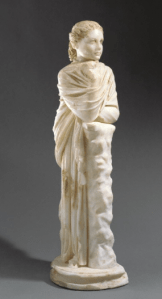
Statue of a Muse. From Cremna, Turkey, circa 200 AD. (JPGM 94.AA.22)

The 10 Getty objects sought by Turkey were acquired from dealers, auction houses or collectors for more than $1 million between 1968 and 1994 and include four marble muses now on display in the Getty Villa’s Basilica gallery. According to ownership histories provided by the Getty in accordance with its reformed antiquities policy, several originated with Elie Borowski or Nicolas Koutoulakis, two antiquities dealers known to have ties to the illicit trade.

The Getty’s talks with Turkey began in the 1990s, government officials said, and gained steam under the directorship of interim museum director David Bomford, who left the Getty in February.

“We expect those discussions to continue and while they do, we will not be getting into specifics,” said Getty spokesman Ron Hartwig.

The 18 contested objects at the Met are all from the private collection of Norbert Schimmel, a longtime Met trustee who died in 1990. The museum acquired the Schimmel collection in 1989, and several of the contested objects are now highlights of the museum’s Ancient Near East Galleries.

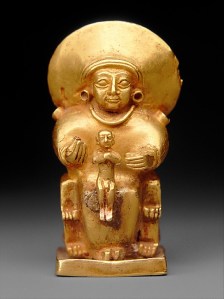
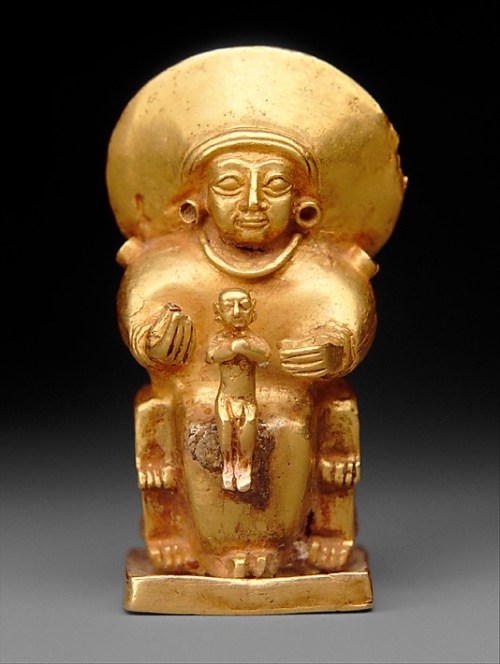
A Hittite gold pendant of a goddess with a child, circa 1400 BCE from Central Anatolia. (MMA 1989.281.12)

Harold Holzer, a spokesman for the Met, initially denied the museum had received a request for specific objects. He later acknowledged in a statement that Turkey had requested information about the 18 objects in September, adding that the museum is “in the process of providing” that information. Turkish officials say the Met’s only response has been to write a letter to the Turkish Prime Minister Recep Tayyip Erdogan.

At Dumbarton Oaks inWashington, D.C., ancient silver plates and other decorative objects known as the Sion Treasure are among the items Turkey is seeking to recover. The treasure was reportedly found in the early 1960s in an ancient burial mound in Kumluca, Turkey. It was acquired by the museum in 1966 from a private collector who bought them that same year from George Zakos, an antiquities dealer with documented ties to the illicit trade.

Paten with Cross, from the Sion Treasure. (BZ.1963.36.3)

Turkey has been asking for the return of the treasure since 1968, hoping to reunite the objects with the rest of the treasure, which is in a museum in Antalya, on Turkey’s southwest coast.

Twenty-one objects are being sought from the Cleveland Museum, which Turkish officials say has not responded to their inquiries. A museum spokeswoman declined to comment or release a list of contested objects.

Turkey has long sought the return of objects taken illegally from its borders, with occasional success.

Most famously, the country’s government fought a six-year legal battle with the Met for the return of the Lydian Hoard, a collection of goods looted from a burial mound in western Turkey. (It, too, had passed through the hands of Zakos.) The Met agreed to return the objects in 1993 after evidence emerged that museum officials had been aware of the material’s illicit origins and sought to hide it. To the chagrin of Turkish authorities, soon after its return a key piece of the treasure was stolen from the local museum to which it was returned.

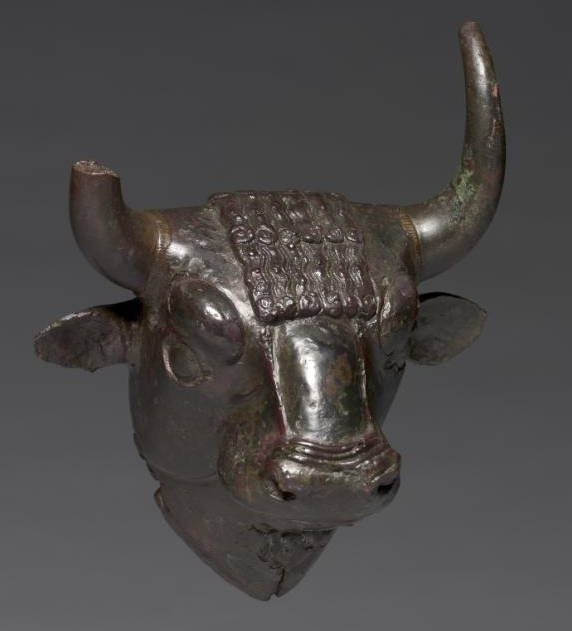
CMA 1942.204

A similar battle played out between Turkey and the Boston MFA over the Roman statue Weary Herakles. Turkey requested the statue’s return in the 1990s after finding its bottom half in an excavation in Perge. The MFA had purchased the top half in 1981 jointly with New York collectors Leon Levy and Shelby White. The MFA’s piece has been known to fit the bottom half in Turkey since 1992, but the museum only returned it last September as part of a broader cultural cooperation agreement.

In hopes of avoiding such protracted disputes, Turkey adopted a more aggressive stance in 2010, barring loans to institutions harboring contested objects. The Art Newspaper reported earlier this month that two British museums have recently been denied loans.

“It’s part of a broader shift in the government saying, ‘culture matters to us,'” said Christina Luke, a lecturer in archaeology at Boston University. While working in Turkey over the last decade, Luke has seen Turkey make major investments in regional cultural sites, efforts to educate children about the value of their heritage and attempts to clarify and strengthen the country’s cultural policies.

“Turkey is offended because of having insincere responses to her claims,” said Turkish official Suslu. “Turkey has been fighting against illicit trafficking of cultural objects since the Late Ottoman Period. Many ways were tried during the past years but they were not sufficient.”

jason.felch@latimes.com

The Dark Side of Aphrodite: The Getty’s New Aphrodite Show Features Collection of Famous Pederast

Starting today, the Getty Villa is hosting a remarkable exhibit of ancient art, the first ever dedicated to the goddess of love and carnal desire.

“Aphrodite and the Gods of Love” features 150 antiquities centered around Aphrodite, the Greek goddess of love. The show was organized by the Boston Museum of Fine Art, where it has been on display since October. It features nine stunning loans from Italy — a byproduct of collaboration deals struck in the wake of revelations that the Boston MFA, the Getty and other American museums had been purchasing looted antiquities.

But there is a darker side to this exhibit, one that until now has avoided mention.

Roughly half of the objects in the show come from the collection of Edward Perry Warren (1860-1928,) a Boston collector who the show’s organizer, MFA antiquities curator Christine Kondoleon, describes as “philanthropic gentleman scholar.”

Omitted from that account is the fact that Warren was also a renowned advocate of pederasty — sexual relationships between men and boys. Indeed, this was the source of his passion for collecting erotic ancient art — Warren hoped to revive the ancient tradition of sex between men and boys.

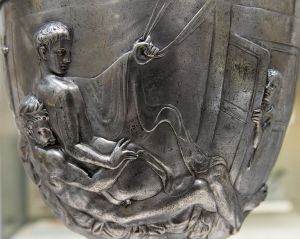
More than 4,000 pieces of art from his collection are now in the Boston MFA’s collection. They include sexually explicit objects that are rarely on display, including the sculpture of Priapos, the child of Aphrodite and Dionysos, displaying his genitals. Warren is also the source of the Warren Cup at the British Museum, which depicts scenes of may-boy love. (Some suggest the cup is a modern forgery, created to fulfill Warren’s desire for homoerotic antiquities.)

Warren’s defense of man-boy love culminated in his three-volume opus, “A Defense of Uranian Love.” It is considered “the premier paederastic apologia in the language,” and was republished in 2009. Here’s how it’s described on Amazon.com:

Edward Perry Warren’s three-volume A Defence of Uranian Love, written under his pseudonym Arthur Lyon Raile and privately printed in 1928-1930…is the clearest elucidation of the motives that lay behind his acquisition of Graeco-Roman antiquities for the Museum of Fine Arts in Boston and other prominent collections. Warren’s acquisition practices converted those antiquities into a “paederastic evangel,” as he himself declares, and his Defence is intimately woven into this lifelong, evangelistic mission.

“My verses and my prose,” writes Warren, “advocate a morality, but it is not the current morality in certain matters.” This is understatement at its most playful, for Warren’s Defence is a detailed map to a Utopia where “Grecian grandeur” is restored, and the “Christian sublime,” all but banished; where masculine virtues topple the feminine that have mistakenly led to democracy, sexual purity, and feminism; where aristocracy, nobleness, and male supremacy establish a civilisation in which Nietzsche would have found himself at home; and where paederasty, in the form familiar to the ancient Spartans, could and needs must flourish. For, according to Warren, “Love” (in this case, Boy-love) “can revive the old Hellenic day.” It is this revival – this veritable “Renaissance of Paederasty”-that Warren’s elaborate apologia aims to begin, by reminding Western culture of what it has lost or only forgotten: a sacral Boy-love and its accompanying traditions.

Mark Miner, who translated the Greek and Latin passages in the re-released volume and brought it to our attention, explains: “Although the MFA is very grateful for Warren’s generosity, his sexuality remains unmentionable, even though his magnum opus, A Defense of Uranian Love, has now (2009) been reprinted.  Warren, to put  it simply, was quite open about being a boy-lover, and his motivations for collecting Classical art and leaving it to Boston were paederastic. Paederastic on the highest cultural level, to be sure, but undeniably paederastic.”

“Warren had a specific plan for fostering the development of classical (hard, masculine, pagan) values on American soil by deploying as much art and literature as he could lay his hands on,” Miner told us. “That plan has lain dormant for more than 100 years– ‘an acorn in the the forest’ — but is beginning to bear fruit now. I am VERY curious to see if the publicity now being generated for the MFA & Warren results in any greater understanding of his ‘paederastic evangel,’ or if a Boston silence will continue to prevail, even when Warren’s favorite objects are exposed to the West Coast’s sea-breezes.”

Federal Investigators Behind Criminal Case Against Coin Dealer Arnold Peter Weiss

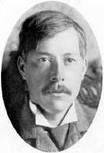
Dr. Arnold Peter Weiss

[See below for updates.]

Dr. Arnold Peter Weiss, the Rhode Island doctor arrested in New York City on Jan. 3 for allegedly trying to sell a looted ancient coin, had his first court appearance in a Manhattan criminal court on Wednesday. The case was adjourned until July 3rd, and no additional documents have been filed in the case, according to the District Attorney’s office.

We first reported on the case in January here, and have posted the criminal complaint in the case here. You can find our reports on Weiss’ ties to RISD and Harvard here and here; and on a link between his Swiss coin dealership Nomos AG and the Getty Museum here.

There have been few other public developments in the case since January. But we have confirmed that the investigation was initiated by federal agents with Immigration and Customs Enforcement, an agency under the Department of Homeland Security.

“Agents with HCI’s El Dorado Task Force Cultural Property group did arrest Dr. Weiss on Jan. 3rd,” according to agency spokesman Lou Martinez, referring to ICE’s Homeland Security Investigations directorate. “This was an HSI lead investigation.”

The El Dorado Task Force is a multi-agency group formed in 1992 described as “an aggressive, multi-agency approach to target financial crimes within the New York and New Jersey metropolitan area.” It includes more than 250 law enforcement agents from 55 local, state and federal agencies in the region.

Among the members of the El Dorado Task Force are a half-dozen agents focused on the illicit trade in cultural property, Martinez said. Here’s how ICE describes their mission:

ICE takes pride in bringing to justice those who would trade in such items for personal profit and in returning to other nations these priceless items.

The theft and trafficking of cultural items is a practice that is older than history. What is new about it is how easy it is for cultural pirates to acquire valuable antiquities, artworks and artifacts, fossils, coins or textiles and move them around the globe, swiftly, easily and inexpensively without regard to laws, borders, nationalities or their value to a nation’s heritage.

Fortunately, ICE agents are better prepared than ever to combat these crimes. Our specially trained investigators and attachés in more than 40 countries not only partner with governments, agencies and experts who share our mission to protect these items, but they train the investigators of other nations and agencies on how to find, authenticate and enforce the law to recover these items when they emerge in the marketplace.

Customs laws allow ICE to seize national treasures, especially if they have been reported lost or stolen. ICE works with experts to authenticate the items, determine their true ownership and return them to their countries of origin.

Recent ICE cases involving the illicit antiquities trade include:

  • The 2009 return of 334 Pre-Colombian artifacts to Peru. The objects were found during a 2007 raid of the Laredo, TX home of Jorge Ernesto Lanas-Ugaz, who received one-year probation and a $2,000 fine.
  • The 2008 return of 79 objects to Egypt. Edward George Johnson, an active duty Chief Warrant officer in the U.S. Army who had been assigned to the U.S. Embassy in Cairo in 2002, had used his diplomatic status to illegally ship the Ma’adi artifacts he had acquired in Egypt to the U.S., in violation of Egypt’s export laws, diplomatic protocol as outlined in the Vienna Convention, and U.S. law for smuggling the artifacts into the country. He then sold them to a dealer claiming that they were family property dating back to the early 20th century. An expert on the Ma’adi excavations later recognized the items were from an excavation. In July 2008, Johnson pleaded guilty to a misdemeanor charge of possession and selling of stolen antiquities. He was sentenced in September 2008 to 18 months probation and was ordered to make restitution to the antiquities dealer to whom he sold the artifacts.
  • The 2008 return of  1,044 cultural antiquities to Iraq that were seized in four separate investigations dating to 2001. The items, which included terra cotta cones inscribed in Cuneiform text, a praying goddess figurine that was once imbedded in a Sumerian temple and coins bearing the likenesses of ancient emperors, are an illustration of the long and varied history of the country now known as Iraq. Remnants of ancient Cuneiform tablets, which were seized by the Customs Service in 2001, were recovered from beneath the ruins of the World Trade Center in 2001 and will be restored in Iraq. The objects were turned over in a ceremony at the Embassy of Iraq, where Iraqi Ambassador Samir Shakir al-Sumaydi accepted on behalf of his government.
  • The 2008 return to the Colombian of 60 artifacts that were seized in a joint 2005 investigation with the Broward County, Fla., Sheriff’s Office. The artifacts, which included ancient pottery, gold pieces and emeralds, some as old as 500 B.C., were stolen from Colombia and smuggled into the United States. ICE agents arrested and charged a 66-year-old Italian national, Ugo Bagnato, with sale and receipt of stolen goods. He was convicted and served 17 months in federal prison, after which he was deported.

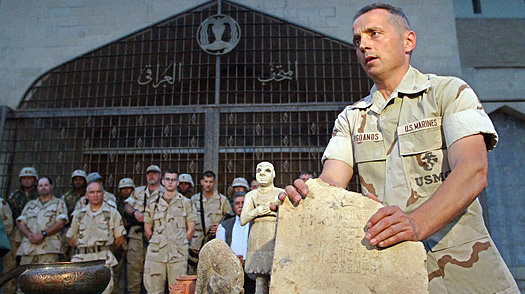
The New York City District Attorney’s office also has a significant background in these investigations. The Assistant District Attorney assigned to the Weiss case is Matthew Bogdanos, the Marine Corp. Colonel who led the search for antiquities looted from the Baghdad Museum, as chronicled in his 2005 book Thieves of Baghdad, co-authored with William Patrick.

UPDATES:

Rick St. Hilaire has a good analysis of the important legal precedent this case could establish: “Federal prosecutions involving international theft or trafficking of cultural objects are rare. State prosecutions [like Weiss] are novel. That is why the current case against Arnold-Peter Weiss, involving New York state law, is worth watching. with its novel use of state law.”

NY Post headline: “Doc nab in coin caper.” Weiss was released after posting  $200,000 bail.

EXCLUSIVE: Turkey Seeks The Return of 18 Objects From The Metropolitan Museum of Art

[See below for updates.]

The Turkish government is seeking the return of 18 objects from the Metropolitan Museum of Art.

The requested objects include several highlights of the Met’s collection that are currently on display in the museum’s Ancient Near East Galleries. Turkey claims all of them were illegally excavated and smuggled out of the country after the passage of a 1906 law that gave the state ownership of its cultural property.

All the contested objects are from the Norbert Schimmel Collection, which the museum has described as “the finest private assemblage of its kind in America” and “one of the most important gifts of ancient and Classical art ever presented to this museum.” Between the 1950s and his death in 1990, Schimmel was a member of the Met’s board of trustees and acquisitions committee. In 1989, he donated 102 objects from his collection to the Met. The museum’s 1992 catalog of the collection quotes Schimmel saying, “Collectors are born, note made, possessed of an enthusiasm that borders on madness.”

We’ve posted a list of 16 of the 18 objects Turkey is requesting here. Here are a few highlights:

A Hittite gold pendant of a goddess with a child, circa 1400 BCE from Central Anatolia.  (MMA 1989.281.12)

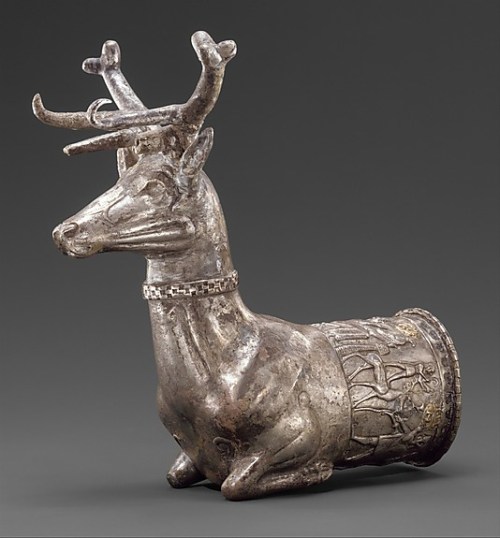
A silver Hittite rhyton, or drinking cup, in the form of a stag, circa 1400 BCE from Central Anatolia. (MMA 1989.281.10)

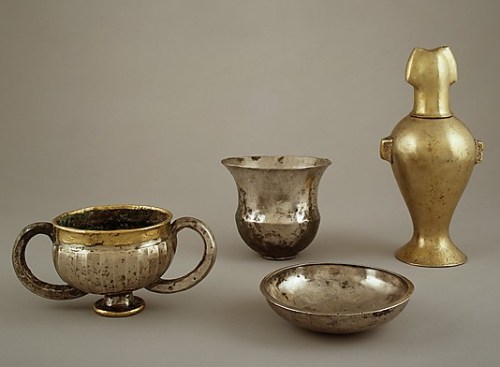
Vases of electrum, gilt silver and silver “said to be found together” in Northwest Anatolia by 1974. Made circa 2300 BCE.
(MMA 1989.281.45a,b-.48)

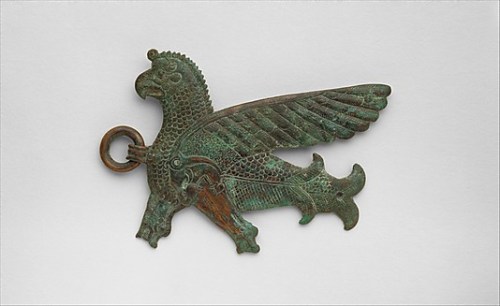
Urartian belt ornament in the form of a bird demon, circa 8th century BCE. (MMA 1989.281.19)

The requests from Turkey were first reported by Martin Bailey in the Art Newspaper earlier this month. The report said Turkey was requesting the return of two objects from British museums — the British Museum and the Victoria and Albert Museum — and 11 unidentified objects at the Met. Turkey has refused to loan objects to those institutions until questions about the contested objects were addressed.

But the scope of Turkey’s demands reach far beyond those three museums, we have learned. Turkey has requested the return of objects from several other American museums. We’ll be posting details on those objects soon.

The Met has refused to publicly identify the objects Turkey has requested, and in response to our inquiries has changed its story about the requests several times. On March 2, Harold Holzer, the museum’s senior vice president for external affairs told us,  “We have had a request for no specific objects at all.” Soon after, he corrected that statement and said Turkey had requested information about 11 objects at the museum, as reported by the Art Newspaper. A few days later, Holzer acknowledged the actual number was 18 objects, and offered the following statement:

This past fall, The Metropolitan Museum of Art was contacted by officials from the Turkish Ministry of Culture with regard to 18 works of art in our collection. The Ministry requested provenance information, which we are in the process of providing. Because this matter is currently under discussion with the Turkish government, the Museum will have no further comment at this time—except to acknowledge with appreciation that Turkey has long been a valued lender to significant exhibitions at the Metropolitan, and we look forward to the continuation of that relationship.

The museum did not explain why it has taken several months to provide Turkey with provenance information that is readily available on the museum’s website. Most of the objects have no documented ownership history other than being in the Schimmel Collection by the mid 1960s or 1970s.

Ancient Art: The Norbert Schimmel Collection (1974)

The Schimmel Collection was published in a 1974 volume entitled “Ancient Art:The Norbert Schimmel Collection.” The editor of the volume was Oscar White Muscarella, a former Met curator who has been an outspoken critic of the role museums have played in the illicit antiquities trade. We’ve asked Muscarella for his thoughts on the Turkish claim and will post his response when we have it.

In a 1990 obituary for Schimmel in the New York Times, another outspoken reformer — Maxwell Anderson, current director of the Dallas Museum of Art — was quoted saying, “As a collector he was an inspiration to the antiquities field, in the sense that he quietly and devotedly promoted the appreciation of ancient art through sage collecting and through the generosity he manifested to several collections throughout the country.”

HOT DOC: TURKEY REQUESTS FROM THE MET

UPDATES:

In early June, Met director Thomas Campbell made some public comments about claims like those coming from Cambodia and Turkey: “We welcome any additional information about the provenance of these or any other contested objects and I think it’s inevitable that as a result of the mandate I gave our staff a year and a half ago to get all our collections online, we are going to see a number of cases like this coming forward. In the spirit of our new collecting guidelines which we adopted just as I took over from Philippe [de Montebello] in late 2008, we are fully committed to dealing with such claims with transparency.” Perhaps Harold Holzer didn’t get the memo?

Lee Rosenbaum has picked up the story on her blog CultureGrrl, noting that Schimmel himself had regrets about his collecting practices. Citing her 1979 interview with Schimmel, Lee writes: “Norbert Schimmel says that he now generally does not buy objects that were once attached to buildings. Gesturing towards paintings displayed in his Manhattan apartment that had been hacked out of an Egyptian tomb, he said he was now ‘ashamed I bought these.’ He added that he does not like to buy objects that left their countries of origin after the effective dates of laws banning their export, ‘but when I see a nice object, I believe it left before. Sometimes I ask. In Europe, everybody buys and they don’t ask any questions.’ Schimmel noted that even if you ask questions, you are unlikely to get illuminating answers. ‘Dealers never tell you exactly where something was found. They say, ‘Anatolia,’ and then they tell you all their stories.'”

Derek Finchham has posted some interesting analysis of the legal challenges facing the Turkish request on his blog Illicit Cultural Property. “In order to pursue a legal claim here Turkey would have to justify its reasons for not bringing a claim in 1974,” Fincham writes. “What Turkey does have though is a potential ethical claim which the Met may respond to. And if the Met does not, Turkey is imposing a damaging cultural embargo, and pressure will likely mount on the Met to justify their continued possession of these objects.”

David Gill at Looting Matters reminds us of that several objects linked to Schimmel that have already been returned to source countries: an eye of Amenhotep III; an Apulian dinos that the Met has returned to Italy; and the Met’s Morgantina silvers, which now reside in a museum in Aidone, Sicily alongside the Getty’s statue of a Cult Goddess (once thought to represent Aphrodite.)

Introducing WikiLoot: Your Chance to Fight the Illicit Antiquities Trade

[UPDATE: Our WikiLoot proposal has sparked a great conversation about the project. Thanks for all the comments submitted below and on the application, which you can find here. Collaboration is at the heart of this project, so we’ve created an open group in Facebook where people can continue to exchange ideas about the potential (and pitfalls) of WikiLoot. Join the conversation here.]

Today we’re pleased to announce — and to seek your help with — an exciting new project we’ve been tinkering with in private for some time. We’re calling it WikiLoot.

The idea behind WikiLoot is simple:

1. Create an open source web platform, or wiki, for the publication and analysis of a unique archive of primary source records and photographs documenting the illicit trade in looted antiquities.

2. Use social media and other tools to engage a broad network of contributors — experts, journalists, researchers, dilettantes and curious citizens — to collaborate in the analysis of that material.

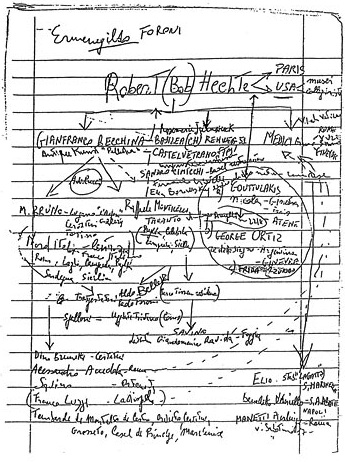
This chart showing the key players in the illicit antiquities trade was seized by Italian police in the 1990s.

The inspiration for WikiLoot is the vast amount of documentation seized by European investigators over the past two decades during investigations of the illicit trade in Classical antiquities smuggled (primarily) out of Greece and Italy. The business records, journals, correspondence and photographs seized from looters and middlemen during those investigations comprise a unique record of the black market.

Much of that documentation remains tangled in legal cases that are likely to end inconclusively, like that of former Getty antiquities curator Marion True and dealer Robert Hecht. Despite remarkable investigative work by authorities in Italy and Greece, only the trial of Italian dealer Giacomo Medici reached a verdict.

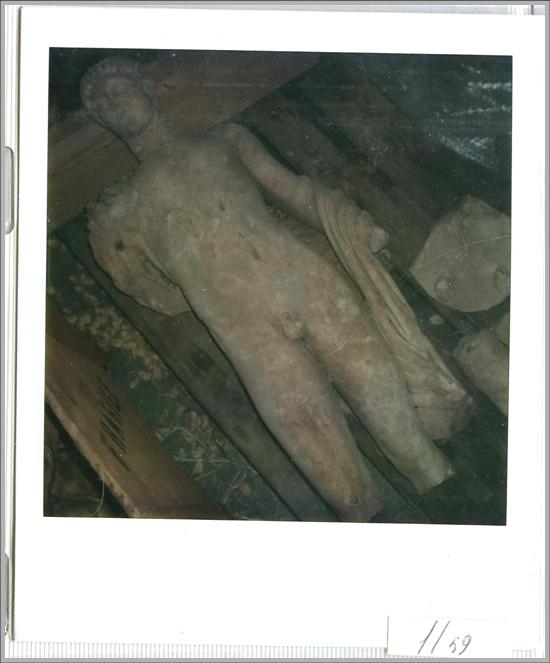
This Polaroid seized from the warehouse of dealer Giacomo Medici shows the Getty Museum's Statue of Apollo shortly after it was looted from a tomb in Southern Italy.

WikiLoot will make these records and photographs publicly available on the web and will enlist collaborators around the world to tag and analyze them. As with Wikipedia, participants will be given credit for their contributions. Ultimately, we hope to create the world’s most authoritative dataset of a black market whose size and reach is still poorly understood. (Estimates of the illicit antiquities trade range from $200 million a year to $10 billion dollars a year.)

The project is still embryonic — we’re consulting with open-source techies on the best way to structure the wiki; with lawyers about the legal issues involved; and with social media experts on on how to engage the broader public in the effort. We’re also considering concerns about the effect this release of information will have on existing collections and the still-thriving market for antiquities with unclear ownership histories.

Today we’re taking an important step toward launching WikiLoot with our application for a Knight Foundation News Challenge Grant. And we need your help.

Challenge Grants reward innovative uses of new media to solve problems and inform the public. The theme of this round of grants is “networks.” Here’s how the folks at Knight explain what they’re looking for: “The Internet, and the mini-computers in our pockets, enable us to connect with one another, friends and strangers, in new ways. Witness the roles of networks in the formation, coverage and discussion of recent events such as the rise of the Tea Party, flash mobs, the Arab Spring, last summer’s UK riots and the Occupy movement. We’re looking for ideas that build on the rise of these existing network events and tools – that deliver news and information and extend our understanding of the phenomenon.”

For WikiLoot, our network is YOU — the growing number of interconnected people around the world concerned about the illicit antiquities trade and looking to do something about it. We’re relying on your input to shape the project and, once launched, contribute to it with your knowledge.

To start, we need your support for our Challenge Grant proposal. One of the key things considered by judges is public engagement with the proposed idea. The best way to show this is for you to “like” our proposal or add a comment on how you think it could help — or be improved. (You may need to sign in with a Tumblr or other social media account.)

Show your support by liking or commenting on our WikiLoot proposal, which is posted on Knight’s Tumblr page here

We’re also eager to tap your expertise — or curiosity — during this development stage of WikiLoot. What features would help engage a broad audience in the analysis of this material? What concerns do you have about its release? Who else should we be reaching out to or partnering with? What can you contribute?

To that end, we’ll be making WikiLoot a new tab at the top of ChasingAprhodite.com. That’s where you can submit public comments, suggestions or rants. We’ll update it with new information as things develop. If you’d like to contact us privately, do so via email: chasingaphrodite@gmail.com

Thanks for your interest and support. We look forward to hearing your thoughts on WikiLoot!

Almagia Objects Traced to Boston MFA, San Antonio Museum, Indiana University.

We’ve heard back from more museums about objects they acquired from Edoardo Almagia, the Italian dealer at the center of an investigation into the illicit antiquities trade.

As we’ve reported previously, the Met and Princeton University museums have recently returned more than 200 Almagia objects and fragments to Italy, some of which may be used as evidence in the criminal trial of Almagia and Princeton antiquities curator Michael Padgett. Italian investigators have also traced the dealer’s objects to the Dallas Museum of Art, and we found one at the Getty.

We can now provide details about Almagia objects at three more American museums.

BOSTON MUSEUM OF FINE ART

The Boston Museum of Fine Art has ten objects tied to Almagia, nine of which were impasto vases acquired in 1995 as donations from Jonathan Kagan, a prominent investment manager. Prior to Almagia, the objects were “said to have been purchased in Basel.” An old Swiss collection there, no doubt. A decade before donating the Almagia objects to the Met, Kagan was reportedly behind the sale of the Elmali Treasure, a vast hoard of ancient coins allegedly looted from Turkey.

Boston 1991.534

The tenth Almagia object at the Boston MFA is a lovely Roman bust of an old man made of Carraran marble from northwest Italy. The museum purchased the bust directly from Almagia in 1991. It has no documented ownership history.

Details of all the Almagia objects in Boston can be found in the MFA’s release here.

In a statement, museum spokeswoman Amelia Kantrovitz said, “Since 2000, the provenance of these objects–like virtually all objects in the Museum’s collection–has been available at mfa.org. There have been no recent discussions with Italy or Mr. Almagià about these works. The MFA’s relationship with Italy over the last 5 years has led to important loans, several of which are on view in the current exhibition ‘Aphrodite and the Gods of Love.'”

None of the 13 objects returned by Boston in 2006 came from Almagia, Kantrovitz added, though the bust shown above was among the objects discussed during negotiations.

SAN ANTONIO MUSEUM OF ART
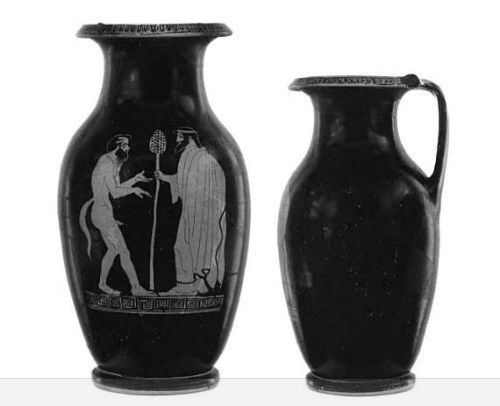
The San Antonio Museum of Art purchased two Greek vases from Almagia in the 1980s. The first (above) is a red-figure Oinoche depicting Dionysos and a satyr attributed to the Florence Painter.

The second vase (right) is a red-figure Attic plate depicting the head of a man. As for its provenance, the museum could only say it is “said to be from Barbarano Romano,” an Etruscan necropolis in Viterbo, Italy. (You can view a panoramic image of the tombs here.)

The museum also has 54 vase fragments — also said to be from Barbarano Romano — that were purchased from Almagia in 1986 by a local attorney, Gilbert Denman Jr., who donated them to SAMA the same year.

Carlos Picon, curator of antiquities at the Met

None of the antiquities have a documented ownership history. All were acquired under then-curator Carlos Picon, the current antiquities curator at the Metropolitan Museum of Art. As David Gill has noted, Picon also knew Giacomo Medici and has described being touched by the generosity of the convicted antiquities trafficker. It will be interesting to know more about the relationship between Picon and Almagia as the Italian investigation unfolds.

SAMA director Katie Luber said in a statement that the museum reached out to Italian authorities about the Almagia objects on February 17th, two weeks after first being contacted by us. It has not yet heard back.

INDIANA UNIVERSITY ART MUSEUM

The museum Indiana University acquired two objects from Almagia in 1986. Mark Land, a museum spokesman, said in an email, “IU Art Museum has not been contacted by Italian authorities regarding Mr. Almagia nor has the museum been asked to return any objects associated with Mr. Almagia. The museum has had no discussions with Mr. Almagia about the objects in question.”

Land did not have details about the objects’ ownership histories but he did provide images:
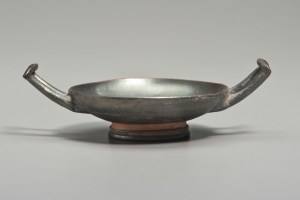
A South Italian stemless kylix, 3rd century BC (UI 86-48-2)
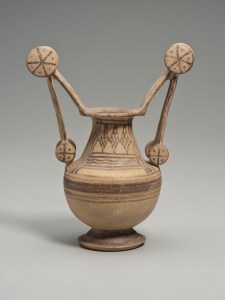
An Apulian trozella (urn), ca. 5th-4th century BC (UI 86-48-1)

PRINCETON UPDATE: STILL STONEWALLING

Meanwhile, Princeton University is refusing to respond to questions about its own ties to Almagia, perhaps because the museum’s antiquities curator Michael Padgett remains the subject of a criminal investigation for his ties to the dealer. Since the University released a vague statement on January 25th, we have sent several follow-up requests for additional information. University spokesman Martin Mbugua has failed to respond to any of them — odd behavior for an educational institution.

Below are the questions I send to Martin on January 27th. Perhaps some of our readers will have better luck than I getting answers. Should you care to try, his email is mmbugua@Princeton.edu

Thank you for the link, Martin.

Unfortunately the release was not very helpful. It did not state the reason for the returns and did not answer my questions about the objects. I shall try again:

Can you please provide images and the ownership history for each of the returned objects?

Also, please provide a copy of the internal investigation that apparently led to the decision.

Can you clarify the release’s statement that Princeton had good title to the objects it returned? If Princeton had title, that would indicate the objects had not been illegally exported from their country of origin. If that is the case, why would the university return them?

Finally, are there additional objects in Princeton’s collection that were donated or purchased from Almagia that have not been returned? If so, please provide a list of them with information about their ownership histories.

You referred me to investigators for an update on the Padgett investigation. I have contacted them. Given that Padgett is an employee of the university, I have a few questions that only the university can answer:

— is the University paying for Dr. Padgett’s defense?

— The Met indicated it returned objects so they could be used as evidence in a possible criminal trial. Were the Princeton returns sent back for the same purpose?

— Has the University investigated the allegations against Dr. Padgett? If so, what conclusion was reached?

I understand that on-going investigations are sensitive matters. My experience is that transparency in these matters is the best way to demonstrate good faith to the public.

James Cuno on Timothy Potts and the Getty’s New “Appetite for Risk”

Getty CEO James Cuno discussed his “appetite for risk,” his decision to hire Timothy Potts as the Getty’s next museum director and his vision for the museum in an interview on Warren Olney’s Which Way LA program on KCRW.

Chasing Aphrodite’s Jason Felch and CultureGrrl Lee Rosenbaum were also guests on the program. The interview came on the same day that Cuno announced a shakeup at the Getty museum that consolidated administrative powers under the Trust  and led to the dismissal of two senior staff members.

Listen to the full program here:

Cuno Shakeup at the Getty: The Memo

UPDATE: As the Getty announced cost cutting measures, new fundraising efforts and the dismissal of two senior museum staff members, we found this tidbit on the Trust’s updated financial disclosure: Timothy Potts will be paid $690,000 a year as Getty Museum director, and will receive a signing bonus of $150,000. As already reported, CEO James Cuno earns $728,000 per year in base salary plus a $20,000 per month housing allowance, plus a one-time bonus of $150,000 for moving expenses and $250,000 in signing bonuses, plus a $500,000 deferred comp payment if he stays until 2016.

Here is the memo Getty Trust CEO James Cuno sent to museum staff regarding forthcoming changes across the institution:

Dear Museum Colleagues,

Among the most important responsibilities for the trustees, including the Trust President, is establishing strategic priorities for the J. Paul Getty Trust and ensuring that the resources available to us are focused on those priorities.  Another important responsibility is to assist the program directors in attracting additional resources, where possible, to achieve our goals.

As I discussed at the all-staff meeting in January, these responsibilities are especially important in the current economic environment when we cannot rely on growth in the value of our endowment investments to fund new ideas, projects and acquisitions.  That is why constant attention to finding better and more effective ways to accomplish our work is critical, and it is one of the reasons the trustees approved a plan for the expansion of development activities here at the Getty.

You know that I have had meetings with the leadership of each of the Getty’s programs to better understand the goals and aspirations of each of the programs as well as their operations since my arrival last August.  Likewise, I have been working directly with various Museum departments to review their operations and policies.

It is very possible that these reviews will result in changes by the end of the fiscal year. Even as this review process goes forward, however, I believe it is appropriate to make some immediate changes that will allow the Museum to focus more on collections and exhibitions and less on administrative matters and site-wide operations.  The savings created by these changes will remain within the Museum to address new Museum priorities that will be established by Tim Potts when he arrives in consultation with the trustees and me.

First, we will move Visitor Services to the Trust reporting to a newly named department, Visitor Services and Security.  This makes sense since these staff and our dedicated volunteers serve the entire Getty, not just the Museum.  We will also combine the Museum’s Events Department with the Trust’s events team, in the Facilities Department.  And we will move the operation of the Museum stores to the Trust, reporting to the Controller.  This relieves the Museum of the administrative oversight of the stores, as well as the obligation to meet the stores’ annual revenue target.

As a result of these changes, combined with the earlier relocation of Publications to the Foundation, the Museum’s administrative responsibilities have been reduced substantially.  There will no longer be a need for an Associate Director of Administration at the Museum, and regretfully, I must report that Tom Rhoads, who has held this post since 2006, will be leaving the Museum.  Tom’s assistant will be placed in an open position at the GRI.  The job of Museum Manager/Villa will also be eliminated and Guy Wheatley will be leaving the Museum.

I am very pleased that Tim Potts will join the Museum as its Director September 1.  By completing the review of Museum operations before then, we will be able to welcome him to a Museum that is focused directly on its core mission, with its financial and staff resources deployed in a more efficient and effective way.  I believe it is important for Tim to be able to focus on our collections, exhibitions and programming from day one, and not be distracted by administrative and financial functions that can be more efficiently handled by the Trust.

– Jim

LA Times: “Antiquities issue rears head with Getty leaders Potts, Cuno in place”

Here is Jason’s article from Saturday’s LA Times on Timothy Potts’ views on the antiquities issues:

Over the last five years, the J. Paul Getty Museum has earned a reputation as a leading reformer on a topic that has embroiled American museums in scandal for the past decade: the acquisition of recently looted antiquities.

After evidence of the museum’s longtime participation in the illicit trade was uncovered by Italian and Greek investigators, the Getty agreed to return 49 of its most prized pieces of ancient art, cultivated collaborative relationships with those countries and adopted a strict acquisition policy, setting a standard that has been adopted by museums across the country.

But come September, when Timothy Potts starts as director of the Getty Museum with Getty Trust CEO James Cuno as his boss, the institution will be led by two men who opposed the adoption of some of those reforms.

Cuno has denounced repatriation claims of looted antiquities as “nationalistic” and argued against placing limits on museum purchases of objects with an uncertain origin. Potts, whose appointment Cuno announced this week, has echoed some of those views. He played a central role in establishing lenient acquisition standards for American museums — which were eventually abandoned — as a member of the Assn. of Art Museum Directors, which sets ethical guidelines for art museums.

A highly respected museum director and Oxford-trained archaeologist, Potts was well positioned to wrestle with the looting issue. From 1983 to 1989, he was co-director of the University of Sydney’s excavations in Pella, Jordan. Later at Oxford, he conducted research in Iraq, and was among the most outspoken museum directors to decry the looting there in 2003.

Participants in the museum directors’ group deliberating new ethical standards in 2004 recall Potts as intelligent, persuasive and open to hearing others’ arguments. But the positions he advocated often put him at odds with advocates of reform and with fellow archaeologists, who criticized the willingness of museums to purchase objects whose murky ownership histories suggested they were likely the result of looting.

Potts also had brushes with the issue as director of the Kimbell Art Museum in Fort Worth, where he was director from 1998 to 2007.

In late 2000, Potts approved the acquisition of a rare Sumerian statuette for $2.7 million. The 15-inch alabaster figure was an ancient masterpiece from the cradle of civilization, the region Potts had specialized in while studying at Oxford. It was to be an important contribution to the Kimbell’s small but highly regarded collection.

But shortly after the statue arrived at the museum, court records show that Potts took the unusual step of returning it to the dealer and asking for a full refund.

Publicly, Potts said that he wanted to free up money for other acquisitions. But he later testified that he had learned the dealer — Hicham Aboutaam, owner of the New York City antiquities gallery Phoenix Ancient Art — was under investigation by the IRS, and decided against buying from him.

Soon, though, Potts changed his mind about doing business with Aboutaam. After receiving repayment for the Sumerian statuette in November 2001, Potts moved to acquire a $4-million Roman torso he had admired on an earlier visit to Aboutaam’s gallery on East 66th Street in Manhattan.

Five days after the Kimbell board approved the purchase, the museum received a federal grand jury subpoena for museum records related to Aboutaam.

Aboutaam had been targeted in a sweeping investigation of the illicit antiquities trade. Several months earlier, Italian investigators had raided the dealer’s Swiss warehouse and seized dozens of antiquities. (All were later returned.)

The Kimbell abruptly abandoned the acquisition of the torso, sparking two breach of contract lawsuits by Aboutaam.

When asked about the two abandoned acquisitions this week by The Times, Potts and the Kimbell declined to comment. But in 2002, Potts told Art & Auction magazine that he had decided to pursue the Roman torso after learning the IRS investigation of Aboutaam was “benign.”

The lawsuits were ultimately dismissed. Aboutaam was arrested in 2003 and charged by U.S. authorities with smuggling a looted antiquity from Iran and making a false customs declaration. He pleaded guilty to a misdemeanor and paid a $5,000 fine.

While the Kimbell controversy was still unfolding, Potts played a prominent role in formulating a policy on how American museums should handle questions about ancient art with unclear ownership histories.

As a member of a task force of museums directors between 2002 and 2004, Potts allied himself with Philippe de Montebello, then director of the Metropolitan Museum of Art, who opposed putting limits on collectors and museums. Potts and De Montebello eventually championed a 2004 policy that allowed museums to collect ancient art as long as they could demonstrate it had been out of its country of origin for a decade.

The position struck some on the task force as effectively sanctioning the acquisition of looted antiquities. And it proved out of step with the times when, a year later, Getty antiquities curator Marion True was indicted by Italy for trafficking in looted antiquities, some of which had been acquired under a Getty policy that was stricter than the one Potts and De Montebello supported.

Soon, the antiquities controversy grew into a full-fledged scandal, with Italy and Greece demanding the return of some of the most prized objects in American museum collections. American museums have since returned more than 200 looted objects to Italy and Greece, valued at up to $1 billion.

Potts first met Cuno while chairing a 2006 AAMD task force on loans of archaeological material. Cuno had recently taken the reins of the Art Institute of Chicago and, like De Montebello, was an outspoken critic of attempts to limit the collecting of antiquities. Cuno and Potts became like-minded allies in the heat of a growing controversy.

The policy resulting from the 2006 task force allowed museums to accept loans of objects even if their ownership histories were clouded “because of their rarity, historical importance and aesthetic merit.” Potts told the New York Times that the focus on the role of museums and collectors in fostering the destruction of archaeological sites was “misplaced.”

By 2008, the policies Potts had advocated were replaced with a stricter one that required objects to have an ownership history dating back to 1970. It emulated the position of the Getty Museum, which had been hardest hit by the antiquities controversy.

Asked how he felt about operating under a policy he had opposed, Potts said in an email Thursday that he “completely respects the Getty’s antiquity policy,” which he called “increasingly the national standard.”

“I have persistently emphasized the need to do more to protect sites and contexts on the ground before the looting takes place,” he said, adding, “Perhaps the nearest thing to a certainty is that whatever policy we have in place today will be seen to have been flawed in the future.”

Potts and Cuno have signaled that their priority will be to build the Getty’s collection in new directions and shift attention back to the Getty Villa, where the museum’s antiquities collection is displayed.

Might the Getty expand its antiquities collection into ancient Near Eastern art, the area of Potts’ specialty? Cuno said in an interview Thursday that he “couldn’t rule it out.”

That could put the Getty back in business with Hicham Aboutaam, who, despite his past legal worries, continues to be a leading dealer of antiquities.

In an interview this week, Aboutaam praised the selection of Potts, and said he held no grudges from the past lawsuits. “It’s rare to find a museum director with such a sophisticated eye for quality,” he said.

He has similar words of praise for Cuno, who as director of the Art Institute acquired antiquities from Aboutaam as recently as 2009. That same year, Aboutaam voluntarily returned 251 antiquities to Italy, valued at $2.7 million, conceding they were likely the product of illicit excavations.

With Cuno and Potts in charge, the dealer couldn’t help but wonder: “Do you think the Getty will now buy more?”