Tag Archives: Getty Museum

Almagia Objects Traced to Boston MFA, San Antonio Museum, Indiana University.

We’ve heard back from more museums about objects they acquired from Edoardo Almagia, the Italian dealer at the center of an investigation into the illicit antiquities trade.

As we’ve reported previously, the Met and Princeton University museums have recently returned more than 200 Almagia objects and fragments to Italy, some of which may be used as evidence in the criminal trial of Almagia and Princeton antiquities curator Michael Padgett. Italian investigators have also traced the dealer’s objects to the Dallas Museum of Art, and we found one at the Getty.

We can now provide details about Almagia objects at three more American museums.

BOSTON MUSEUM OF FINE ART

The Boston Museum of Fine Art has ten objects tied to Almagia, nine of which were impasto vases acquired in 1995 as donations from Jonathan Kagan, a prominent investment manager. Prior to Almagia, the objects were “said to have been purchased in Basel.” An old Swiss collection there, no doubt. A decade before donating the Almagia objects to the Met, Kagan was reportedly behind the sale of the Elmali Treasure, a vast hoard of ancient coins allegedly looted from Turkey.

Boston 1991.534

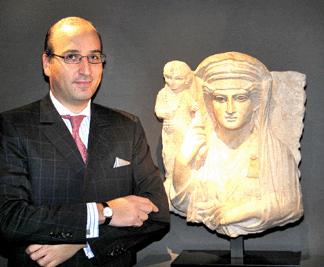
The tenth Almagia object at the Boston MFA is a lovely Roman bust of an old man made of Carraran marble from northwest Italy. The museum purchased the bust directly from Almagia in 1991. It has no documented ownership history.

Details of all the Almagia objects in Boston can be found in the MFA’s release here.

In a statement, museum spokeswoman Amelia Kantrovitz said, “Since 2000, the provenance of these objects–like virtually all objects in the Museum’s collection–has been available at mfa.org. There have been no recent discussions with Italy or Mr. Almagià about these works. The MFA’s relationship with Italy over the last 5 years has led to important loans, several of which are on view in the current exhibition ‘Aphrodite and the Gods of Love.'”

None of the 13 objects returned by Boston in 2006 came from Almagia, Kantrovitz added, though the bust shown above was among the objects discussed during negotiations.

SAN ANTONIO MUSEUM OF ART
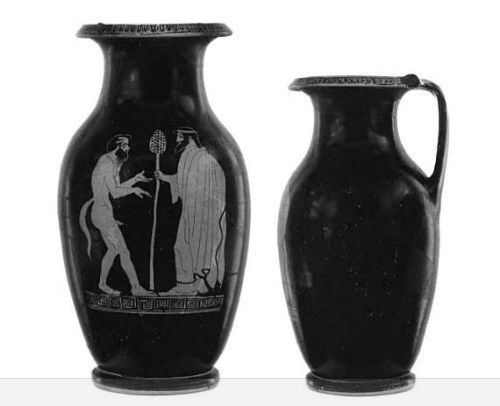
The San Antonio Museum of Art purchased two Greek vases from Almagia in the 1980s. The first (above) is a red-figure Oinoche depicting Dionysos and a satyr attributed to the Florence Painter.

The second vase (right) is a red-figure Attic plate depicting the head of a man. As for its provenance, the museum could only say it is “said to be from Barbarano Romano,” an Etruscan necropolis in Viterbo, Italy. (You can view a panoramic image of the tombs here.)

The museum also has 54 vase fragments — also said to be from Barbarano Romano — that were purchased from Almagia in 1986 by a local attorney, Gilbert Denman Jr., who donated them to SAMA the same year.

Carlos Picon, curator of antiquities at the Met

None of the antiquities have a documented ownership history. All were acquired under then-curator Carlos Picon, the current antiquities curator at the Metropolitan Museum of Art. As David Gill has noted, Picon also knew Giacomo Medici and has described being touched by the generosity of the convicted antiquities trafficker. It will be interesting to know more about the relationship between Picon and Almagia as the Italian investigation unfolds.

SAMA director Katie Luber said in a statement that the museum reached out to Italian authorities about the Almagia objects on February 17th, two weeks after first being contacted by us. It has not yet heard back.

INDIANA UNIVERSITY ART MUSEUM

The museum Indiana University acquired two objects from Almagia in 1986. Mark Land, a museum spokesman, said in an email, “IU Art Museum has not been contacted by Italian authorities regarding Mr. Almagia nor has the museum been asked to return any objects associated with Mr. Almagia. The museum has had no discussions with Mr. Almagia about the objects in question.”

Land did not have details about the objects’ ownership histories but he did provide images:

A South Italian stemless kylix, 3rd century BC (UI 86-48-2)
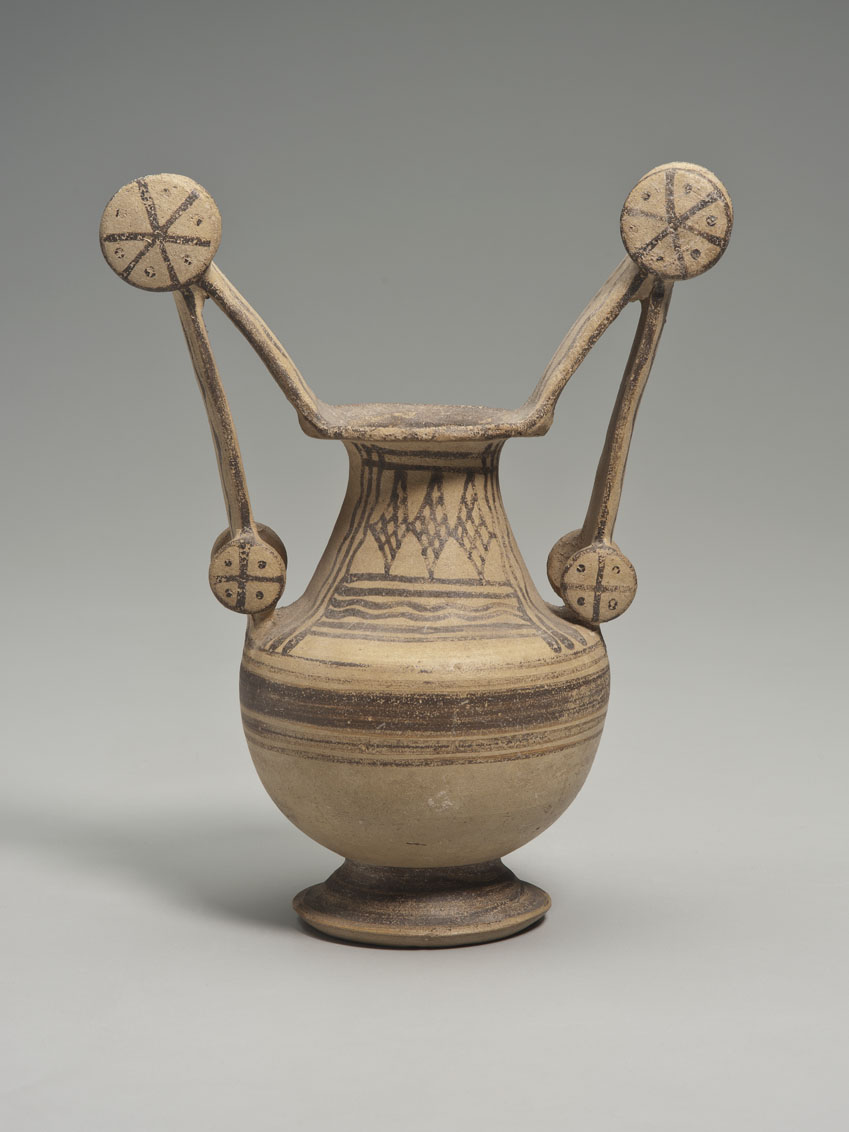
An Apulian trozella (urn), ca. 5th-4th century BC (UI 86-48-1)

PRINCETON UPDATE: STILL STONEWALLING

Meanwhile, Princeton University is refusing to respond to questions about its own ties to Almagia, perhaps because the museum’s antiquities curator Michael Padgett remains the subject of a criminal investigation for his ties to the dealer. Since the University released a vague statement on January 25th, we have sent several follow-up requests for additional information. University spokesman Martin Mbugua has failed to respond to any of them — odd behavior for an educational institution.

Below are the questions I send to Martin on January 27th. Perhaps some of our readers will have better luck than I getting answers. Should you care to try, his email is mmbugua@Princeton.edu

Thank you for the link, Martin.

Unfortunately the release was not very helpful. It did not state the reason for the returns and did not answer my questions about the objects. I shall try again:

Can you please provide images and the ownership history for each of the returned objects?

Also, please provide a copy of the internal investigation that apparently led to the decision.

Can you clarify the release’s statement that Princeton had good title to the objects it returned? If Princeton had title, that would indicate the objects had not been illegally exported from their country of origin. If that is the case, why would the university return them?

Finally, are there additional objects in Princeton’s collection that were donated or purchased from Almagia that have not been returned? If so, please provide a list of them with information about their ownership histories.

You referred me to investigators for an update on the Padgett investigation. I have contacted them. Given that Padgett is an employee of the university, I have a few questions that only the university can answer:

— is the University paying for Dr. Padgett’s defense?

— The Met indicated it returned objects so they could be used as evidence in a possible criminal trial. Were the Princeton returns sent back for the same purpose?

— Has the University investigated the allegations against Dr. Padgett? If so, what conclusion was reached?

I understand that on-going investigations are sensitive matters. My experience is that transparency in these matters is the best way to demonstrate good faith to the public.
James Cuno on Timothy Potts and the Getty’s New “Appetite for Risk”

Getty CEO James Cuno discussed his “appetite for risk,” his decision to hire Timothy Potts as the Getty’s next museum director and his vision for the museum in an interview on Warren Olney’s Which Way LA program on KCRW.

Chasing Aphrodite’s Jason Felch and CultureGrrl Lee Rosenbaum were also guests on the program. The interview came on the same day that Cuno announced a shakeup at the Getty museum that consolidated administrative powers under the Trust  and led to the dismissal of two senior staff members.

Listen to the full program here:

Cuno Shakeup at the Getty: The Memo

UPDATE: As the Getty announced cost cutting measures, new fundraising efforts and the dismissal of two senior museum staff members, we found this tidbit on the Trust’s updated financial disclosure: Timothy Potts will be paid $690,000 a year as Getty Museum director, and will receive a signing bonus of $150,000. As already reported, CEO James Cuno earns $728,000 per year in base salary plus a $20,000 per month housing allowance, plus a one-time bonus of $150,000 for moving expenses and $250,000 in signing bonuses, plus a $500,000 deferred comp payment if he stays until 2016.

Here is the memo Getty Trust CEO James Cuno sent to museum staff regarding forthcoming changes across the institution:

Dear Museum Colleagues,

Among the most important responsibilities for the trustees, including the Trust President, is establishing strategic priorities for the J. Paul Getty Trust and ensuring that the resources available to us are focused on those priorities.  Another important responsibility is to assist the program directors in attracting additional resources, where possible, to achieve our goals.

As I discussed at the all-staff meeting in January, these responsibilities are especially important in the current economic environment when we cannot rely on growth in the value of our endowment investments to fund new ideas, projects and acquisitions.  That is why constant attention to finding better and more effective ways to accomplish our work is critical, and it is one of the reasons the trustees approved a plan for the expansion of development activities here at the Getty.

You know that I have had meetings with the leadership of each of the Getty’s programs to better understand the goals and aspirations of each of the programs as well as their operations since my arrival last August.  Likewise, I have been working directly with various Museum departments to review their operations and policies.

It is very possible that these reviews will result in changes by the end of the fiscal year. Even as this review process goes forward, however, I believe it is appropriate to make some immediate changes that will allow the Museum to focus more on collections and exhibitions and less on administrative matters and site-wide operations.  The savings created by these changes will remain within the Museum to address new Museum priorities that will be established by Tim Potts when he arrives in consultation with the trustees and me.

First, we will move Visitor Services to the Trust reporting to a newly named department, Visitor Services and Security.  This makes sense since these staff and our dedicated volunteers serve the entire Getty, not just the Museum.  We will also combine the Museum’s Events Department with the Trust’s events team, in the Facilities Department.  And we will move the operation of the Museum stores to the Trust, reporting to the Controller.  This relieves the Museum of the administrative oversight of the stores, as well as the obligation to meet the stores’ annual revenue target.

As a result of these changes, combined with the earlier relocation of Publications to the Foundation, the Museum’s administrative responsibilities have been reduced substantially.  There will no longer be a need for an Associate Director of Administration at the Museum, and regretfully, I must report that Tom Rhoads, who has held this post since 2006, will be leaving the Museum.  Tom’s assistant will be placed in an open position at the GRI.  The job of Museum Manager/Villa will also be eliminated and Guy Wheatley will be leaving the Museum.

I am very pleased that Tim Potts will join the Museum as its Director September 1.  By completing the review of Museum operations before then, we will be able to welcome him to a Museum that is focused directly on its core mission, with its financial and staff resources deployed in a more efficient and effective way.  I believe it is important for Tim to be able to focus on our collections, exhibitions and programming from day one, and not be distracted by administrative and financial functions that can be more efficiently handled by the Trust.

– Jim

LA Times: “Antiquities issue rears head with Getty leaders Potts, Cuno in place”

Here is Jason’s article from Saturday’s LA Times on Timothy Potts’ views on the antiquities issues:

Over the last five years, the J. Paul Getty Museum has earned a reputation as a leading reformer on a topic that has embroiled American museums in scandal for the past decade: the acquisition of recently looted antiquities.

After evidence of the museum’s longtime participation in the illicit trade was uncovered by Italian and Greek investigators, the Getty agreed to return 49 of its most prized pieces of ancient art, cultivated collaborative relationships with those countries and adopted a strict acquisition policy, setting a standard that has been adopted by museums across the country.

But come September, when Timothy Potts starts as director of the Getty Museum with Getty Trust CEO James Cuno as his boss, the institution will be led by two men who opposed the adoption of some of those reforms.

Cuno has denounced repatriation claims of looted antiquities as “nationalistic” and argued against placing limits on museum purchases of objects with an uncertain origin. Potts, whose appointment Cuno announced this week, has echoed some of those views. He played a central role in establishing lenient acquisition standards for American museums — which were eventually abandoned — as a member of the Assn. of Art Museum Directors, which sets ethical guidelines for art museums.

A highly respected museum director and Oxford-trained archaeologist, Potts was well positioned to wrestle with the looting issue. From 1983 to 1989, he was co-director of the University of Sydney’s excavations in Pella, Jordan. Later at Oxford, he conducted research in Iraq, and was among the most outspoken museum directors to decry the looting there in 2003.

Participants in the museum directors’ group deliberating new ethical standards in 2004 recall Potts as intelligent, persuasive and open to hearing others’ arguments. But the positions he advocated often put him at odds with advocates of reform and with fellow archaeologists, who criticized the willingness of museums to purchase objects whose murky ownership histories suggested they were likely the result of looting.

Potts also had brushes with the issue as director of the Kimbell Art Museum in Fort Worth, where he was director from 1998 to 2007.

In late 2000, Potts approved the acquisition of a rare Sumerian statuette for $2.7 million. The 15-inch alabaster figure was an ancient masterpiece from the cradle of civilization, the region Potts had specialized in while studying at Oxford. It was to be an important contribution to the Kimbell’s small but highly regarded collection.

But shortly after the statue arrived at the museum, court records show that Potts took the unusual step of returning it to the dealer and asking for a full refund.

Publicly, Potts said that he wanted to free up money for other acquisitions. But he later testified that he had learned the dealer — Hicham Aboutaam, owner of the New York City antiquities gallery Phoenix Ancient Art — was under investigation by the IRS, and decided against buying from him.

Soon, though, Potts changed his mind about doing business with Aboutaam. After receiving repayment for the Sumerian statuette in November 2001, Potts moved to acquire a $4-million Roman torso he had admired on an earlier visit to Aboutaam’s gallery on East 66th Street in Manhattan.

Five days after the Kimbell board approved the purchase, the museum received a federal grand jury subpoena for museum records related to Aboutaam.

Aboutaam had been targeted in a sweeping investigation of the illicit antiquities trade. Several months earlier, Italian investigators had raided the dealer’s Swiss warehouse and seized dozens of antiquities. (All were later returned.)

The Kimbell abruptly abandoned the acquisition of the torso, sparking two breach of contract lawsuits by Aboutaam.

When asked about the two abandoned acquisitions this week by The Times, Potts and the Kimbell declined to comment. But in 2002, Potts told Art & Auction magazine that he had decided to pursue the Roman torso after learning the IRS investigation of Aboutaam was “benign.”

The lawsuits were ultimately dismissed. Aboutaam was arrested in 2003 and charged by U.S. authorities with smuggling a looted antiquity from Iran and making a false customs declaration. He pleaded guilty to a misdemeanor and paid a $5,000 fine.

While the Kimbell controversy was still unfolding, Potts played a prominent role in formulating a policy on how American museums should handle questions about ancient art with unclear ownership histories.

As a member of a task force of museums directors between 2002 and 2004, Potts allied himself with Philippe de Montebello, then director of the Metropolitan Museum of Art, who opposed putting limits on collectors and museums. Potts and De Montebello eventually championed a 2004 policy that allowed museums to collect ancient art as long as they could demonstrate it had been out of its country of origin for a decade.

The position struck some on the task force as effectively sanctioning the acquisition of looted antiquities. And it proved out of step with the times when, a year later, Getty antiquities curator Marion True was indicted by Italy for trafficking in looted antiquities, some of which had been acquired under a Getty policy that was stricter than the one Potts and De Montebello supported.

Soon, the antiquities controversy grew into a full-fledged scandal, with Italy and Greece demanding the return of some of the most prized objects in American museum collections. American museums have since returned more than 200 looted objects to Italy and Greece, valued at up to $1 billion.

Potts first met Cuno while chairing a 2006 AAMD task force on loans of archaeological material. Cuno had recently taken the reins of the Art Institute of Chicago and, like De Montebello, was an outspoken critic of attempts to limit the collecting of antiquities. Cuno and Potts became like-minded allies in the heat of a growing controversy.

The policy resulting from the 2006 task force allowed museums to accept loans of objects even if their ownership histories were clouded “because of their rarity, historical importance and aesthetic merit.” Potts told the New York Times that the focus on the role of museums and collectors in fostering the destruction of archaeological sites was “misplaced.”

By 2008, the policies Potts had advocated were replaced with a stricter one that required objects to have an ownership history dating back to 1970. It emulated the position of the Getty Museum, which had been hardest hit by the antiquities controversy.

Asked how he felt about operating under a policy he had opposed, Potts said in an email Thursday that he “completely respects the Getty’s antiquity policy,” which he called “increasingly the national standard.”

“I have persistently emphasized the need to do more to protect sites and contexts on the ground before the looting takes place,” he said, adding, “Perhaps the nearest thing to a certainty is that whatever policy we have in place today will be seen to have been flawed in the future.”

Potts and Cuno have signaled that their priority will be to build the Getty’s collection in new directions and shift attention back to the Getty Villa, where the museum’s antiquities collection is displayed.

Might the Getty expand its antiquities collection into ancient Near Eastern art, the area of Potts’ specialty? Cuno said in an interview Thursday that he “couldn’t rule it out.”

That could put the Getty back in business with Hicham Aboutaam, who, despite his past legal worries, continues to be a leading dealer of antiquities.

In an interview this week, Aboutaam praised the selection of Potts, and said he held no grudges from the past lawsuits. “It’s rare to find a museum director with such a sophisticated eye for quality,” he said.

He has similar words of praise for Cuno, who as director of the Art Institute acquired antiquities from Aboutaam as recently as 2009. That same year, Aboutaam voluntarily returned 251 antiquities to Italy, valued at $2.7 million, conceding they were likely the product of illicit excavations.

With Cuno and Potts in charge, the dealer couldn’t help but wonder: “Do you think the Getty will now buy more?”

Kimbell Art Museum Responds To Questions About Ancient Cup Acquired Under Timothy Potts

Timothy Potts

The Kimbell Art Museum has decided to list one of its prized possessions — a Greek cup acquired in 2000 under then-director Timothy Potts — on a public registry of ancient art with unclear origins.

The move comes after Jason raised questions about the cup while reporting an article for Saturday’s LA Times on Potts’ role in the controversies involving American museums and the looted antiquities trade discussed in Chasing Aphrodite. This week Potts was named as the next director of the Getty Museum.

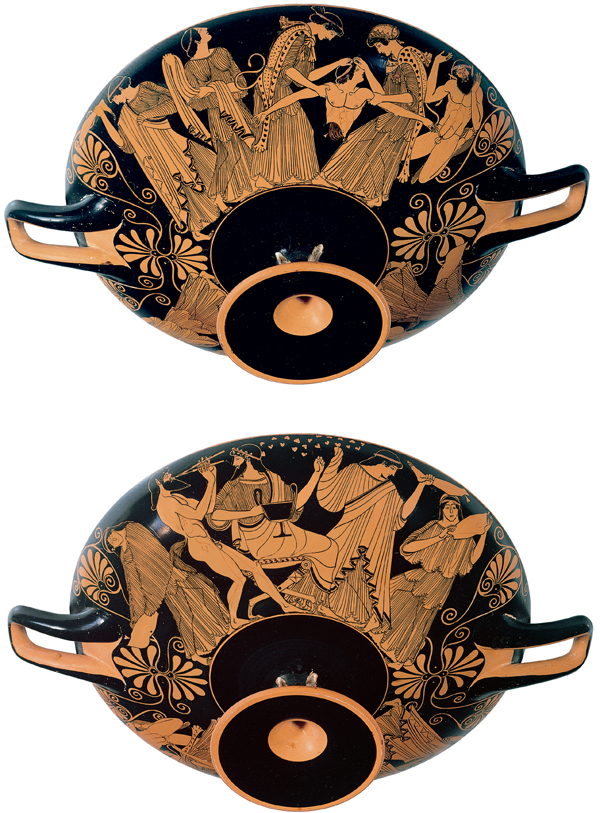
The cup in question is from the 5th century BC and was masterfully painted by the Greek artist known as the Douris Painter. The Kimbell describes it as “one of the finest surviving vases of the early Classical period.” The scene on the cup depicts the death of Pentheus, a mythical king of Thebes, being torn limb from limb by a group of drunken followers of Dionysus.

The museum lists the cup’s ownership history as follows: (Elie Borowski [1913-2003]) by 1977; sold to a Japanese oil company, probably late 1980s; (sale, Christie’s, New York, June 12, 2000, no. 81); purchased by Kimbell Art Foundation, Fort Worth, 2000.

As David Gill noted in his review of James Cuno’s book Whose Culture? The Promise of Museums and the Debate Over Antiquities, the vase was published by Robert Guy in “Glimpses of Excellence: A Selection of Greek Vases and Bronzes from the Elie Borowski Collection” (Toronto Royal Ontario Museum) and highlighted in an interview with Potts for Apollo Magazine (vol. 166,October 1,2007).

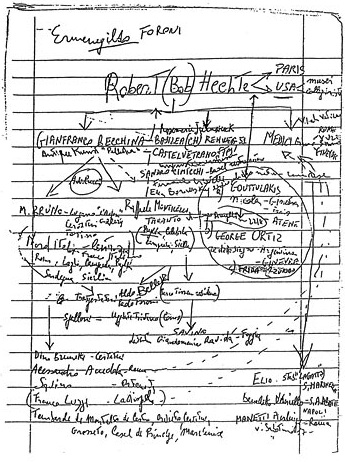
This chart showing the key players in the illicit antiquities trade was seized by Italian police in the 1990s.

The earliest documented owner of the cup, Elie Borowski, has been linked to the illicit trade by Italian and Greek investigators. His name appears  in Robert Hecht’s memoir as a client of convicted antiquities dealer Giacomo Medici and on a handwritten organization chart of the illicit trade seized by Italian authorities in 2001 (on right). Marion True told Italian authorities that Borowski had also been a client of Gianfranco Becchina, the Sicilian antiquities dealer (also named on the chart) who is now on trial in Italy.

In correspondence with Potts and the Kimbell, we asked why they were confident the cup was not the product of an illicit excavation after 1970.

Kimbell spokeswoman Jessica Brandrup initially said: “The Museum has not been contacted by the Italian or the Greek government in regards to works in the Museum’s permanent collection. The purchase of the Greek vase was legitimate and remains a highlight in the Kimbell’s permanent collection.”

Potts said via email, “We did due diligence on the object and were confident that it fell within the AAMD and other U.S. guidelines then in force.” (Worth noting: Four years after the acquisition of the cup, Potts played a central and somewhat controversial role in re-writing those AAMD guidelines, as we note in Saturday’s LA Times story.)

When we pushed the Kimbell for additional information about the cup, we received this statement:

“When the Douris cup was purchased at auction in 2000, the Kimbell Art Museum, like most US museums, held antiquities to the standard of the US 1983 ratification of the 1970 UNESCO treaty.

We believe that the piece can be documented as being outside its country of finding before 1983. Subsequent to its purchase, the AAMD recommended in 2008 that museums apply the 1970 standard instead.

We don’t have information on the cup’s whereabouts between 1970 and 1977, as is evident in the provenance described on our website. To further comply with the AAMD recommendations, we will post it on the AAMD Registry of New Acquisitions of Archaeological Material and Works of Ancient Art.

Thank you for calling this discrepancy to our attention.”

The AAMD object registry was created in 2008, when American museum directors decided the 2004 policy championed by Potts and others was not adequate. As described on AAMD’s website, the 2008 changes sought “to affirm more clearly and tangibly its members’ commitment to helping protect and preserve archaeological resources worldwide, and to strengthen the principles and standards used in making decisions regarding the acquisition of archeological materials and ancient art.”

The AAMD’s object registry lists recent acquisitions of ancient art whose ownership histories cannot be traced back to 1970, the date of the UNESCO anti-looting treaty. The goal is “to make information about such objects freely available to students, teachers, visitors, source countries, officials, as well as possible claimants.”

The registry also contains 10 objects acquired by the Chicago Institute of Art, many of then under director James Cuno, who is now Getty Trust CEO.

Cheat Sheet on Timothy Potts, New Director of the Getty Museum

Timothy Potts

On Feb 14th, Getty CEO James Cuno announced to staff that Timothy Potts had been named as the new director of the Getty Museum, the wealthiest art museum in the world. He will start in September.

Potts comes with an impressive provenance. He was trained as an archaeologist at the University of Sydney and Oxford, where he received his doctorate in Near Eastern art and archeaology. He dug for several years at Pella in Jordan, where he was co-director. And after a stint at Lehman Brothers, Potts directed the National Gallery of Victoria (1994 – 1998), the Kimbell Art Museum in Ft. Worth Texas (1998 – 2007) and most recently the Fitzwilliam Museum in Cambridge.

Despite his background in field archaeology, Potts has more recently held some controversial views on the collecting of unprovenanced antiquities. Here’s a quick cheat sheet:

As director of the Kimbell, Potts helps build the antiquities collection of the Ft. Worth museum, which has an acquisition budget on par with the Getty Museum. Among his acquisitions are some with questionable provenance, such as this Greek cup by the Douris Painter, which the Kimbell bought in 2000. The cup can be traced back to 1977 and Elie Borowski, an antiquities dealer (now deceased) known have trafficked in recently looted objects.

In 2003, Potts was outspoken about the looting in Iraq. He appeared on Charlie Rose Show with Philippe de Montebello here.

James Cuno

In 2004, Potts was a key player in the deliberations over the AAMD’s revised antiquities collecting policies, which you can find here. The policy allowed museums to collect unprovenanced (and likely looted) antiquities if they had documentation going back 10 years. It was a controversial position that would be modified a few years later amidst the antiquities scandal we write about in Chasing Aphrodite.

In 2006, Potts chaired a taskforce for the AAMD that devised new guidelines for accepting loans of antiquities. The policy stated:

Archaeological material and works of ancient art for which provenance information is incomplete or unobtainable may deserve to be publicly displayed, conserved, studied, and published because of their rarity, historical importance and aesthetic merit…

Many saw it as a loophole that allowed museums to continue displaying looted antiquities. Potts defended the policy in an interview with the New York Times:

“If [the ancient art] goes on view with other like objects, then scholars get to see it and study it; the public gets to come; the claimant, if there is one, gets to know where it is and file a claim,” said Timothy Potts, the director of the Kimbell Art Museum in Fort Worth and the chairman of the task force that drew up the guidelines. “Who has lost in this process?” Some museum directors argue that the current wave of antiquities claims against museums and collectors actually resulted from active efforts by museums to display the works and publish articles about them.

For Mr. Potts, an archaeologist by training, the recent attention to the role of collectors and museums in fostering the destruction of archaeological sites is misplaced. The real issue, he argued, is insufficient incentives in countries like Italy and Greece for discoverers of objects to report their finds.

“So much of the pressure is focusing on the wrong end of the chain,” he said. “I think there should be much more done to stop the looting at its source.”

Later that year, Potts and Cuno organized a public symposium to address the controversy over museums and the illicit antiquities trade.  Many of the leading voices in the heated debate participated. The goal was “to explore how museums have, and can responsibly continue to, protect, interpret and exhibit archaeological material and works of ancient art.”

May 2007: Potts was interviewed on NPR about looting and the illicit antiquities trade. He said:

“There were empires, there was war, there was booty taken. To the victor went the spoils, and the museums of the world still represent the dispositions of some of those historical events. We are now living in this different world, and we are requiring more provenance history, and if we think it was recently excavated, we’re just not going to buy it.”

In Jan 2010, Potts gave a tour of the renovated antiquities galleries at the Fitzwilliam Museum in Cambridge. Video and story here.

Dr Potts said: “The Fitzwilliam’s collection of Greek and Roman antiquities is of international significance, so I’m delighted that we now have a superbly redesigned space in which to display it to its full potential.

“This new presentation, which is based on recent research and conservation work, will offer many fresh insights, not only to new visitors, but also to those familiar with the collection.”

In Feb 2010, Potts and de Montebello were among several experts who advised the Leon Levy Foundation about an effort to publish “the trove of unpublished information from important ancient world sites excavated under ‘partage’ agreements.”

Given their pro-collecting positions in a museum world that has largely turned in a different direction, it will be interesting to see how Cuno and Potts decide to deploy the Getty’s wealth in the coming years.

Robert E. Hecht Jr., leading antiquities dealer over five decades, dead at 92.

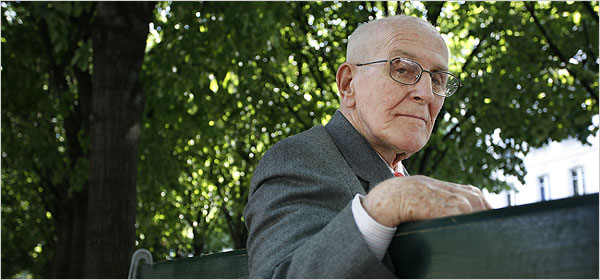
photo by Ed Alcock/NYT

Robert E. Hecht Jr. 1919 - 2012

Bob Hecht died quietly at home in Paris at about noon on Wednesday, according to his wife Elizabeth. He was 92 years old. Here’s my obituary in the LA Times.

When Robert E. Hecht Jr. arrived at the loading platform of the Metropolitan Museum of Art in New York in the fall of 1972, he was carrying a large wooden box and was escorted by an armed guard.

Inside the box was perhaps the finest Greek vase to survive antiquity, a masterpiece that would soon be making headlines around the world.

The Met had agreed to pay a record $1 million for the ancient work. Hecht said it had been in the private collection of a certain Lebanese gentleman.

But when Met director Thomas Hoving heard the story, he scoffed: “I bet he doesn’t exist.”

Indeed, as Hecht later revealed in his unpublished memoir, he had just bought the vase from “loyal suppliers” who had dug it up from ancient tombs outside Rome and smuggled it out of Italy.

Robert Hecht poses in front of the famous looted Greek vase he sold the museum in 1972 for $1 million.

The ensuing controversy over the so-called Euphronios krater marked a turning point in the art world, opening the public’s eyes to the shady side of museums. It also solidified Hecht’s reputation as the preeminent dealer of classical antiquities, driving him underground — but not out of business.

He became a legendary but mysterious figure, one whose passion for ancient art overcame any questions about the destruction wrought by its illicit origins.

That career ended Wednesday, when Hecht died at his home in Paris at age 92.

His death comes less than three weeks after the ambiguous end of his criminal trial in Rome on charges of trafficking in looted antiquities. Since the 1990s, Hecht had been at the center of an Italian investigation that traced objects looted from tombs in Italy through a network of smugglers, dealers and private collectors to museums across the United States, Europe and beyond.

This chart showing the key players in the illicit antiquities trade was seized by Italian police in the 1990s.

Hecht was accused of being a key player in that illicit trade, along with his alleged co-conspirators, former J. Paul Getty Museum antiquities curator Marion True and Italian dealer Giacomo Medici. Medici, who supplied Hecht with the Met’s famous vase after buying it from looters, was convicted in 2004. The trial of Hecht and True began in 2005, but the statute of limitations expired before the court could reach a verdict for either.

In a phone interview after his trial ended, Hecht sounded frail but characteristically coy about the source of his remarkable inventory of ancient vases, statues and frescoes, which now reside in museums around the globe.

“I have no idea of where an object was excavated,” he said. “It could have been excavated 100 years ago; it could have been excavated an hour ago.”

Hecht was born in Baltimore in 1919, heir to the Washington, D.C.-area department store chain that bore his family name. He served in the Navy Reserve in World War II, then accepted a scholarship to study classics and archaeology at the American Academy in Rome.

It was there that he began buying ancient art. At the time, ancient artifacts were sold openly to tourists in the city’s piazzas. But Hecht soon learned that his passion carried risks.

In 1962, he was barred from reentering Turkey after being accused of trying to smuggle out ancient coins. Not long after, he was accused in Italy of trafficking in looted antiquities. Italy’s highest court eventually exonerated him for lack of evidence.

That case was still working through Italy’s legal system when Hecht was offered the Euphronios krater by Medici, who had grown up near the Etruscan necropolis where the vase was illegally excavated.

The deal cemented Hecht’s relationship with Medici, whom he describes in his memoir as “a faithful purveyor” who “rose early each morning [and] toured the villages … visiting all the clandestine diggers.”

The ensuing scandal forced Hecht to relocate to Paris and do business through a series of front men, one of whom was a precocious ancient coin dealer named Bruce McNall.

“He was like a father,” said McNall, who first met Hecht in 1970 while buying ancient coins at an auction in Basel. “He was one of the most fascinating characters I’ve met in my life — a man of mystery, a genius, a family man.”

Soon after meeting, McNall and Hecht became partners, and according to McNall began selling recently looted antiquities to museums and collectors out of McNall’s Rodeo Drive storefront gallery. They also created an elaborate tax fraud scheme with former Getty antiquities curator Jiri Frel, arranging for Hollywood figures to donate looted antiquities to the Getty in exchange for inflated tax write-offs.

“I found him to be without question the most knowledgeable person I’d met in the business, much more of an academic than a dealer,” said McNall, who went on to produce Hollywood films and buy the Los Angeles Kings hockey team before going to jail on unrelated bank fraud charges.

Among Hecht’s top clients was the J. Paul Getty Museum, which was aggressively building its collection of ancient art in the 1980s and ’90s. In a deposition, True said Hecht could be “charming, very, very intelligent, but he could also turn, be very hostile, very sarcastic, very sinister.”

It was Hecht’s ties to the Getty that landed him on trial with True in Rome. In addition to Hecht’s memoir, which was seized in 2001, investigators found correspondence in which the two appeared to openly discuss the illicit origin of objects the Getty was buying.

Confronted with the evidence, the Getty and other leading American museums agreed to return more than 100 antiquities to Italy, including dozens that came through Hecht. Among them was the Met’s Euphronios krater, which was returned to Italy in 2008.

Ultimately, Italian prosecutors could not win a criminal conviction in the case before the allotted time elapsed.

“He was not able to be proven guilty, so he was innocent,” Hecht’s wife, Elizabeth, said Wednesday.

In addition to his wife, Hecht is survived by his daughters Daphne Hecht Howat of Paris, Andrea Hecht of Brooklyn, N.Y., and Donatella Hecht of Westchester, N.Y.

Please feel free to share your memories of him in the comments below.

American art dealer Robert Hecht, 86, center, is approached by reporters as he leaves a Rome court for a break Friday Jan. 13, 2006

Marion True and the Getty Museum’s Almagia Vase

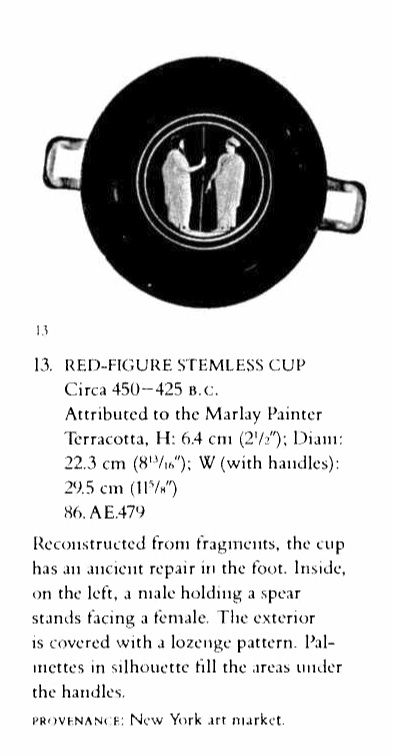
In 1986, former J. Paul Getty Museum antiquities curator Marion True recommended the purchase of an attic cup from Edoardo Almagia, the antiquities dealer now under investigation by Italian authorities for allegedly trafficking in looted antiquities.

True was offered the red-figured cup attributed to the Marlay Painter in New York City, where Almagia was based, according to Getty spokesman Ron Hartwig. It was in fragments at the time. The board of trustees approved the purchase for $7,500, and the restored cup is now on display today at the Getty Villa.

JPG 86.AE.479

The attic cup is not listed in the Getty’s online collection, but was published in the 1987 edition of the museum’s acquisition journal, shown at right. The journal lists the cup’s provenance as “New York art market.” Hartwig added that it “was said to have been bought in Switzerland, of Southern Italian origin.”

The cup is the only acquisition from Almagia in the Getty’s collection, Hartwig said.

The Metropolitan Museum of Art and the Princeton University Museum of Art have recently returned hundreds of objects and fragments purchased from Almagia, whose criminal investigation is on-going. Hartwig said Italian officials have not asked about the Getty’s cup.

Transparency check: Dallas, Tampa, the Met and now the Getty have all been forthcoming about their acquisitions from Almagia. We have not received a response to our Feb 3 inquiries to the San Antonio Museum of Art or the Indiana University Museum, where Almagia objects have also been traced. Princeton University has likewise not responded to our request for additional information about their recent return of dozens of objects to Italy. The Boston Museum of Fine Art says it is now compiling information about Almagia acquisitions for us.

Hecht Trial Ends With No Verdict, Medici Conviction Affirmed

American art dealer Robert Hecht, 86, center, is approached by reporters as he leaves a Rome court for a break Friday Jan. 13, 2006

The criminal trial of Robert E. Hecht ended this week with no verdict, while Giacomo Medici’s conviction for trafficking looted antiquities was upheld last month by Italy’s high court.

Here is Jason’s story in the Los Angeles Times:

The trial of Robert E. Hecht Jr., the alleged mastermind of an international black market in ancient art, ended with no verdict this week when a three-judge panel in Rome found the time allotted for the trial had expired.

Hecht, a 92-year-old Baltimore native now confined to bed at his home in Paris, has cut a wide swath through the art world since the 1950s, supplying museums and collectors around the world with some of the finest examples of ancient Greek, Roman and Etruscan art.

“I have no idea of where an object was excavated,” he said in a phone interview on Thursday. “It could have been excavated 100 years ago, it could have been excavated an hour ago.”

Throughout that colorful career, Hecht has been dogged by allegations that his wares had been recently looted from archaeological sites and smuggled out of their homeland. It was a claim he never directly denied while maintaining his innocence of the Italian charges, which focused on an alleged conspiracy among dealers he considers rivals.

The ruling brings an ambiguous end to a sweeping investigation that traced relics looted from tombs in Italy through a network of smugglers, dealers and private collectors before appearing on display at museums in the United States, Europe and beyond.

The criminal case stemming from that investigation has dragged through Italian courts since 2005 and focused on Hecht and two co-defendants: Marion True, the former Getty antiquities curator, and Italian dealer Giacomo Medici.

True’s trial ended without a verdict in October 2010 when the statute of limitations on her charges expired. Medici, who opted for a fast-track trial, was convicted in 2004, a verdict upheld last month by Italy’s highest court, which imposed an eight-year prison sentence and a 10-million-Euro fine, the largest in Italian history for such a case.

Paolo Ferri, the original prosecutor in the case, expressed exasperation with the Italian legal system, which he said made it impossible to conclude the complex cases in the time allotted. In Italy, months can pass between hearing dates in criminal cases — there were only about 18 hearings in the Hecht case over the six years, Ferri said.

Ferri dismissed critics, mostly in the United States, who suggest that he had purposefully stretched out the cases because he lacked the evidence to convict.

“There is plenty of evidence,” Ferri said, citing as an example Hecht’s own handwritten memoir, in which the dealer detailed his long career buying ancient art from Medici and other suppliers whom Hecht described as “clandestine diggers.” An organizational chart seized from a middleman in the illicit trade showed Hecht’s name at the top of a pyramid of suspected looters and smugglers.

This chart showing the key players in the illicit antiquities trade was seized by Italian police in the 1990s.

Evidence gathered during the investigation was compelling enough to convince American museums to voluntarily return more than 100 masterpieces of ancient art in their collections after they were linked to Hecht, Medici and other dealers. In 2007, the J. Paul Getty Museum offered to return 40 objects to Italy, including its prized statue of Aphrodite.

Confronted with evidence of their own role in an international black market, American museums also adopted strict new acquisition standards designed to prevent the purchase of recently looted antiquities, the excavation of which results in the destruction of archaeological sites around the world.

Still, the failure to bring the Hecht case to a verdict suggests Italy — whose national police force is widely considered a leader in policing archaeological sites — is still lacking a strong deterrent against further looting, a fact that Ferri acknowledged.

“The truth is the Italian legal system is out of order,” said Ferri, who retired in 2010.

As for Hecht, he said he holds no hard feelings about the arduous trial, which did not require him to attend hearings. In a voice weakened by age, he cited a favorite biblical passage:

“Forgive them, for they know not what they do.”

Hard not to feel like Bob is having the last laugh here. But he didn’t sound well when we spoke, and his wife Elizabeth told me he was happy to have this done before he goes.

Robert Hecht poses in front of the famous looted Greek vase he sold the museum in 1972 for $1 million.

Arnold Peter Weiss’ Coin Partner and The Getty Connection

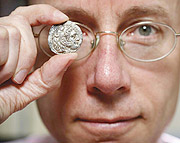
A surprising detail emerged while we were reading about Nomos AG, the Swiss coin dealership whose principal, Dr. Arnold-Peter Weiss, was arrested on January 3 for felony possession of an ancient coin allegedly looted recently in Sicily.

One of Weiss’ partners in Nomos is Eric McFadden, a senior director of Classical Numismatic Group, one of the world’s leading dealers in ancient coins. McFadden has an impressive resume — he received degrees in Classics from Pomona College and Oxford University before getting a law degree from Harvard University.

But here’s the detail that caught our eye, described in a 2008 profile of McFadden in Pomona College Magazine:

“McFadden began his career in the coin world in the summer of 1977, after graduating from Pomona College with a degree in classics. He volunteered to work on the coin collection of the then fledgling Getty Museum in Malibu. There, he learned that it’s virtually impossible for a new museum to build an outstanding collection of ancient statuary or ceramics, because the finest quality items are not available at any price. However, it is entirely possible for a well-funded museum to collect first-rate ancient coins, which are still regularly sold in the marketplace.”

At the Getty in 1977, McFadden would have been working under Jiri Frel, the rogue Czech antiquities curator who ran the department until he was chased out of town in 1984 amid a tax fraud investigation by the IRS.

As readers of Chasing Aphrodite know, Frel was charming, brilliant and deeply corrupt. A confidential Getty damage assessment later found that Frel had falsified provenances for recently looted antiquities, given inflated attributions to objects in the collection and recommended the purchase of several multi-million dollar fakes in exchange for kickbacks from dealers. (The assistant curator who exposed Frel went on to become a prominent name in the numismatic world as well: Arthur Houghton III, president of the American Numismatic Society from 1994-1999 and currently a lifetime trustee.)

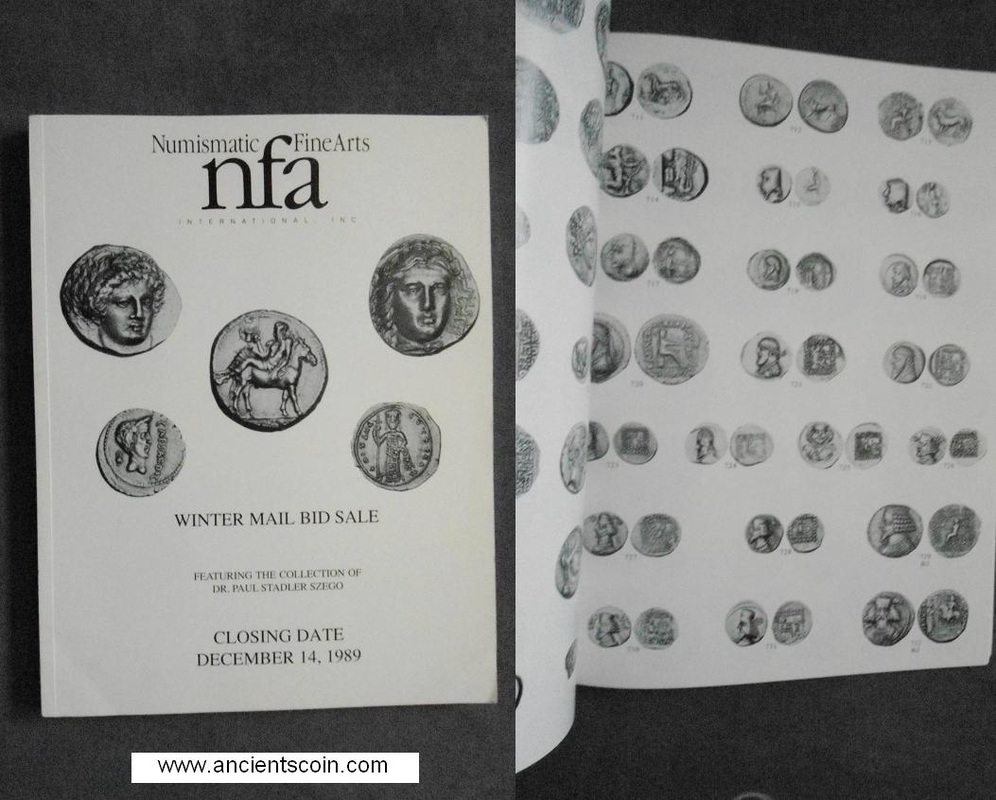
McFadden’s work at the Getty is likely where he met Bruce McNall, the cherubic ancient coin dealer who ran Numismatic Fine Arts, the Beverly Hills gallery on Rodeo Drive. McNall had opened NFA in 1971 and built it into the world’s leading ancient coin dealership, eventually branching out into Classical antiquities (Summa Gallery) with the help of his silent partner, the antiquities dealer Robert E. Hecht Jr. Hecht had been selling recently looted antiquities since the 1950s, and his network of loyal suppliers reached deep into tombs across the Mediterranean.

As we recount in Chapter Two of Chasing Aphrodite, it was this crooked triumvirate — Hecht the supplier, McNall the salesman, and Frel the curator — that cooked up one of the largest tax fraud schemes in American museum history. Thousands of recently looted antiquities and coins were donated to the Getty Museum by Hollywood elites looking for a tax dodge. In exchange for donating objects they often never saw, they got tax write-offs at inflated values thanks to appraisals forged by Frel.

photo by Ed Alcock/NYT

Robert Hecht

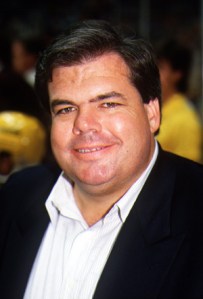
Nomos’ McFadden worked for McNall during those years, first during his summer breaks at Oxford, then for another three years after completing his degree. In an interview this week, McNall recalled McFadden as “a knowledgeable, nerdy kind of guy,” which was helpful. “You don’t want to be looking like a slick car sales man selling ancient art,” McNall said.

McNall said that it was common knowledge that many of the coins he was getting in those days had been recently — and therefore illegally — excavated. “Fresh” coins were were more attractive to buyers. “Any time you find something brand new, it’s sexier,” he said. “Otherwise it’s been around, it’s been seen, and maybe there’s a reason someone else hasn’t bought it…Nobody wants some old broad that’s been around on the town for too long.”

Ironically, McNall thinks that may explain the case of Arnold-Peter Weiss, who was allegedly recorded by a confidential informant bragging that he knew the 4th century BC silver tetradrachm from Katane he was selling was “a fresh coin, this was dug up a few years ago” in Italy. Such talk is common in the coin trade, said McNall, but “90% of the time it’s just a sales tool.” McNall also finds to be credible the rumor circulating in the coin world that one or more of the coins Weiss was offering for sale may have been fakes.

McNall, who no longer trades coins but still follows the market,  sees parallels to today’s coin market and that of the late 1970s, when he pitched ancient coins as safe harbor in a troubled economy. Investors “have gotten burned in supposedly safe sources, and they’ve gone back to things like coins. If your other investments hit the fan, you’ve always got these things, which have found a market for the last 2000 years.”

In time, authorities caught up with the triumvirate. McNall got out of the coin business after declaring bankruptcy and spending four years in federal prison for bank fraud. Frel left the country in 1984 amid an IRS investigation into the donation scheme, and died in 2006.  Robert Hecht, 92, has been was on trial in Italy since 2005 for trafficking in looted antiquities until Jan 16th, when his trial ended with no verdict.

Eric McFadden was never, to our knowledge, accused of a crime. He left NFA in the mid-1980s for Harvard Law School, and practiced in Los Angeles for several years before returning to the coin trade and joining CNG in 1990. He apparently maintained his ties to Bob Hecht. Over the years, CNG has sold several ancient coins tied to Hecht, including its 2008 sale of Hecht’s collection of Byzantine coins.

Most recently, McFadden has been a vocal opponent of import restrictions on ancient coins, submitting statements to the Cultural Property Advisory Committee in opposition of restrictions for Greece and Bulgaria, calling them “unworkable, ineffective, and ultimately counterproductive.”

In his letter arguing against restrictions for Greek coins, McFadden wrote,” “…there is no simple way of determining either where or when a coin might have been found before being moved from its find spot.” The Weiss case, which appears to rely on the testimony of an informant, may test that theory.

We’ve reached out to Nomos and McFadden, who lives in London,  for comment and will post any response here.

ALSO: Attorney Rick St. Hilaire has posted a helpful update on the legal case of Ancient Coin Collectors Guild v. U.S. Customs and Border Protection; U.S. Department of State; Assistant Secretary of State, Educational and Cultural Affairs.

ALSO: David Gill at Looting Matters notes that Nomos AG is a member of  the International Association of Professional Numismatists (IAPN) which “has apparently paid $100,000 over the last two years for lobbying services in the US.”