Category Archives: News

The Antiquities Trade as Organized Crime: Glasgow Team Digs Deep into the Market For Ancient Art

An exciting new research effort has been launched by some of the most prominent researchers of the illicit antiquities trade.

Simon Mackenzie, Neil BrodieSuzie Thomas and Donna Yates* at the University of Glasgow have received £1 million over four years from the European Research Council to pursue new research of the illicit trade in ancient art.

The program, called “Global Traffic in Cultural Objects,” will be based at Glasgow’s Scottish Centre for Crime and Justice Research. Here’s how the team describes their goal:

“National and international laws intended to regulate or suppress the trade have been only partially successful, and the illicit trade has been linked to further criminal problems such as corruption and physical violence…By developing new empirical approaches and drawing upon criminological theory, this project will work towards a regulatory regime that goes beyond straightforward law enforcement, allowing the legitimate exchange of cultural objects while suppressing the illicit market.”

The project’s four main endeavors are:

1. Mapping and measurement. Through a series of case studies, the project will examine publicly available sales data to establish whether they can be used to estimate flows of illicit material through the market, and therefore to assess the effectiveness of any implemented regulation.

2. Qualitative data-gathering and analysis. Through ethnographic interviews of market agents such as dealers, collectors, museum curators and university academics, the project will gather information about the trade in licit and illicit cultural objects, and opinions about suitable regulation and opportunities for novel regulatory interventions. It will also, by means of a major case study, trace the path taken by a defined category of illicit material from ground to market, thereby offering greater depth to the analysis.

3. Regulation theory and practice. There will be a comprehensive review of the academic and policy literature as regards comparable transnational criminal markets and their regulation. Regulatory successes and failures will be identified, and considered in relation to the traffic in cultural objects, utilizing information obtained through themes 1 and 2. The project will also consider whether the traffic in cultural objects is ‘knotted’ together with other criminal activities in such a way as to render it insoluble as an isolated problem.

4. Knowledge mobilization. The project will establish a website that will make available project outputs and data, and that will also contain an ‘encyclopedia’ of material relevant to the project and to the traffic in cultural objects more generally.

Simon Mackenzie

We recently interviewed Simon Mackenzie, a criminologist who has been studying the antiquities trade since 2002, about his perspective on the illicit antiquities trade. (We’ve edited a bit for clarity and length.)

Chasing Aphrodite: What is known and not known about the illicit antiquities trade? How does our knowledge of it compare with our knowledge of other types of crime?

Simon Mackenzie: Compared to the trade in narcotics, we know virtually nothing. The narcotics trade has been heavily researched. There are specialist areas within the fields — country experts, modes of regulation. There’s been all sorts of research into the people producing drugs, the mechanisms for supply and demand. For people studying cultural heritage traffic, its a good place to start. The trade wild life is more comparable to the antiquities trade in terms of the state of research. There is some research and lots of policy activity. We see a remarkably high level of NGO involvement in awareness raising around wild life trafficking.

People are always talking about the illicit antiquities trade as something that is under-researched, with a small number of people working in the field. But when you think about it, it’s not too bad. Clemency Coggins really started the field in the 1960s. The last 40 years, from UNESCO onwards, has been a period of relatively high activity compared to other criminal problems – quite a lot has happened. There’s been increasing regulation of museums and ethical codes adopted. Once you start looking into the literature — for example, ethnographic studies of markets by Morag Kersel , the work of Christopher Chippindale  and David Gill, Ricardo Elia, Patty Gerstenblith. It has been a small field, but there are a good spread of methodological approaches, with respectable and reliable researchers.
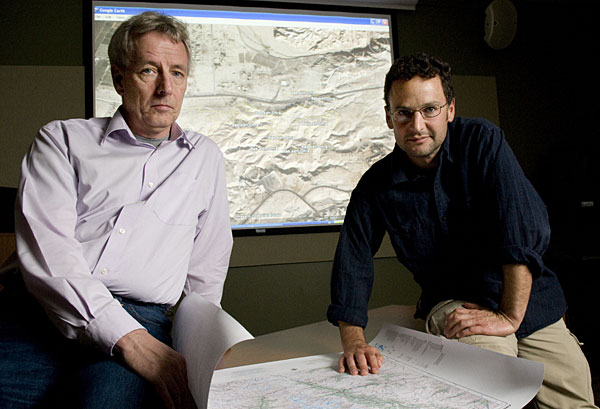
Neil Brodie (left)

CA: Estimates of the size of illicit trade range from tens of millions to as much as $2 billion annually. Why?

SM: It’s amusing, or depressing, or tragic. I teach a course on transnational criminal markets — human organ, radiological material, etc. The first largest international market is drugs. The second is arms. Third is everything else — wild life says it’s the third largest, antiquities says it’s the third largest, several others also claim to be the third largest. The evidence disappears and nobody has any idea how big it is. Part of our project is to create more accurate sizing statistics.
I don’t want to say it doesn’t matter, but we know there is a lot of looting going on and we have first hand accounts of widespread looting. We see regular occurrences of looted objects in Western markets, in prestigious institutions and auction houses. We know we have a serious problem here and something needs to be done about it, whether it’s $6 billion of $50 million.

CA: Is organized crime involved in antiquities trade?

SM: There is clearly organized crime in the antiquities market, as we conventionally conceive of organized crime. The more interesting question is whether antiquities trafficking is in itself an organized crime. It’s not what we would think of as organized crime on its face because the actors are often quite respectable figures. It seems counter-intuitive to say that museums and auction houses are organized crime. But look at the definition of organized crime: three or more people operating over a sustained period of time in a serious criminal way. Antiquities trafficking meets that definition. So you can make a technical argument quite easily.

The more interesting question to ask is: why do we care whether it’s organized crime? The policy response to organized crime, the regulatory response, is much greater, more of an international threat. So the distinction can be quite important on a policy basis.

The reason why organized criminals are involved in the antiquities trade is because it’s under-regulated. But you can take the organized criminal out of the antiquities trade and you’ll still have looting. It’s a story of supply and demand on an international basis. The trade attracts organized criminals, but they don’t define the shape of it because it is created and sustained by more conventional trade actors.

Suzie Thomas

CA: The trade in illicit antiquities is often seen, especially in the United States, as a victimless crime. The public sometimes has trouble grasping the harm. Your thoughts?

SM: It’s difficult. The general public is not particularly interested in the context of any particular object dug up in a far flung corner of the world. And yet, museums and cultural debates are a strong current full of voices who feel very strongly about people’s culture and human rights. So in one sense, it’s certainly true that sometimes people don’t get that broken old pots are important to mankind. But when you elevate that to a greater concern with history and culture and knowledge and civilization, what that means and how we might find our way forward, people do care quite deeply about that. These are fundamentals.

CA: What do you think of the current regulatory regimes for the antiquities trade? Your thoughts on de-criminalization?

SM: Most criminologists agree that supply-side interventions are going to be problematic, particularly on their own. The drug trade and prohibition are  pretty good examples of trying to control something where there’s a high level of demand in a globalized economy. None of these have particularly good records of success. Most of the current ideas seems to be about reducing demand or, alternatively, taking an end-to-end type solution — take both ends seriously and start to unwind the economic cultural and social forces underpinning the market. Once you see that, strict legal responses begin to look problematic. It’s very difficult for the law to seriously engage with an entrenched, large-scale global trade. The nature of regulatory intervention in the cultural heritage market has largely been legal. Mostly its been about UNESCO, passing laws in source countries, prohibition of theft, and passing laws in market countries to prevent purchase. The interesting question for regulation is how do we build up systems around these laws we have.

Donna Yates

Some scholars, such as Paul Bator, have argued that increasing regulation produces the black-markets — that regulators are culpable for the illicit trade. I’ve never really bought into that. It’s a dead end: if you believe that, what do you do, stand back? You can talk about decriminalizing cannabis use, where the moral limitations are so widely disputed so there’s a general debate about whether it should be a crime. But not many people would seriously argue that knowingly steeling cultural property is ok. It’s reasonably clear that all sides say it’s wrong. Therefore the idea that we should decriminalize it doesn’t seem to do much except legitimate illicit stuff. It wouldn’t stop the illicit trade. It might make it worse.

*UPDATE: We’ve added Donna Yates, who recently joined the Glasgow team fresh from her PhD work at Cambridge. 
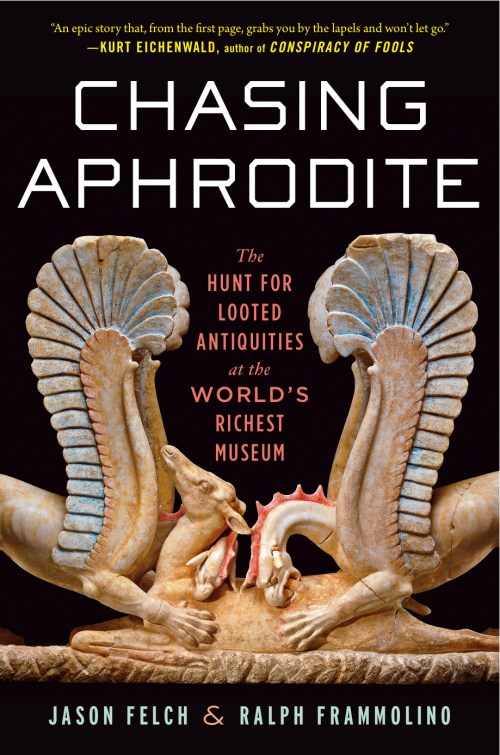
The Year of Aphrodite: Book Launch Plus 365

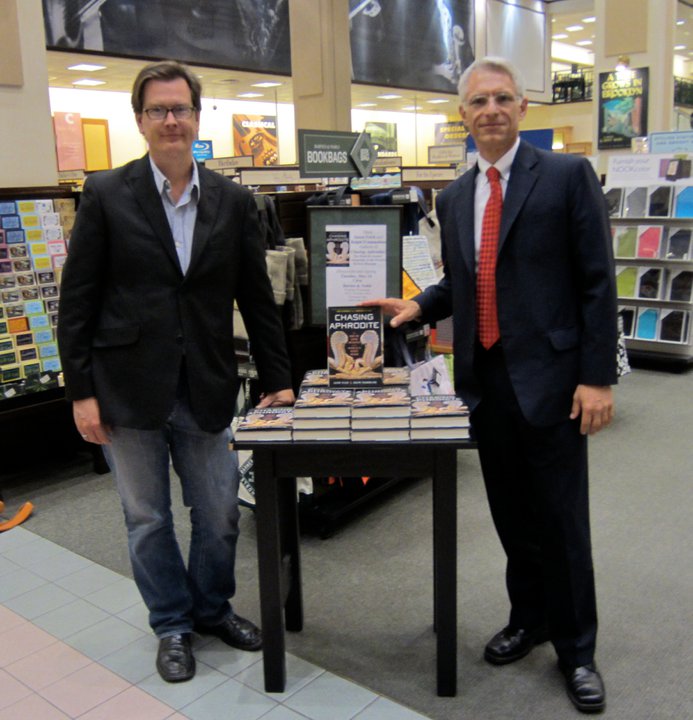
One year ago, Chasing Aphrodite hit bookstores. The amazing success we’ve enjoyed over the past twelve months is humbling, and we thought it a good opportunity to thank you, our most dedicated fans. Thank you for everything you’ve done to help spread the word.

Here are some highlights from the past year:

We’ve written magazine cover-stories and excerpts; newspaper Op-Eds and several articles; and nearly 100 muckraking blog posts, including several exclusive scoops.

We’ve fired off 2,000 tweets with the latest looting news; and fed our 300 Facebook friends with a steady stream of news and updates about museums and the illicit antiquities trade.

We’ve revealed suspect art at the Met, the Getty, the Seattle Art Museum, the ClevelandDumbarton Oaks, The Norton SimonTampaToledoDallasKimbellLACMA, the WaltersBoston MFASan Antonio MuseumIndiana UniversityHarvardPrincetonYaleRISDSotheby’s and elsewhere.

We’ve received rave reviews from readers and critics (a few sour ones too) and have been interviewed by an alphabet soup of outlets: NPR, PBS, VOA, KPCC, KCRW, KQED, KPFK, etc.

We’ve (briefly) made the bestseller list, and sold more copies that the publisher (and authors) expected — we’re currently in the third printing. Chasing Aphrodite has been honored with the SAFE Beacon Award, the ARCA Prize for Art Crime Scholarship and, most recently, the California Book Award.

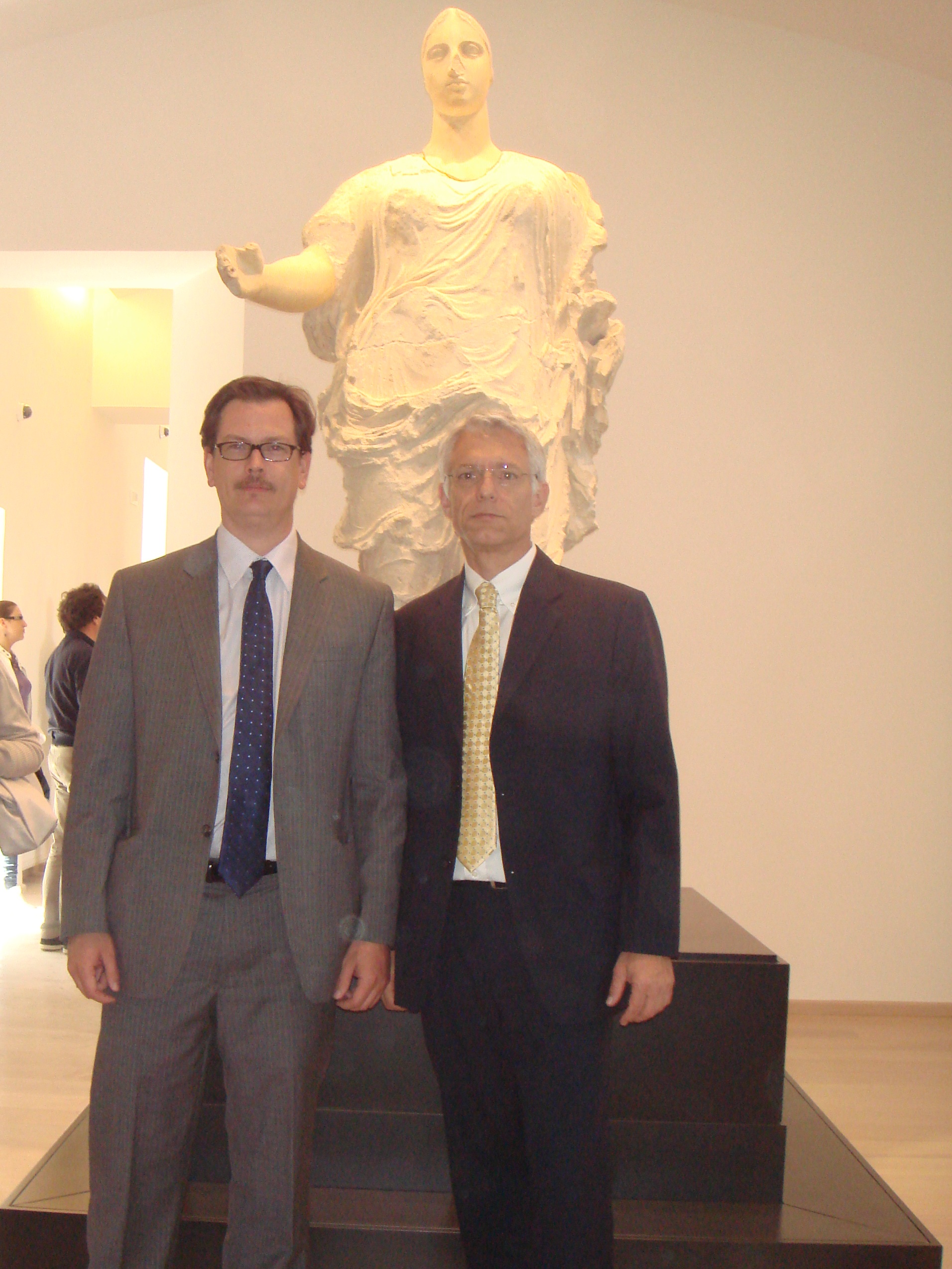
The authors in front of the goddess in her new home.

We escorted a goddess back to her homeland.

We’ve given talks at Google; The Pacific Palisades Historical Society; UCLA; The National Press Club; Society for the Preservation of Greek Heritage/Friends of the New Acropolist Museum; The Jonathan Club of Los Angeles; Chapman University; Central Michigan University; The Walters Art Museum; UPenn Law School; UPenn Museum; The Harvard Club of New York City; The National Arts Club; Princeton University; Villanova Law School; Rutgers University; New York University; Cardozo Law School;  Archaeological Institute of America (NY Chapter); SAFE; The Benson Family Farm; Elliot Bay Bookstore in Seattle; Powell’s Books in Portland; The Commonwealth Club of San Francisco;  Loyola Law School; University of Kore in Enna, Sicily; Book Soup on Hollywood Blvd; Barnes and Noble of Thousand Oaks; and the LA Festival of Books.

Looking forward, we’re hard at work on WikiLoot, our new initiative to crowdsource the fight against the illicit antiquities trade.

Thanks to you, our dedicated readers, for helping us achieve all this and more over the past year.

Jason and Ralph

PS: It’s not too late to recommend Chasing Aphrodite to a friend. But you better hurry up: last we checked, Amazon only had 11 copies left!

Artifacts and Fictions in Baltimore: Roger Atwood on the Walters’ Pre-Colombian Collection

Today we’re publishing a guest post from Roger Atwood, author of “Stealing History: Tomb Raiders, Smugglers and the Looting of the Ancient World.”   We reached out to Roger for his thoughts when we heard about an exhibition of suspect pre-Colombian material at the Walters Art Museum in Baltimore. Atwood has written extensively about looting in Latin America, and took a recent trip to the Walters to see the collection. Here is what he found.

The Walters Art Museum in Baltimore has mounted a show of ancient artifacts from Latin America that belong, or once belonged, to the collector John Bourne.  According to the show’s catalogue, Bourne has already given some of the pieces to the museum while others have been promised, a long, gradual donation that maximizes the donor’s tax deduction. Aside from a few likely fakes, whose presence the Walters candidly admits, the objects all date from before the arrival of Europeans in 1492.

Collector John Bourne, circa 1947

The collection has a long and checkered history. Bourne originally intended to give it, or at least part of it, to the Museum of New Mexico’s Palace of the Governors unit in Santa Fe, which, in fact, displayed it for several years after 1997. The collection brought the Palace of the Governors some problems, to put it mildly. Four objects in the collection were seized by the FBI in 1998 and held for nearly two years, pending probes into allegations that the pieces were looted and smuggled out of Peru. The investigation ultimately fizzled, leading to no charges and the return of the pieces. But the Museum of New Mexico got some nasty publicity from that case, and one can only assume the Walters and its lawyers were fully cognizant of the risks of a repeat of it before accepting this dubious gift. I tell the story of the Bourne case in detail in my 2004 book Stealing History: Tomb Raiders, Smugglers, and the Looting of the Ancient World, based on interviews and documents acquired through the Freedom of Information Act.

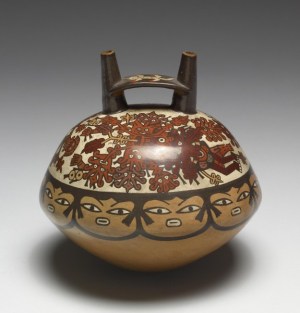
A couple of weeks ago I took a train to the handsome city of Baltimore and saw the Bourne collection in its new home. It’s a revealing show with some lovely artifacts, including some I don’t remember seeing in Santa Fe. The painted Nasca stirrup bottles (right), masterpieces of design and economy dating from about 500 CE, alone were worth the trip.

Yet I came away thinking that, perhaps without realizing it, the organizers have given an object lesson in the dangers of collecting antiquities that have no record of archaeological excavation. What I wrote in Stealing History – that “not a single piece on display” in the Bourne collection “gives a specific provenance, archaeological history or other sign it emerged from any place but a looter’s pit” – remains true but needs some amending.

First, there are the fakes. To its credit, the Walters is completely up front about the fact that some pieces in the Bourne collection are probably not what they claim to be. “[T]he atypical imagery of these objects calls into question their authenticity,” says the wall label next to a pair of Maya eccentric flints. It adds, helpfully, that tests are inconclusive “because modern replicas are made using the same kinds of tools and techniques as well as the same sources of flint” as the real ones. So, in this case, we’re learning more about technique for making fakes than about Maya flints.
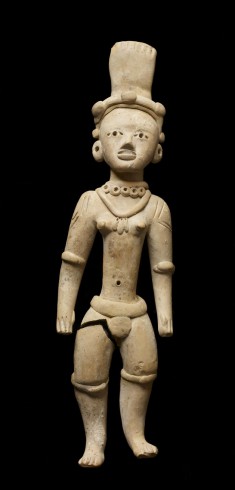
Another sculpture looks like a bad pastiche of old and new, or, as the wall panel says, a “modern assembly of a variety of ancient parts.” Meant to look Moche, the piece shows a wooden, crouching warrior of ungainly proportions, with a clamshell perched on its head like a fez and a backflap on its lower back that seems to have been made for a much smaller object. “Together, the C-14 [radiocarbon dating] and iconographic data suggest that the piece – in its current state – postdates Moche culture by at least 700 years,” says the show’s catalogue. The operative phrase there is “at least,” for the piece has a funny, cinematic kind of look, like a prop from “The Curse of the Andes”.

What do fakes have to do with the problem of looting? Fakes and unprovenanced, authentic antiquities often turn up together in collections because neither was found through the transparent process of archaeological excavation. They flock together.  Collectors might think their connoisseurship protects them from fakes, but they get hoodwinked all the time. This is not a sign of denseness or gullibility, necessarily; it just comes with the territory if you’re in the business of acquiring undocumented antiquities. If the Getty, with all its experts and budget, could buy a dubious piece like the Kouros, then what hope is there for a single collector such as John Bourne, no matter what the credentials of the people advising him?

The Walters is more coy on the implications of all this. Has the collector gained a tax benefit for the donation of what are quite possibly, if the Walters’ analysis is correct, worthless fakes?  Why is it even showing them? The show constantly refers to authentication and laboratory analysis on the pieces; indeed, it’s one of the main themes of the exhibit.  One piece, a Zapotec pottery figure actually has a copy of its thermoluminescence analysis report right on the wall, indicating the piece dates from 450 to 800 CE. Wall texts and the catalogue go on about CT scans and minute studies of chemical compositions.

I spoke on the phone with the director of the Walters, Gary Vikan, who said that the museum decided to go ahead and show what its conservators believed to be fakes because “there is a value in being candid and open about our own research.” He added, “our business is to gather and share knowledge, not to vindicate” a collector’s decisions. Two conservators worked full-time for two-and-a-half years analyzing the pieces, he said.

To the viewer, all this research could signal that the Walters has doubts about the larger integrity of the collection. But it also suggests the museum is trying to compensate for the lack of any archaeological information about the pieces by running them through gauntlets of laboratory tests. It’s as if the museum is trying to scratch its way to some information – any information – about pieces that are so patently lacking any hard archaeological data.

And that leads me to the second problem associated with undocumented artifacts that this exhibit so richly demonstrates: the lack of information. For all the museum’s months of laboratory work, we know strikingly little about where these pieces came from, in what context they were found, and what function or meaning they had. This is because they were, presumably, all purchased from the cast of looters, dealers and assorted hoodlums that make up the supply end of the Latin American antiquities market. Whatever information those sellers claim to have on the origin of the artifacts they sell is usually conjecture or lies.

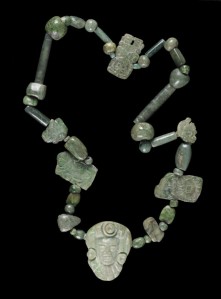
An earthenware crocodile effigy claimed to be from Costa  Rica is said to date from 500 to 1350 CE, an absurdly wide spread that stratigraphic data or radiocarbon materials found in proper excavation could narrow down to decades. A Mayan jadeite pendant (left) dates from “250 to 450 CE” and could come from Guatemala, Belize, Mexico or Honduras, says the catalogue. In other words, from two centuries and any one of hundreds of sites over four countries.   It’s a nice piece, but how helpful is that? True, it is difficult for a private collector to buy archaeologically excavated material, since it rarely comes on the market. But a museum of the Walters’ caliber could certainly arrange loans of properly excavated pieces if wants to show pre-Columbian antiquities.

The show takes pains to stress that Bourne purchased many artifacts on trips to Latin American hinterlands starting in the 1940s, before most current rules on removing and selling cultural property were in effect. The catalogue describes Hiram Bingham-style adventures, Bourne cutting through forest to reach the lost city of Bonampak and finding artifacts in situ.  These accounts are entertaining and I don’t doubt their authenticity, but other facts make you wonder if he had other sources. Bourne himself told the FBI in 1998 that he bought merchandise from the late Ben Johnson, a notorious Los Angeles dealer in high-end pillage whose dealings were exposed in the Sipán trial of 1989.

What little information we’re given on the origin of the Bourne pieces amounts to a roll call of the most pitilessly looted parts of Latin America: the north coast of Peru, the Petén lowlands of Guatemala, rural Veracruz.  Commercial looters erased incalculable amounts of archaeological data and a valuable economic resource to gather prizes for middlemen and collectors. It’s a story of exploitation and greed that is still rarely acknowledged  by big collecting museums.

A clear example of that destructive cycle – collectors buy loot, looters destroy sites to get more loot to sell, over and over – was the pillage at Sipán in northern Peru in 1987. Before the Getty’s Aphrodite, before the Marion True trial, the case of Sipán showed everyone the power of the antiquities trade to consume heritage.  That case led to the 1990 emergency ban on the import of a long list of types of Peruvian antiquities, arguably the most important step by the federal government to tackle the illicit trade up to that time, and, later, a bilateral agreement between Peru and the United States imposing broad import restrictions that remains in effect today. (By way of disclosure, I should say that I spoke in favor of a five-year renewal of that agreement before the State Department’s Cultural Property Advisory Committee in 2007.)

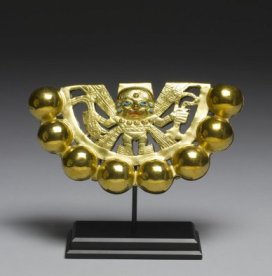
The Bourne collection (now the Walters collection) includes a piece widely attributed to Sipán, a golden belt rattle (left) [Note: An earlier version of this post had an incorrect image. The mistake was ours, not Atwood’s.]  It wasn’t on display when I visited Baltimore but it appears in the catalogue, which calls the piece “Moche style, North Coast, Peru.” The Sipán tomb was looted by the Bernal brothers in February 1987. Its fabulous artifacts spread quickly through the elite antiquities racket before police fenced off the site and allowed archaeologists to excavate it. They found two more, undisturbed tombs that have enriched our understanding of pre-Columbian society.

The word “style” after Moche is a wink-wink that the Walters is not sure of the piece’s authenticity, as Vikan pointed out to me.  I spoke with one of the museum’s conservators, Jessica Arista, who said the surface of the belt rattle showed marks from metal tools that did not exist in ancient Peru. “There are a lot of modern polishing marks,” she said. Also, said Arista, the metal itself looked too fresh to be ancient and a corrosive pigment seems to have been applied to it, possibly with the intention of making it look older.  A sample from the piece was detached and sent to the Museum of Fine Arts in Boston for analysis, she said. The piece was found to be 72 percent gold, 13 percent silver and 10 percent copper, figures similar to those found in authentic pieces, she said. (The catalogue gave slightly different numbers: 86.6 percent gold, five percent silver and 8.4 percent copper.) But the interior of the metal lacked the leaching and compositional variation that you would expect from a truly ancient piece, she said. Also, the microscopically thin gilding that you would see on the surface seems to be missing.

Still, the information is not conclusive, said Arista. The museum would need detailed comparisons with authentic Sipán pieces to give a more definitive answer on the piece’s authenticity. The Walters has not made contact with the Sipán museum in Lambayeque, Peru to arrange such a comparison, she said.

I mentioned to her that many Sipán pieces, including the backflap seized by the FBI in Philadelphia in 1997, had been soaked and scrubbed with Brillo pads while in the hands of looters and smugglers. This, I suggested, could account for the modern tool marks and the metal’s shiny appearance (which I’d also noticed in Santa Fe.) Perhaps, she said, but the metal’s inner composition, not just the surface, raises red flags about the piece’s authenticity.

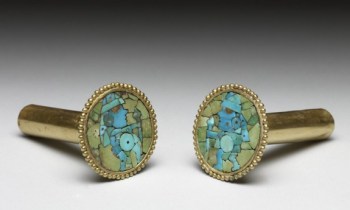
The belt rattle was one of four from the Bourne collection seized by the FBI in 1998. (Another, a golden monkey head looted from a nearby site called La Mina around 1988, was restituted to Peru last year, with the cooperation of the Palace of the Governors. A pair of Moche earflares, seen at right, also seized by the FBI remain on display at the Walters. ) While the artifacts were held by the FBI, the Peruvian archaeologist who excavated Sipán, Walter Alva, went to Santa Fe and examined the belt ornament. If he had any doubts about its authenticity, he never raised them with me or the FBI.  Alva doubted the authenticity of other Peruvian pieces in the Bourne group, but not that one.  In Stealing History, I quote Christopher Donnan of UCLA, an expert on Moche iconography, as saying he also believed it an ancient Sipán artifact. I’ve never heard an authority on Moche archaeology say anything different.

So if the Sipán belt rattle turns out to be a fake – well, there are some very good forgers out there, and kudos to the Walters’ conservation team for exposing it.

But if it’s not, then the Walters will have some explaining to do. Its presence at the Walters would make a mockery of the museum’s policy (stated by Vikan here at minute 18) of not acquiring pieces that do not have a clear chain of ownership from before the UNESCO agreement of 1970.  Vikan says in the catalogue that the museum will “promptly and openly respond to any claims for repatriation … from possible source countries.”  Indeed, in a sign of transparency, the Walters has posted the collection – including the now-suspect Sipán belt rattle – on the American Association of Museum Directors’ Object Registry of antiquities acquired since 2008 that lack clear provenance dating back to 1970.

But why wait until source countries make repatriation claims? You wonder what other controversies over title might lurk behind the Bourne collection. This would be a good opportunity for a major American museum to recognize proactively a source country’s title to dubious objects, rather than make Peru or Guatemala jump through hoops — or wait for the storm as the Met did with the Euphronios krater, today recognized as property of the government of Italy.  Museums badly need to get the provenance problem past them and institute policies they can live by, permanently and consistently.  At its heart, the question is about more than ownership.  It’s about accountability, a subject on which the Walters exhibit demonstrates how far museums have come. It also shows how far they have to go.

ROGER ATWOOD investigated the illicit antiquities trade in 2002-03 with a fellowship from the Alicia Patterson Foundation. His website is http://rogeratwood.com/

The Harvard List: Turkey wants Dumbarton Oaks to Return the Sion Treasure

Among the dozens of objects that the government of Turkey is asking American museums to return are 40 Byzantine relics at Harvard University’s Dumbarton Oaks Museum.

(We’ve previously reported on Turkey’s requests in the LA Times and detailed the objects being sought from the Met, the Getty, and the Cleveland.)

The silver and gold liturgical objects known as the Sion Treasure consist of plates, candlesticks, crosses and plaques. Some 40 pieces of the treasure are at Dumbarton Oaks, while another 10 or so are at the Antalya Museum in Turkey, with a few more said to be in private collections.

There does not appear to be much doubt that the treasure was looted and smuggled out of Turkey in 1963 — decades after the nation’s patrimony law made such acts illegal. Dumbarton Oaks’ own publication of the Sion Treasure suggests as much repeatedly.

In 1986, Dumbarton Oaks organized a symposium about the treasure at the Walters Art Museum in Baltimore, which resulted in a 1992 book, “Ecclesiastical silver plate in 6th Century Byzantium,” edited by the museum’s Byzantium curator Susan A. Boyd. That publication includes this photograph of the looter’s hole where the treasure is believed to have been found.

The treasure’s precise findspot is later detailed at length: “Late in the summer of 1963, the Sion Treasure was found in the field called Buyuk Asar (big ruin) north of the hamlet Haciveliler (2km west of Kumluca, a modern town in southeastern Lycia,)” wrote German Byzantinist Hansgerd Hellenkemper. A marking on a nearby wall identified it as the ancient Lycian polis of Korydalla. The treasure was found some 30 meters from the ruins of an early Byzantine church, Hellenkemper added, suggesting it may have been buried by church leaders in the 7th Century to hide it from invading Arabs. She goes on to note that illegal excavations have made it difficult to know more about such treasures. “In the Eastern Mediterranean, a large number of Early Byzantine church treasures have been found, but an exact of nearly exact findspot is known for very few of them.”

Dumbarton Oaks’ acquisition history says the treasure was purchased in 1963 in Switzerland from the antiquities dealer George Zakos by Mrs. Robert Woods Bliss, a private collector who donated it to the museum the same year. Zakos has been repeatedly tied to the illicit antiquities trade — among other things as a major supplier to Robert Hecht and the source of the Metropolitan Museum’s looted Lydian Hoard, which was returned to Turkey in 1993 after a bitter six-year legal battle.

Turkey has been seeking to reunite the Dumbarton Oaks material with the rest of the Sion Treasure for decades. Nizeh Firatli of the Istanbul Archaeological Museum first noted the missing treasure at a 1964 meeting in Athens, and soon after Turkey first requested that Dumbarton Oaks return the treasure. Several subsequent requests have been sent over the ensuing years, and Turkey’s request was recently revived.

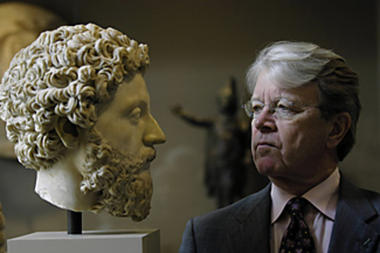
Dumbarton Oaks director Jan Ziolkowski

Dumbarton Oaks did not respond to repeated requests for comments on Turkey’s request — a curious position for an institution that serves as a research library. We eventually contacted Harvard University’s press office, which released the following statement on behalf of director Jan M. Ziolkowski: “Dumbarton Oaks has made the Sion Treasure available for exhibition, research and study for nearly a half-century. We are confident that we have proper title to these antiquities and, while representatives from Turkey have inquired about them on occasion over the years, they haven’t responded to requests for any documentation that might raise questions about the provenance of this important part of the collection.”

We asked both Ziolkowski and Harvard for additional information about why they believe the museum has proper legal title to the treasure. Given the suspect source of the treasure and Dumbarton Oaks’ own publication of details of its looting in 1963, what further “documentation” is Harvard waiting for? So far, our follow-up questions have been met with silence.

The Getty’s Bronze? Italian Court Upholds Order to Seize a Getty Masterpiece

UPDATE: Law professor Derek Fincham has commented on Italy’s case: “Using a domestic court to seek the seizure of an illegally exported object from another country has not been attempted before. But Italy has been at the forefront of repatriation strategies. This novel approach could lead to a new legal tool for nations of origin to pursue, if it can convince the Attorney General and a U.S. District Court to enforce this seizure order. The Getty appealed the earlier ruling, and they did so for a reason, this case could set a precedent which would open up museums to seizure suits in the nation of origin.” We’d be interested to hear more legal analysis of this issue.

UPDATE: David Gill notes a comment by the Italian prosecutor saying that the ruling leaves the Getty “little room for maneuver.”

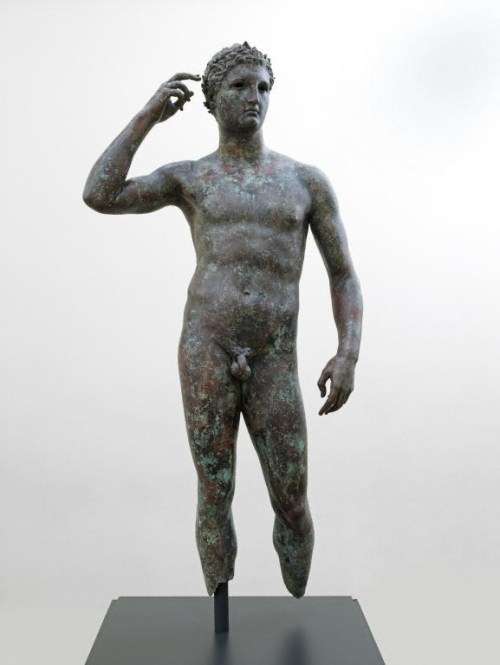
The Getty had a significant setback in the legal case over one of its most important antiquities — the bronze statue of a victorious athlete known as the Getty Bronze.

Here’s Jason’s story in the LA Times. We’ve posted the judge’s complete ruling below.

An Italian court has upheld an order for the seizure of a masterpiece of the J. Paul Getty Museum’s antiquities collection, finding that the bronze statue of a victorious athlete was illegally exported from Italy before the museum purchased it for $4 million in 1976.

The ruling Thursday by a regional magistrate in Pesaro will likely prolong the legal battle over the statue, a signature piece of the Getty’s embattled antiquities collection whose return Italian authorities have sought for years.

“This was the news we were waiting for,” said Gian Mario Spacca, president of the Marche region where the statue was hauled ashore in 1964, in an interview with Italian reporters. “Now we will resume contacts made with the Getty Museum to build a positive working relationship.”

Spacca visited the Getty last year hoping to negotiate an agreement to share the statue. But the Getty has made clear it will fight in court to keep the piece and is expected to appeal the ruling to Italy’s highest court.

“We’ve not yet seen the ruling and won’t comment until we do so,” said Getty spokesman Ron Hartwig.

The long battle over the bronze athlete — one of the few complete Greek bronzes to have survived and believed by some to have been made by Alexander the Great’s personal sculptor Lysippus — is a lingering reminder of the controversy that has surrounded the Getty’s collection of ancient art.

Since 2005, the Getty has voluntarily returned 49 antiquities in its collection, acknowledging they were the product of illegal excavations and had been smuggled out of their country of origin. Hundreds of other objects were returned by other American dealers, collectors and museums. In the wake of those returns, several American museums struck cooperative deals with Italy and Greece that allow for long-term loans of ancient art.

But such agreements have not shielded American museums from further claims that ancient art in their display cases are the product of a black market responsible for the destruction of archaeological sites around the world. In March, Turkish officials revealed they were seeking the return of dozens of allegedly looted antiquities from the Getty, the Metropolitan Museum of Art in New York, the Cleveland Museum of Art and Harvard’s Dumbarton Oaks.

Most such repatriation claims have been settled without legal action. The dispute over the Getty’s bronze ended up in Italian court thanks to its complicated legal status — an accidental discovery in international waters off Italy’s Adriatic coast.

The statue was most likely lost at sea after being plundered by Roman soldiers in Greece around the time of Christ. (The government of Greece has never asked that the statue be returned there.)

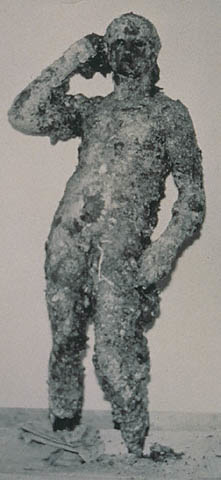
The Getty Bronze, before restoration

In 1964, Italian fishermen found the statue snagged in their nets. They hauled it ashore in the small port town of Fano, buried it in a cabbage field and then hid it in a priest’s bathtub rather than declare it to customs officials, as required under Italian law.

Three brothers and the priest were convicted of trafficking in stolen goods, but an appeals court threw out their convictions in 1970, citing insufficient evidence. At the time, the statue was still missing, and its value was unknown.

In the early 1970s, the statue resurfaced in London, where millionaire oilman J. Paul Getty first became enamored of it.

Getty himself never authorized the purchase of the statue because he had concerns about its legal status, records show. In 1974, Italian officials tried to seize the statue in Germany, where it was being restored, but authorities there would not honor the request.

It was only after Getty’s death in 1976 that his namesake museum purchased the statue, ignoring the legal conditions its founder had placed on the acquisition, according to documents related to the case. The statue was one of the museum’s first acquisitions and was dubbed the “Getty Bronze.”

The bronze was one of dozens of ancient objects demanded by Italy during a lengthy fight with the Getty in recent years over its antiquities collection, much of which was acquired from middlemen who trafficked in objects looted from Italian tombs and ruins.

Talks broke down when the Getty refused to include the bronze on a list of objects it was willing to return. The impasse was broken only when a new criminal case about the bronze was filed in Italian court in 2007, taking it off the negotiating table.

That case has wound through the Italian legal system ever since. In February 2010, a judge ordered the statue’s return, citing the Getty’s “grave negligence” when acquiring a statue. The Getty appealed that ruling to Italy’s highest court, which sent the case back to the judge in Pesaro, not far from the port where the statue was first hauled ashore. The Getty has argued that the seizure order is invalid because no underlying crime has been proved.

If the high court ultimately upholds the seizure order, Italy will still have to convince U.S. authorities to enforce the order and seize the statue from the Getty Villa, where it is on display today in its own humidity-controlled room.

Read the full story of the Getty Bronze here.

Here’s the complete text of the May 3rd ruling:

Cuno’s Memo: 34 Positions Eliminated at Getty Museum, Mostly in Education, for “More Efficient Operations”

UPDATE 2: An interesting post on the Getty cuts at Hyperallergic ends with this provocative question: “Are museums Universities of Vision or Churches of the Eye?”

UPDATE: The website Art Museum Teaching has posted a stinging critique of the Getty cuts by Robert Sabol, president of the National Art Education Association. Sabol calls the Cuno’s decision to cut gallery educators “a significant step backward” and “out of step” with the museum field. You can read Sabol’s full letter here.

In the comments to the post, Cuno has responded (via Getty PR chief Ron Hartwig) saying, “This new approach will not reduce our educational programs or the quality of teaching available at the Museum.” Two educators have also commented, questioning the accuracy of Cuno’s statements. One notes, “At the Getty Villa alone, four out of five Gallery Teachers, the Education Specialist for Gallery Teaching, the Education Specialist for School and Teacher Programs, and the Manager of Education were all laid off. Obviously, when one considers the volume of work these seven people accomplish on a daily basis, there is no question that the quality of programs is already severely affected, and will continue to diminish!”

This morning, Getty CEO James Cuno sent out a memo to Getty Museum staff announcing the elimination of 34 staff positions. Ten positions were eliminated today, and Cuno is looking for  another 24 staffers to volunteer or face layoffs on May 7th.

Monday’s move is the latest in Cuno’s shakeup at the museum, which began in February with the dismissal of Thom Rhoads, assistant director of administration, and Guy Wheatley, a manager at the Getty Villa. At the time, Cuno said the cuts would “allow the Museum to focus more on collections and exhibitions and less on administrative matters and site-wide operations.” Some saw it as a move to concentrate power in the Getty Trust, which oversees the Museum.

Monday’s cuts target the museum’s education department, which has long been known for its use of staff gallery teachers rather than volunteer docents. That approach has been “rethought to be more cost-effective and to reach more children through a robust docent program,” Cuno told staff this morning. Volunteer docents will now be the norm it appears. Last year, the department served more than 860,000 visitors to the Getty Center and Getty Villa. Recent evaluations of the program’s activities can be found here. The Getty’s support for busing students from poor communities will not be affected.

UPDATE: I’m told of the 17 gallery teachers now employed, only five will keep their jobs. Managers positions at both the Getty Center and Villa were also cut.

UPDATE #2: The LA Times has details on the cuts here.

Here’s the full memo. We’d welcome your thoughts and comments below or anonymously via ChasingAphrodite@gmail.com.

Dear Getty colleagues,

Just a short while ago, I emailed Museum staff to let them know the outcome of the meetings I have held over the last two months with the Museum’s leadership team to ensure its resources are being deployed in the most effective manner. The objective throughout that process was to maintain the Museum’s very high standards of excellence in all areas, while at the same time determining where we can realize savings through more effective and efficient operations.

The discussions during the review process were open and candid, with many ideas developed and exchanged, and we always were guided by a commitment to preserving the museum’s core mission:

●   Building the Museum’s collection by acquiring works of art of the greatest importance;
●   Preserving its curatorial ambitions (research, exhibitions, and scholarly publications);
●   Strengthening its conservation work; and
●   Serving a large and diverse public through educational programs and online access to information about its collection, curatorial and conservation research, and curricular resources.

The actions being taken will not affect curatorial or conservation staffing.  Programming for students, families and adults will remain in place, but the program has been rethought to be more cost-effective and to reach more children through a robust docent program.  We will maintain the number and ambition of our excellent exhibitions.  We will increase our efforts to fill priority gaps in collection documentation and improve our visitor experience by providing greater access to information.  I have challenged all of our managers to leverage technology in our work to enhance the visitor experience.

Changes at the Museum will include the transition in September from the primary use of gallery teachers to docent-led gallery experiences so that more visitors, particularly students, will have a Getty-led tour.  There will be no reduction in the number of school visits, including students from Title One schools.

In addition to the reduction in gallery teachers, some administrative and project-focused staffing positions in the Education Department will be reduced, along with staffing in Exhibitions and Imaging Services.   We will also seek volunteers from among our Visitor Services staff to better align staffing requirements in that department.

The changes will result in 10 layoffs, and we will ask for volunteers for 24 additional positions that are being eliminated.  Meetings were held this morning with affected staff.

The departure of valued members of the Getty Museum’s staff is difficult, but I want to assure you that each of those leaving will receive a very generous severance package identical to those offered by the Getty in the past. All of those laid off will receive their regular pay and benefits during a 60-day non-working notice period, and  will be eligible to receive two additional weeks of pay for every year of credited service over four years.  If an employee elects to take the coverage, the Getty will pay up to three months of COBRA payments to extend health benefits.  The Getty will also provide a generous allowance for outplacement services, and of course, pay all accrued and unused vacation and personal hours.

The layoffs being announced today will be handled in two ways.  Some staff will be notified today that their position has been eliminated and they will have the option of remaining at the Getty until Wednesday to transition their responsibilities and say farewell to colleagues.  In other cases, we will ask for volunteers.  On Monday, May 7th, volunteers will be notified if their offer has been accepted.  Those individuals will have the option of remaining at the Getty until Wednesday, May 9th to transition responsibilities and say farewell to colleagues.  If we do not receive sufficient volunteers, additional layoffs will occur on May 7th.

I will be meeting with Museum staff tomorrow to further explain the review process and answer their questions.  These changes are difficult, but I am confident they will result in an institution that is more focused on its core priorities and better positioned for an uncertain economy and lower endowment returns.

Jim

The Getty List: 10 Objects at the J. Paul Getty Museum that Turkey Says Were Looted

Among the dozens of allegedly looted antiquities that the government of Turkey is asking American museums to return are ten objects at the J. Paul Getty Museum.

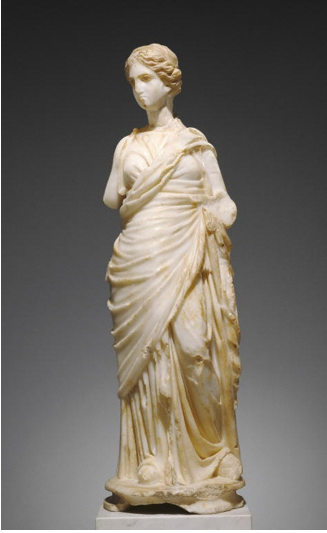
Statue of a Muse, 200 AD. From Cremna, Turkey. Purchased in 1994 for $550,000 from Varya and Hans Cohn, Los Angeles. The Cohn’s acquired the object from Elie Borowsky (Basel) in ’68. (JPGM 94.AA.22)

The Getty declined to provide a list of the objects in question, as did the Met, the Cleveland Museum and Harvard’s Dumbarton Oaks. We obtained a list from Turkish authorities and asked the Getty to provide the collecting history for those objects.

Unlike those other museums, the Getty is obligated by its 2006 acquisition policy to provide the public with provenance information about objects in the collection. Thanks to that policy, we now know something about how the contested objects came to the Getty.

The most prominent are four marble Muses now on display in the Getty Villa’s Basilica Room. All four appear to come from Cremna, Turkey and were first acquired by antiquities dealer Elie Borowski sometime before 1968, the Getty records show.

Borowski, who died in 2003, had ties to the illicit antiquities trade. His name appears in Robert Hecht’s memoir as a client of convicted antiquities dealer Giacomo Medici; it also appears on a handwritten organization chart of the illicit trade seized by Italian authorities in 2001. Former Getty antiquities curator Marion True told Italian authorities that Borowski had also been a client of Gianfranco Becchina, the Sicilian antiquities dealer (also named on the org chart) who is on trial in Italy.

Statue of a Muse, 200 AD. From Asia Minor. Purchased for $10,137 from Elie Borowsky in ’71; Borowsky already owned in 1968 (JPGM 71.AA.461)

Statue of a Muse, 200 AD, from Cremna, Turkey. Purchased for $9,185 in 1968 from Sotheby’s London, November 26, 1968. lot no. 173. (JPGM 68.AA.21)

Statue of a Muse, 200 AD, from Cremna, Turkey. Purchased in 1968 for $13,122 at Sotheby’s London, November 26, 1968. lot no. 173. (JPGM 68.AA.22)


Several other Getty objects sought by Turkey came through another dealer connected to the illicit trade: Nicolas Koutoulakis, now deceased owner of the Paris gallery Segredakis. Koutoulaksi also appears in the org chart and last September, the Getty returned to Greece fragments of a grave stone it had acquired from Koutoulakis after scholars concluded they adjoined an object now in a Greek museum.

Portrait of a Man. (73.AB.8) Purchased in 1973 for  $125,326  from Nicolas Koutoulakis

Bronze bust. (71.AB.458) Purchased in 1971 for $90,000 from Nicolas Koutoulakis.

Bronze foot from “Bubon, Turkey, Asia” (72.AB.103) acquired from Nicolas Koutoulakis. (See the Cleveland bronze from Bubon here.)

Bronze bed (82.AC.94) purchased for $150,000 from Nicolas Koutoulakis; Koutoulakis purchased from Gilette’s estate; Joseph Gilette of Lausanne, ca 1936.

The final two Getty objects come from a private dealer and an auction house:

Roman Eagle (72.AB.151) purchased in 1972 for $200,000 from French & Company.

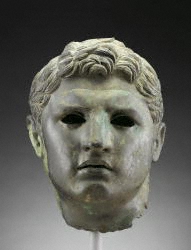
Bronze bust of Lucius Veres  (73.AB.100) purchased in 1973 for $37,701 from Spink & Son, London.

When asked for comment about Turkey’s request, Getty spokesman Ron Hartwig said, “We are in dialogue with officials from the Turkish Ministry of Culture regarding some objects in our collection. We expect those discussions to continue and while they do, we will not be getting into specifics.”

A Blast from the Past: “Norton Simon Bought Smuggled Idol”

 Imagine you’re a thief about to pull a heist at the local temple.

You can’t wait to get your hands on all those statues, altarpieces, gold. In the middle of the night, you sneak up to the entrance and…

(in a different voice, the Temple Guardian speaks.) ‘YE-AHH! BEGONE THIEF! HA HA. THE TEMPLE IS SAFE ONCE MORE.’

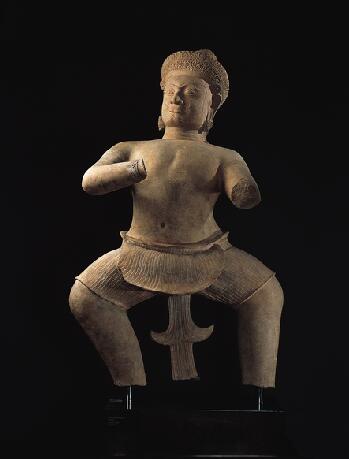
So begins the children’s audio guide for the Norton Simon Museum’s statue of a 10th century sandstone temple warrior from Koh Ker, the one-time capital of the Angkor Kingdom in Cambodia.

Originally, the statue was a temple guardian, “placed outside a house of worship to protect it from evil spirits,” the guide explains. “This is only part of the sculpture…When it was new, it had hands and feet of course.”

The evil spirits apparently won, because the guardian is now in Pasadena, and the Cambodian temple it once guarded has been thoroughly looted. But those missing feet were found in 2007, along with a second pair that experts say belong to a matching statue now at Sotheby’s. Last week, the federal government filed a lawsuit seeking to seize the statue from the auction house on behalf of the Cambodian government.

There is little question that both statues were stolen — their abandoned feet bear witness to the crime. The only question is when: sometime over the past 1,000 years, as Sotheby’s suggests. Or — as Cambodia, the US government and archaeologists suggest — more recently, in the turbulent 1960s or 1970’s when civil unrest in Cambodia fueled unprecedented looting. If the later, both statues could be considered stolen property under U.S. law.

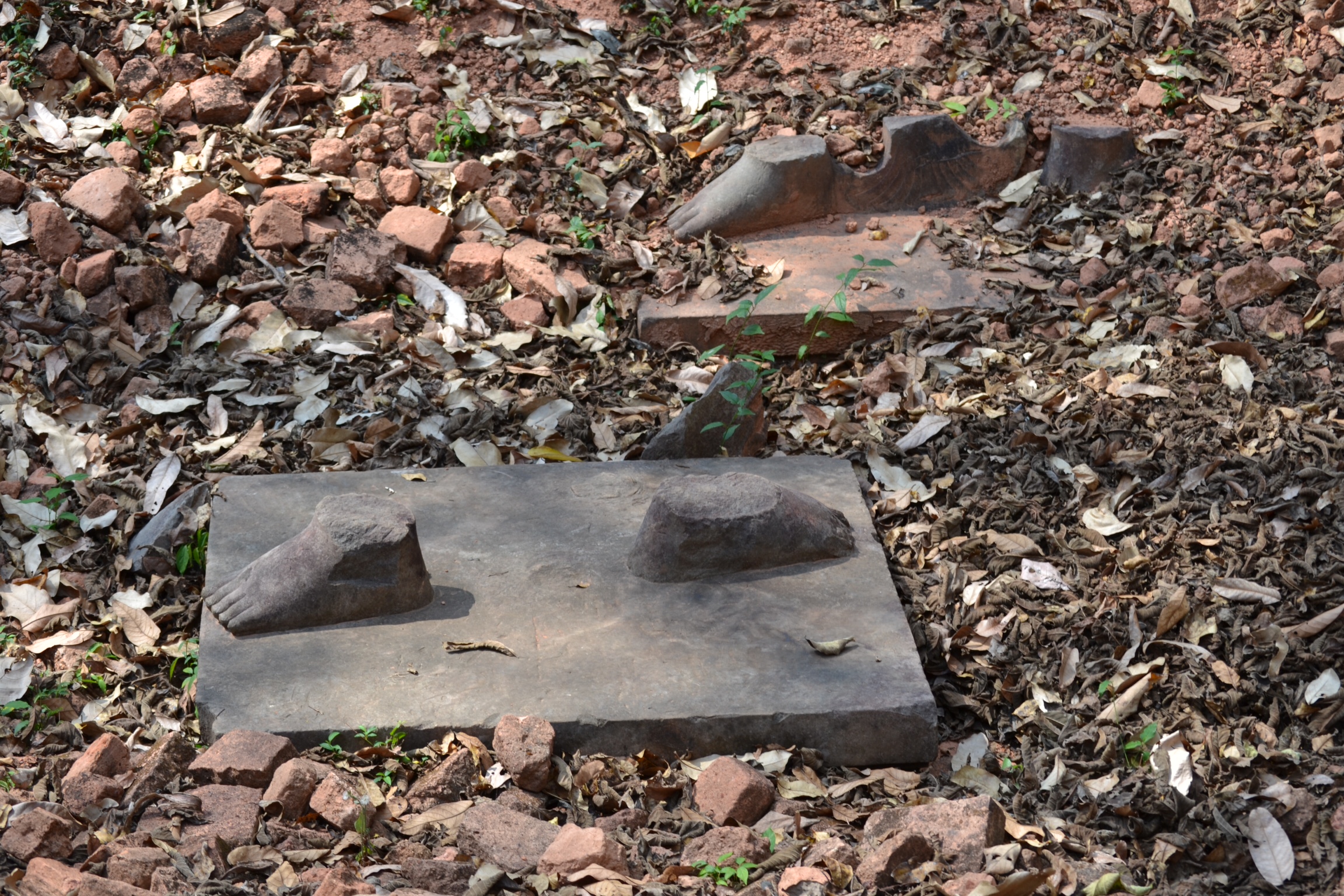
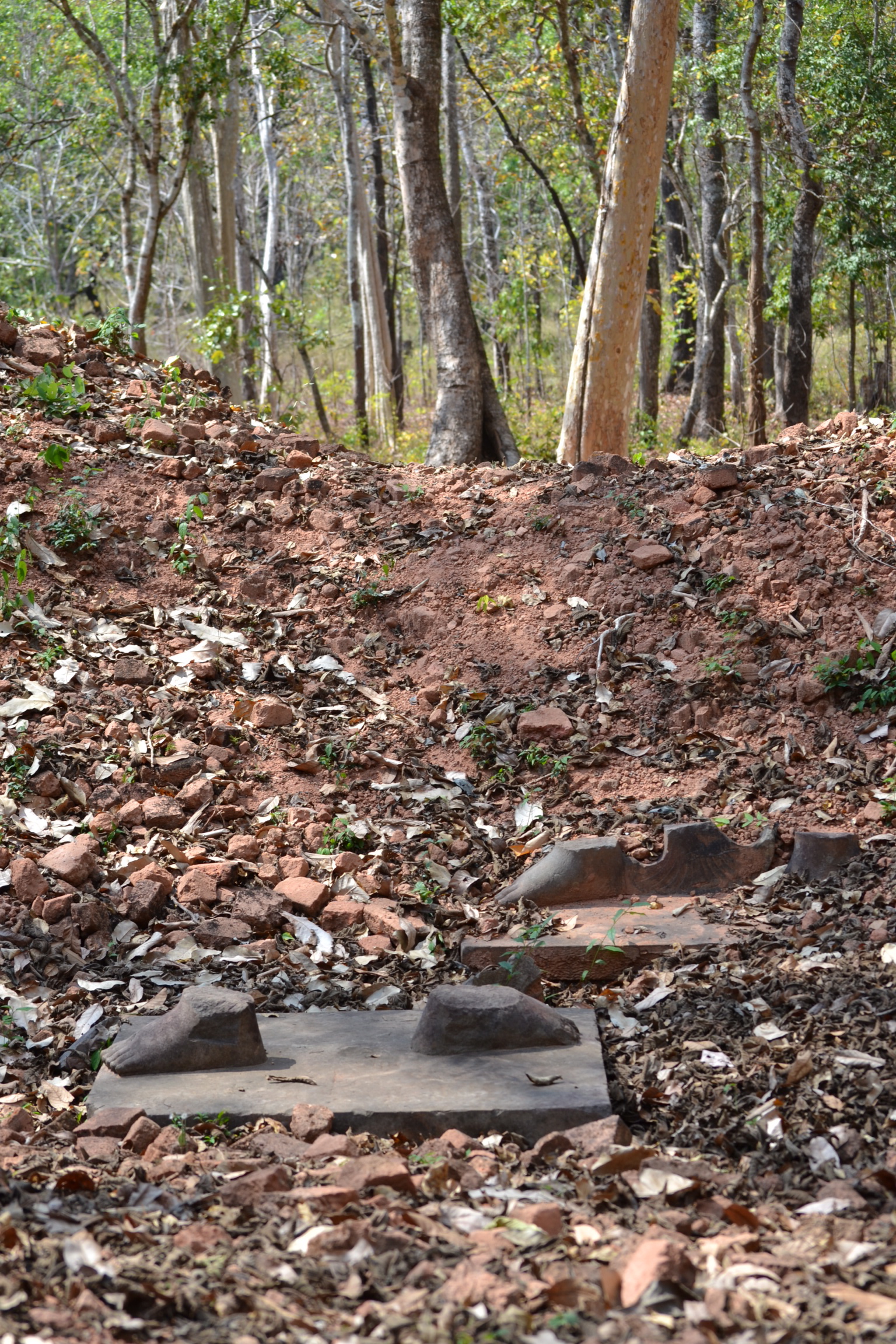
The feet of two ancient sandstone statues were left behind by looters at a temple in Koh Ker, Cambodia. One statue is now at Sotheby's, the other at the Norton Simon Museum in Pasadena.

Norton Simon himself was not coy about the illicit origins of his impressive collection of Asian art, which today is a highlight of his Pasadena museum. In a 1973 article headlined, “Norton Simon Bought Smuggled Idol,” the New York Times asked Simon about a bronze Hindu deity of Siva he had just purchased for $1 million. India claimed it had been ripped from a temple and smuggled out of the country. His answer:

“Hell, yes, it was smuggled,” said Mr. Simon in a telephone interview. “I spent between $15- and $16-million over the last two years on Asian Art and most of it was smuggled. I don’t know whether it was stolen.”

The same would appear to apply to the Khmer temple guardian that he bought three years later from a New York dealer William H. Wolff.

A Norton Simon spokeswoman said in a statement that “since [1976], the museum has proudly displayed this important example of Cambodian art, and has had the privilege of showing it to the Director of the National Museum of Cambodia (who we understand is now the Director General of Heritage, Ministry of Culture and Fine Arts).  In more than three decades of ownership, the Foundation’s ownership of the sculpture has never been questioned.”

Until now, that is. Cambodian officials told Voice of America this week that they will seek the return of the Norton Simon statue and countless other missing pieces if their claim for the statue at Sotheby’s is successful. See:

Much of the evidence cited against the statue at Sotheby’s would seem to apply to its brother in the Norton Simon Museum. Indeed, Sotheby’s apparently linked the two objects to a common site in their own proposal to sell the statue:

An almost identical figure, now resting in the collections of the [deleted] Museum…allows one to conjure up a wonderful vision of the two statues together perhaps lining an entrance way leading to the dark temple interior and the sanctuaries of the gods.

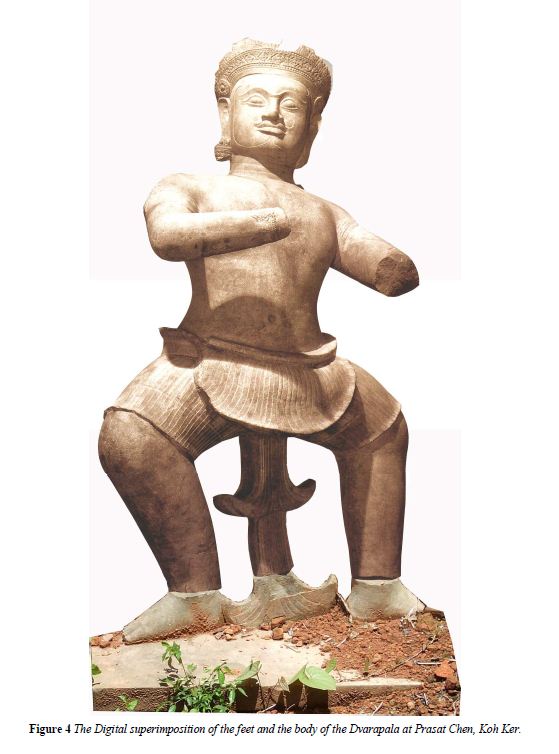
Reunited: The abandoned feet at Koh Ker digitally superimposed on the Temple Warrior at the Norton Simon, from a report to UNESCO by researcher Simon Warrack.

A wonderful vision, indeed — and a surprisingly accurate description of their original context at Koh Ker before they were stolen.

Why hasn’t Cambodia previously claimed the statue? Internal Sotheby’s emails cited in the federal suit suggest an answer. A scholar initially warned Sotheby’s not to offer the statue for sale publicly because it was “definitely stolen” from Koh Ker. But she changed her stance after consulting with Cambodian officials:

…There are no plans at all for Cambodia or the National Museum of Cambodia in Phnom Penh to attempt to ask for anything at the [deleted] Museum or the [deleted] etc. They would also have to ask for Khmer material in the [deleted], and they want to continue to get French support.

It appears that Cambodia was reluctant to risk access to foreign aide over a fight for its stolen cultural heritage. But this calculus may be changing.

This raises an interesting question: Should the Norton Simon and other museums with such objects wait to see if they are sued in federal court? Or should they move to return stolen objects on their own initiative?

Norton Simon himself had an interesting take on that issue in that same New York Times article:

If it did some good, I would return it. If there were reason and probability that smuggling could be stopped, I would do it. It would do a lot to establish a constructive relationship between nations….Looting is a terribly destructive process. In cutting works out of temples, thieves mutilate them. Also, US Customs should not allow works into this country unless they have a total clearance from the countries of origin. If we could get such a clear cut certification to stop smuggling, I would send it back. If not, I’ll probably keep the piece.

Feds vs. Sotheby’s: Legal Tangle over ‘Looted’ Khmer Statue Continues

The feet of the disputed statue were left behind when it was taken from the ruins of the Prasat Chen Temple, 80 miles east of Angkor Wat in Cambodia. The other set of feet belong to a statue now in the Norton Simon Museum in Pasadena, experts say.

In Friday’s LA Times, Jason reports on the federal lawsuit (case #12cv2600) seeking the return of a 10th Century Khmer statue now held at Sotheby’s.

Here’s a late-breaking update: Federal authorities expected to seize the statue from Sotheby’s on Thursday afternoon. But the seizure order was delayed by a late night legal spat between the US Attorney’s office and attorneys for Sotheby’s, authorities say.

UPDATE: Judge George B. Daniels issued a judicial restraining order late Thursday afternoon, prohibiting Sotheby’s from selling, transferring or otherwise disposing of or removing the statue from its current location. The parties will convene again at 10:30 on April 12th.

In dueling letters faxed to District Court Judge George B. Daniels, the two parties traded barbs about their respective legal arguments. The letters offer a preview of a legal battle that could have broad implications for repatriation efforts by source countries, which often rely on indirect evidence of looting to support their claims.

We’ve posted the complete letters below. Here is a summary of the arguments:

Sotheby’s makes no mention of the damaging internal emails cited in the governement complaint. Instead, it argues against the statue’s seizure saying it is based on the government’s “novel reading of ancient Cambodian law” and “the tenuous ‘belief’ of an expert who theorizes (from exceedingly modest evidence) that the statue was looted at some time after Cambodia declared national ownership of its antiquities.”

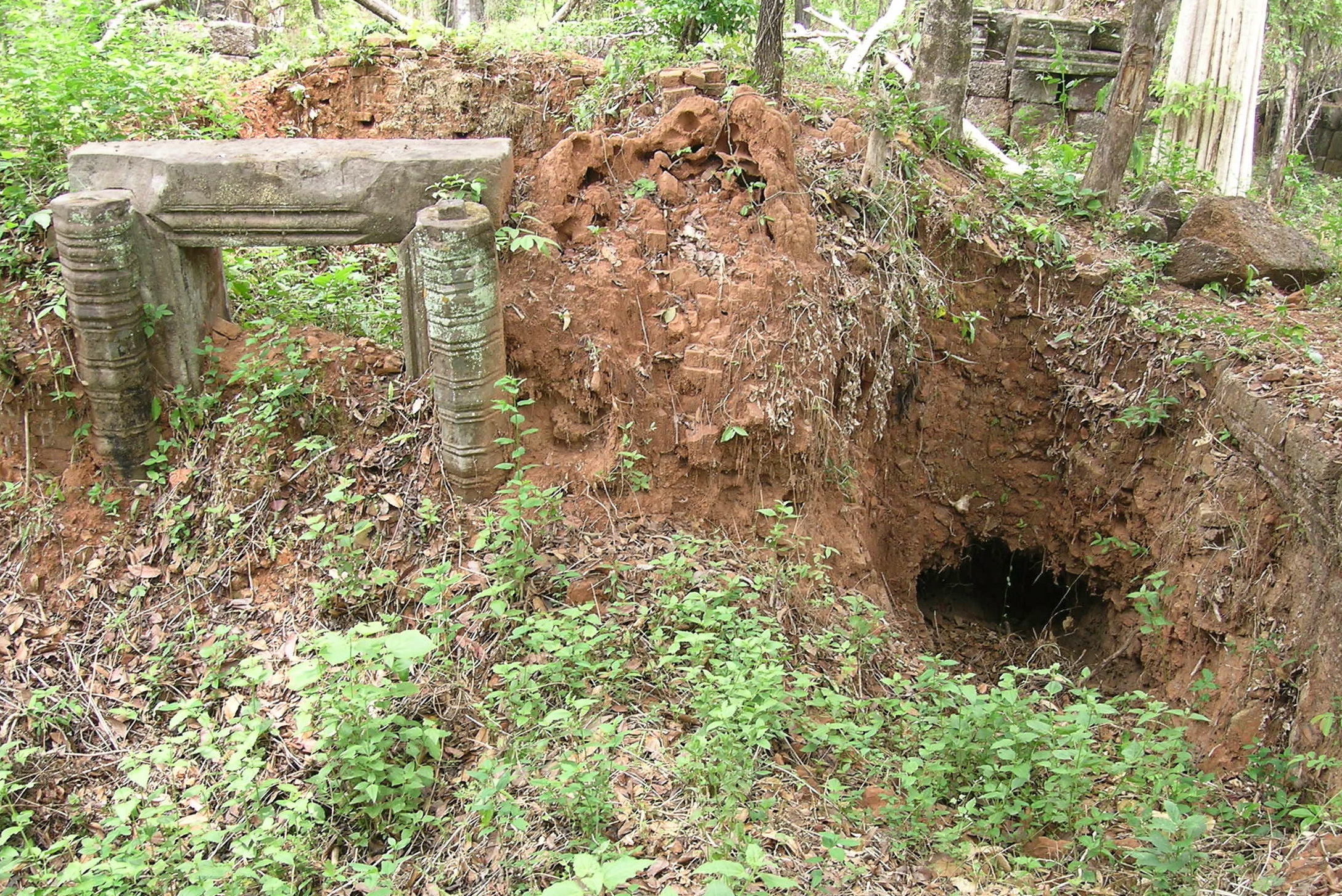
A looter's pit found during a recent survey of the archaeological site of Koh Ker.

The auction house goes on to point out what it calls “major legal and factual holes” in the government’s case. The evidence that the statue was taken from Cambodia recently are photographs and surveys of Koh Ker taken in the 1950s and 1960s, but those photos and surveys do not show or mention the statue in question, Sotheby’s points out. Cambodia’s 1900 patrimony law cited by the government was only discovered in rediscovered by American lawyers in recent months, and is not listed on UNESCO’s database of national patrimony laws, Sotheby’s also notes.

Finally, Sotheby’s points to the recent dismissal of a government suit seeking the seizure of the Ka-Nefer-Nefer mummy mask at the St. Louis Museum of Art on behalf of Egypt, which claimed the mask had been stolen from a government storage facility in the 1960s. In that case, the court ruled that the “Government cannot rest on its laurels and believe that it can initiate a [suit] on the basis of one bold assertion.”

In response to Sotheby’s claims, Assistant US Attorney Sharon Levin sent her own fax to Judge Daniels, citing the federal rules of civil procedure to argue the government has probable cause for the seizure.

Dougald O'Reilly, founder of HeritageWatchInternational.org, surveys looting at an archaeological site in 2006.

Levin calls Sotheby’s request to maintain possession of the property “inappropriate” given that “Sotheby’s marketed and attempted to sell the defendant property for more than a year after being informed by its own expert that the defendant property had been stolen from the Prasat Chen temple. Given Sotheby’s own significant role in the offenses on which this forfeiture action is based, they are not an appropriate independent third party for the Government to entrust with the property during the pendency of the action.”

The government suit was brought at the behest of the Cambodian government, Levin states. And Sotheby’s argument that the statue was not stolen “is at odds wit the conclusions reached by their own expert,” Levin argues, citing the internal emails in which the expert advises the auction house that the statue was “definitely stolen.” Further discussion of the merits of the government’s case should be saved for future hearings.

We’re interested to hear from many of the lawyers who read this blog what their take is on the respective arguments. Feel free to weigh in via the comments below.

Feds Sue for Return of “Looted” Khmer Statue; Insider Emails Reveal Sotheby’s Was Warned Statue Was “Definitely Stolen”

On Wednesday, the U.S. government filed suit seeking to return a 10th Century stone warrior to Cambodia, where it was allegedly looted.

The statue is currently at Sotheby’s in New York, which was set to auction the piece on behalf of a private collector in March 2011. On the day of the sale, Sotheby’s was notified by Cambodian officials that the object had been looted from Koh Ker, an archaeological site 80 miles east of Angkor Watt.

The parties have been negotiating a settlement to the dispute for the past year, as the New York Times reported in February. But those negotiations ended abruptly Wednesday when the US Attorney for the Southern District of New York filed suit. Authorities will seize the statue on Thursday, the Times reported Wednesday.

In making their case for the statue’s return, the US Attorney cites revealing emails from a scholar warning the auction house that the statue should not be sold at public auction:

“The Cambodians in Pnom Penh now have clear evidence that it was definitely stolen from Prasat Chen at Koh Ker, as the feet are still in situ…Please do not give this report to anyone outside of Sotheby, as I often have access to such material, and don’t want to anger my sources. The two Dvarapalas must have stood close together and their feet remain, so it’s pretty clear where they came from.

I think it would be hugely unwise to offer the Dvarapala publicly, and I would not really feel comfortable writing it up under the circumstances. It is also possible that the Cambodians might block the sale and ask for the piece back….I’m sorry as I had some exciting things to say about it, but I don’t think Sotheby wants this kind of potential problem.”

The scholar later consulted with “culture spies and museum director” in Cambodia and told Sotheby’s it was not likely that government would pursue a claim. Sotheby’s proceeded with the sale, with officials saying in internal emails that while it might receive bad press from “academics and ‘temple huggers,'” the potential profits from the sale made it “worth the risk.”

The New York  Times identified the scholar as Emma C. Bunker, an authority on Khmer art. She has written defending the right of collectors to buy ancient art, describing them as “not despoilers of the past but people of great intellectual curiosity who cherished the past long before the world was populated by scientifically trained archaeologists.”

There are frequent references in the federal complaint to another statue looted from the same site at “the museum,” an apparent reference to the Norton Simon Museum in Pasadena, which has a very similar statue that once served as a wrestling figure in Koh Ker. We’ve asked the museum for comment.

The back-story here is interesting: The head of Global Compliance for Sotheby’s is Jane Levine, a former member of the US Attorney’s office now suing for the statue’s return. Levine specialized in making the type of art crime cases her employer is now facing, and has written several articles on international trafficking in stolen art and artifacts. We’ve reached out to her for a comment.

In a statement, Sotheby’s said: “Sotheby’s strongly disputes the allegations made in this complaint. This sculpture was legally imported into the United States and   all relevant facts were openly declared.   We have researched this sculpture extensively and have never seen nor been presented with any evidence that specifies when the sculpture left  Cambodia over the last one thousand years nor is there any such evidence  in this complaint. We have been in active discussions for a year with  both the US and Cambodian governments and  we had assured them that we would voluntarily maintain possession of this statue pending further discussion. Given that Cambodia has always  expressed its desire to resolve this situation amicably, and that  we had an understanding  with the US  Attorney’s  Office that no action would be filed pending  further discussion towards a resolution of this matter,  we are disappointed that this action has been filed and we intend to defend it vigorously.”

HOT DOC: Here is the government’s complaint, which begins citing the internal emails on page 11: