
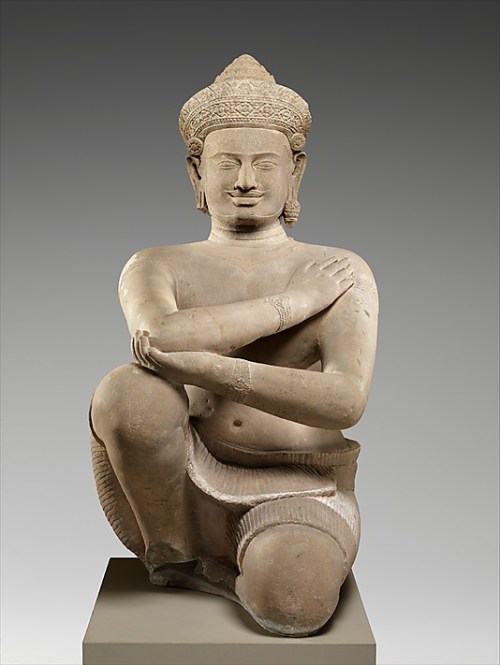
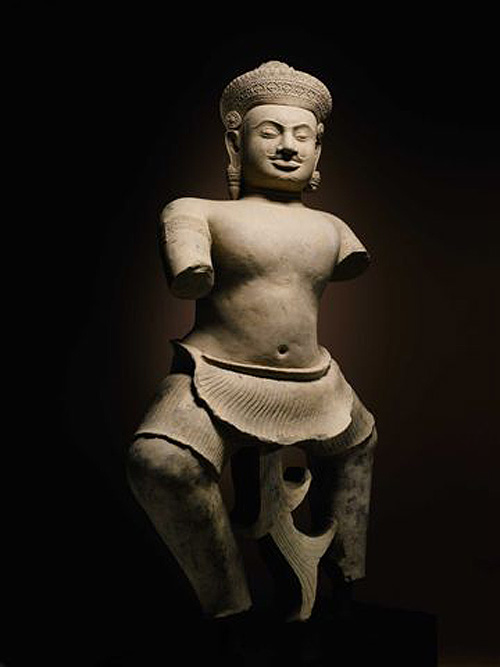
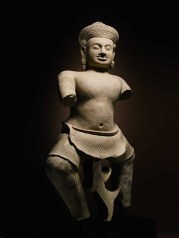
Sotheby’s and a private collector agreed on Thursday to forfeit a 10th century statue of a warrior to Cambodia, ending a lengthy legal fight that exposed the trafficking of looted Khmer antiquities to museums and collectors around the world.

The agreement states that Sotheby’s will transfer the statue of Duryodhana to Cambodia within 90 days in exchange for the U.S. government dropping a lawsuit brought on behalf of the Cambodian government. The suit claimed the auction house and Belgian collector Decia Ruspoli di Poggio Suasa had attempted to sell the statue in 2011 despite their knowledge that it had been looted from a Cambodian temple.
There was never any doubt about whether the statue had been looted, or where it had been found. As we wrote in April 2012, internal emails cited in the case revealed that Sotheby’s officials were warned by an expert that the statue had been stolen from the Khmer temple of Prasat Chen, in Koh Ker, and that its public sale might lead to a legal claim.
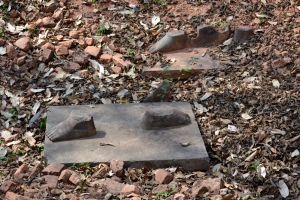
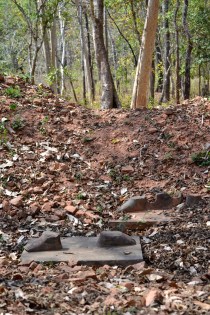 “The Cambodians in Pnom Penh now have clear evidence that it was definitely stolen from Prasat Chen at Koh Ker, as the feet are still in situ…The two Dvarapalas must have stood close together and their feet remain, so it’s pretty clear where they came from,” wrote Emma Bunker, a leading expert on Khmer art and close associate of Douglas Latchford, the Bangkok dealer who allegedly bought it from looters and exported it from Thailand. “It is also possible that the Cambodians might block the sale and ask for the piece back,” she added. “I’m sorry as I had some exciting things to say about it, but I don’t think Sotheby wants this kind of potential problem.”
Sotheby’s officials decided that while it might receive bad press from “academics and ‘temple huggers,’” the potential profits from the sale made it “worth the risk,” internal emails showed.
Thursday’s agreement to forfeit the statue shows that calculation was decidedly wrong. Sotheby’s could have returned the statue to the collector and let her decide its fate, as auction houses have often done when claims arise. It also could have accepted a $1 million offer from a private collector who sought to buy the statue on Cambodia’s behalf. Instead Sotheby’s opted to fight it out in court – at considerable cost to both its bank account and its reputation.
 One of the lingering questions from the case is, why? Some have pointed to the personalities involved in the case, which pit the US Attorney’s office in the Southern District of New York against Jane Levine, one of the former stars of its cultural property crimes unit who now works as Sotheby’s Director of Worldwide Compliance. In a series of bare-knuckled filings, the government accused Levine of providing “false and misleading information to the Government.” Levine pushed back, accusing investigators of misleading the auction house about having probable cause for the statue’s seizure.
Another theory, floated this weekend at a UN-sponsored conference in Courmayeur by a prominent retired art crimes investigator, is that Sotheby’s may have taken on partial ownership of the statue. Why else would it spend what were likely hundreds of thousands of dollars in legal fees defending someone else’s problematic statue?
 Regardless of the motive, the outcome of the case has cast a spotlight on a major trafficking network of looted Khmer antiquities. At the Courmayeur conference, researchers Tess Davis and Simon MacKenzie reported on their field work this summer mapping that very trafficking network, which was responsible for plunder of 10th and 11th century Khmer temples across northern Cambodia. Among the preliminary findings of the research was that Ta Mok, the senior Khmer Rouge leader known as The Butcher and Brother Number 5, may well have played a personal role in the removal of ancient statues from Koh Ker. This lends support to the notion that looted Khmer objects at museums around the world should be considered “blood antiquities.”
Attention now shifts to other Khmer statues likely acquired through the same smuggling network. Over the past year we and others have traced objects from Koh Ker and other sites that passed through the hands of Douglas Latchford before ending up in museums across the United States and Europe. The case for the return of those objects has now grown much stronger.
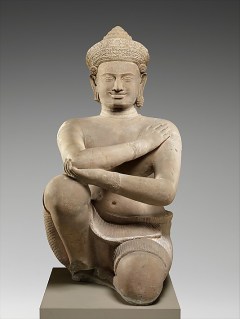
In May, the Metropolitan Museum of Art agreed to return its two Khmer Kneeling Attendants, which it acquired from Latchford and other donors. The decision was reached after museum officials traveled to Cambodia and were presented with “dispositive” evidence of the statues’ illicit origins. The Met continues to possess several other objects tied to Latchford that have not been returned.

Officials from the Norton Simon will soon travel to Cambodia to discuss the museum’s statue of Bima, whose feet remain in the Koh Ker temple next to those of its companion, the Durydhana that Sotheby’s has just agreed to return. The Bima was purchased in 1976 from New York dealer William H. Wolff. The museum may well consider the words of its founder. When asked about repatriation of looted antiquities, Norton Simon once told the New York Times: “If it did some good, I would return it. If there were reason and probability that smuggling could be stopped, I would do it. It would do a lot to establish a constructive relationship between nations….Looting is a terribly destructive process. In cutting works out of temples, thieves mutilate them.”
Cambodia has indicated it is preparing to makes similar claims against Khmer statues tied to Latchford at the Kimbell Museum, the Cleveland Museum and the Denver Art Museum. Many more exist in private collections.
The owners of these blood antiquities would be wise to learn from Sotheby’s experience and not wait for a demand from the U.S. Attorney’s office.
Here’s the stipulation Sotheby’s signed on December 12th agreeing to the statue’s return.




 UPDATE: The New York Times



 Almagia Returns: In January we also wrote about American museums returning
 Cambodia vs. Sotheby’s — The Battle for Koh Ker. In April, we
  Jim Cuno’s shakeup at the Getty: In May, the board of the J. Paul Getty Trust hired James Cuno to lead the organization. It was an odd choice — The Getty was still recovering from a devastating international scandal over its acquisition of looted antiquities, and had enacted a new acquisition policy that respected foreign ownership laws. Cuno had long been a vocal critic of those laws and advocate for the type of unfettered collecting that had gotten the Getty into trouble. One of Cuno’s first moves was the elimination of 34 positions at the Getty Museum, including two respected veterans and 12 professional gallery teachers who were replaced by volunteer docents. We
 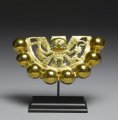 The Bourne Collection: Also in May, we featured a guest post by Roger Atwood on the Walter’s newly acquired collection of
  Subhash Kapoor Case: In July we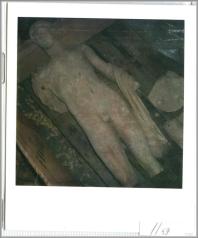

 Acquiring an object based exclusively on a dealer’s warranty — rather than an actual documented ownership history that proves it was not looted — was a common tactic in the 1980s, particularly for pieces that were likely looted. As we described in Chasing Aphrodite, the J. Paul Getty Museum passed a new acquisition policy for antiquities in 1987 that called for a dealer warranty in place of an inquiry into an object’s origins. The practice allowed the Getty to continue acquiring objects it knew or suspected had been looted — including an $18 million statue of Aphrodite — while providing a modicum of legal and public relations cover if the statue were later questioned. But the policy failed: The Getty returned the Aphrodite to Italy in 2010 after
  The Kimbell believes the Harihara is the only object in its collection with ties to Latchford, but can’t be certain, a museum spokeswoman said. It is not the only suspect piece of ancient art to surface at the museum. In February,


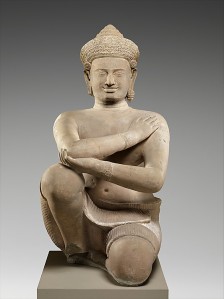

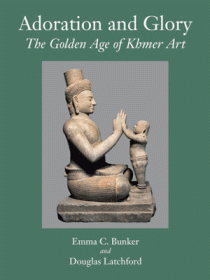
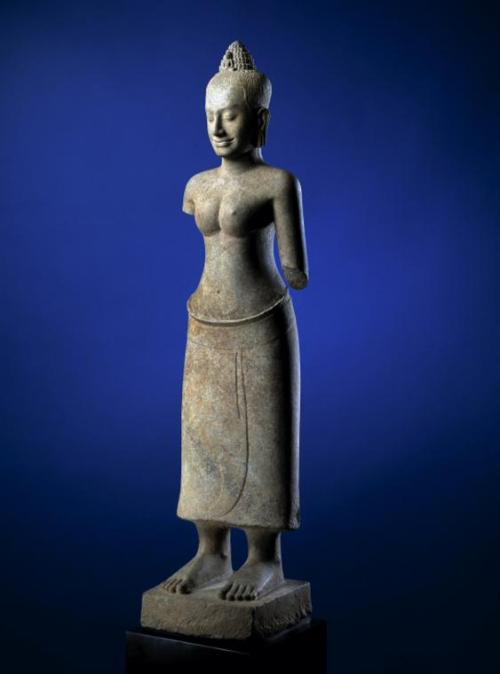
 3. Sun God (Surya) from Cambodia or Vietnam. 600’s to 700’s, Pre-Angkor period, sandstone. Purchased from Latchford in 2004. Accession #2004.371. Published in “Adoration and Glory.” No other provenance information was provided.



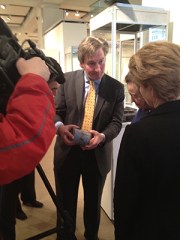

 Hab Touch: The Cambodian government official who Sotheby’s debated notifying before the statue’s sale. (see Exhibit 10) Dismissed as a “bureaucrat,” Touch ultimately objected to the statue’s sale and asked for its return to Cambodia.
 |
|

 CHASING APHRODITE